Engineering & Industrial · August 27, 2026
Propane Tank Fill Percentage and the 80 Percent Safe Fill Rule
Calculate propane tank capacity and 80 percent safe fill volume. Explains NFPA 58 rules, temperature expansion coefficients, and tank float gauge readings.

- Propane Tank Fill Percentage and the 80 Percent Safe Fill Rule
- The Formula: Tank Water Capacity, Safe Fill Limit, and Thermal Expansion
- The 80% Safe Fill Capacity Formula
- Delivery Volume Calculation from Gauge Percentage
- Propane Mass and Energy Content
- Thermal Expansion Coefficient (\beta)
- Reference Data: Standard Propane Tank Sizes, Fill Limits, and Energy Content
- Worked Examples
- Worked Example 1: Metric Stationary Commercial LPG Tank
- Worked Example 2: Imperial Residential 1,000-Gallon Tank Delivery Calculation
- Worked Example 3: Edge Case Sub-Zero Winter Fill and Summer Thermal Expansion
- Common Mistakes in Propane Tank Fill and Sizing
- Related Fuel and Tank Volume Resources
Propane Tank Fill Percentage and the 80 Percent Safe Fill Rule
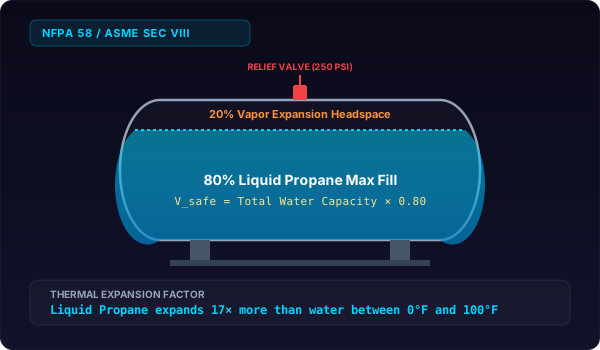
Propane storage uses the rule V_safe = V_water capacity × 0.80. A 500-gallon water capacity tank safely holds 400 gallons of liquid propane, leaving a 20% vapor expansion space to prevent hydrostatic relief valve discharge.
Liquefied petroleum gas (LPG or propane, C_3H_8) is stored under pressure as a liquid in equilibrium with its vapor. Under the National Fire Protection Association Liquefied Petroleum Gas Code (NFPA 58) and ASME Boiler and Pressure Vessel Code Section VIII, propane storage vessels are never filled to 100% capacity. Understanding the 80% rule is vital for gas suppliers, heating technicians, and plant safety managers.
The Formula: Tank Water Capacity, Safe Fill Limit, and Thermal Expansion
Propane tanks are rated by their Total Water Capacity (WC), which is the total physical internal volume of the vessel measured in gallons, liters, or pounds of water at 60°F.
The 80% Safe Fill Capacity Formula
V_safe, gallons = V_WC, gallons × 0.80In metric units:
V_safe, liters = V_WC, liters × 0.80Delivery Volume Calculation from Gauge Percentage
When reading a residential or industrial float gauge:
Delivery Volume (Gallons) = V_WC × ≤ft(0.80 - (Gauge \% / 100)\right)For instance, on a 1,000-gallon tank reading 25%, the fuel delivery volume is 1000 × (0.80 - 0.25) = 1000 × 0.55 = 550 gallons.
To calculate volume for custom cylindrical propane tanks and vessels, check our tank volume calculator and our horizontal cylinder calculator.
Propane Mass and Energy Content
Standard commercial propane has the following physical properties at 60°F (15.6°C):
- Liquid Density:
4.20 to 4.24 lbs per US gallon(504 to 508 kg/m^3) - Specific Gravity:
0.504 to 0.510(relative to water at1.000) - Higher Heating Value:
91547 BTU per US gallon(25.3 kWh/galor25.53 MJ/L) - Vapor Expansion Ratio:
1 gallon of liquid = 36.38 cu ft of vaporat atmospheric pressure.
Stored Propane Weight (lbs) = V_liquid, gal × 4.20 lb/galTotal Thermal Energy (BTU) = V_liquid, gal × 91547 BTU/galThermal Expansion Coefficient (\beta)
Liquid propane has an exceptionally high coefficient of volumetric thermal expansion:
\beta ≈ 0.0015 to 0.0018 per ^\circF (0.0027 to 0.0032 per ^\circC)Between 0°F (-17.8^\circC) and 100°F (37.8^\circC), liquid propane expands by over 16% in volume. The 20% vapor headspace provides the necessary expansion buffer so the liquid never hydrostatically fills the entire vessel cavity.
Reference Data: Standard Propane Tank Sizes, Fill Limits, and Energy Content
The following engineering reference table details standard DOT portable cylinders and ASME stationary horizontal tanks under NFPA 58 rules.
| Tank Type / Nominal Size | Water Capacity (Gallons) | Water Capacity (Liters) | 80% Safe Fill (Gallons) | 80% Safe Fill (Liters) | Propane Weight at 80% (lbs) | Stored Thermal Energy (BTU) | Typical Dimensions (Dia × Length) |
|---|---|---|---|---|---|---|---|
| 20 lb Grill Cylinder | 5.71 gal | 21.6 L | 4.57 gal | 17.3 L | 19.19 lbs | 418,370 BTU | 12.2 in dia × 18.0 in ht |
| 30 lb RV Cylinder | 8.57 gal | 32.4 L | 6.86 gal | 26.0 L | 28.81 lbs | 628,012 BTU | 12.2 in dia × 24.0 in ht |
| 40 lb Commercial | 11.43 gal | 43.3 L | 9.14 gal | 34.6 L | 38.39 lbs | 836,740 BTU | 12.2 in dia × 29.5 in ht |
| 100 lb Cylinder | 28.57 gal | 108.1 L | 22.86 gal | 86.5 L | 96.01 lbs | 2,092,764 BTU | 14.7 in dia × 48.0 in ht |
| 120 gal ASME Tank | 120.0 gal | 454.2 L | 96.00 gal | 363.4 L | 403.20 lbs | 8,788,512 BTU | 24.0 in dia × 66.0 in len |
| 250 gal ASME Tank | 250.0 gal | 946.4 L | 200.00 gal | 757.1 L | 840.00 lbs | 18,309,400 BTU | 30.0 in dia × 92.0 in len |
| 500 gal ASME Tank | 500.0 gal | 1,892.7 L | 400.00 gal | 1,514.2 L | 1,680.00 lbs | 36,618,800 BTU | 37.0 in dia × 119.0 in len |
| 1,000 gal ASME Tank | 1,000.0 gal | 3,785.4 L | 800.00 gal | 3,028.3 L | 3,360.00 lbs | 73,237,600 BTU | 41.0 in dia × 192.0 in len |
Worked Examples
Worked Example 1: Metric Stationary Commercial LPG Tank
A greenhouse heating facility in Europe utilizes an ASME-certified stationary horizontal LPG vessel with an engineered water capacity of 2,000.0 liters. The delivery driver fills the tank to the legal 80% limit at an ambient product temperature of 15.0°C (liquid density of 0.510 kg/L). Calculate the maximum allowable liquid volume in liters, fuel weight in kilograms, total thermal energy in megajoules (MJ), and the remaining vapor headspace volume.
Step 1: Calculate 80% maximum safe liquid volume.
V_safe = 2000.0 L × 0.80 = 1600.00 litersStep 2: Calculate liquid fuel weight in kilograms.
Weight = 1600.00 L × 0.510 kg/L = 816.00 kgYou can check total fluid mass conversions with our cylinder weight calculator.
Step 3: Calculate total stored thermal energy.
At 25.53 MJ per liter:
Energy = 1600.00 L × 25.53 MJ/L = 40848.00 MJ (11,346.7 kWh)Step 4: Calculate vapor expansion headspace volume.
V_vapor = 2000.0 L - 1600.0 L = 400.00 liters (20.0\%)The vessel safely retains 400.0 liters of vapor expansion space above the liquid layer.
Worked Example 2: Imperial Residential 1,000-Gallon Tank Delivery Calculation
A homeowner heating a large rural property has a 1,000-gallon water capacity horizontal propane tank. In November, the tank magnetic float gauge reads 35%. The delivery truck arrives to fill the tank up to the 80% safety limit. Calculate the current gallons in the tank, delivery volume required, total weight of the delivered fuel at 4.20 lb/gal, and total cost at 2.75 per gallon.
Step 1: Calculate current liquid inventory.
V_current = 1000.0 gal × 0.35 = 350.00 gallonsStep 2: Calculate target 80% fill volume.
V_target = 1000.0 gal × 0.80 = 800.00 gallonsStep 3: Calculate required fuel delivery volume.
Delivery Volume = 800.00 gal - 350.00 gal = 450.00 gallonsStep 4: Calculate delivered propane weight.
Delivered Weight = 450.00 gal × 4.20 lb/gal = 1890.00 lbsStep 5: Calculate total delivery invoice cost.
$Cost = 450.00 gal × \2.75/gal = `1237.50`$
The driver pumps 450.0 gallons (1,890 lbs) into the tank, bringing the level from 35% to exactly 80%. For dip stick level readings, explore our horizontal tank dip stick chart guide.
Worked Example 3: Edge Case Sub-Zero Winter Fill and Summer Thermal Expansion
A 500-gallon water capacity tank is filled to exactly 80% (400.0 gallons) on a sub-zero winter morning at -10^\circF (-23.3^\circC), when liquid propane density is 4.42 lb/gal. During the subsequent July heatwave, direct sunlight heats the tank shell and propane to 100.0^\circF (37.8^\circC), reducing propane density to 3.99 lb/gal. Calculate the initial fuel weight, the new expanded liquid volume in the summer, the new percentage on the float gauge, and verify that the fuel does not reach the 100% relief valve threshold.
Step 1: Calculate total propane mass loaded in winter.
Mass = 400.00 gal × 4.42 lb/gal = 1768.00 lbsStep 2: Calculate expanded volume at 100°F.
V_summer = (Mass / Density_summer) = (1768.00 lbs / 3.99 lb/gal) = 443.1078 gallonsStep 3: Calculate new summer float gauge percentage.
Summer Gauge \% = (443.1078 gal / 500.00 gal) × 100 = 88.6216\%Step 4: Verify expansion safety margin.
Remaining Headspace = 500.00 - 443.11 = 56.89 gallons (11.38\%)Even after expanding by 43.11 gallons (an 10.78% increase in liquid volume), the tank still retains 56.89 gallons of vapor space, safely preventing the internal pressure from reaching the 250 PSI relief setting. For more on thermal fluid expansion in industrial tanks, read our transformer cylindrical tank oil capacity guide.
Common Mistakes in Propane Tank Fill and Sizing
-
Confusing Water Capacity (WC) with Propane Capacity A tank stamped “1,000 Gallons WC” does not hold 1,000 gallons of propane. Its maximum legal fill is 800 gallons. Ordering 1,000 gallons of fuel for an empty 1,000-gallon tank results in either an overfill safety hazard or an unexpected short-fill bill adjustment.
-
Reading Float Gauges on Tilted or Unlevel Tanks Magnetic float gauges rely on a float arm swinging in the vertical center plane of the cylinder. If a concrete pad settles and the tank lists 5 degrees toward the float pivot, the gauge will read 5% to 10% higher or lower than actual liquid inventory. Ensure tanks are leveled using a bubble level across the longitudinal and transverse axes.
-
Topping Off Cylinders by Weight Without Tare Weight (TW) Verification When refilling portable cylinders on a scale, operators must check the stamped Tare Weight (TW, empty cylinder weight) on the collar. For a 20-lb cylinder with TW 17.0 lbs, the scale shutoff must be set to
17.0 + 20.0 = 37.0 lbs. Setting the scale to 37.0 lbs on an older, heavier cylinder (TW 19.5 lbs) results in a dangerous 2.5-lb overfill. -
Ignoring Altitude and Direct Solar Radiation on Relief Valves Propane tanks painted dark colors in high-altitude desert regions absorb intense solar thermal radiation. Shell temperatures can exceed 130°F, increasing internal saturated vapor pressure above 250 PSI and causing pressure relief valves to pop and vent gas. NFPA 58 mandates that all above-ground propane storage tanks be painted white or light reflective colors.
-
Assuming Propane Gas Meters Measure Liquid Gallons Directly Vapor meters installed on multi-tenant commercial propane networks measure gas volume in cubic feet (or hundreds of cubic feet, CCF), not liquid gallons. One liquid gallon of propane expands into approximately 36.38 cubic feet of gas at standard temperature and pressure (
1 CCF = 2.748 liquid gallons). Billing requires converting measured cubic feet to equivalent liquid gallons.
Related Fuel and Tank Volume Resources
For related engineering formulas, tank charts, and fuel capacity calculators, explore our technical guides:
- How engineers calculate fuel tank capacity
- Horizontal tank dip stick chart calculation
- Cylindrical pressure vessel volume and wall thickness
- Hydraulic accumulator sizing and gas precharge volume
- Grain bin capacity in bushels and tonnes by crop
- Transformer cylindrical tank oil capacity
- Cylinder volume in gallons calculator
- Cylinder volume in barrels calculator
Adhering to the 80% fill rule ensures safety compliance under NFPA 58, protecting residential, commercial, and agricultural installations from overpressurization.