Guides - May 12, 2026
How Engineers Calculate Fuel Tank Capacity (Cars, Trucks & Aircraft)
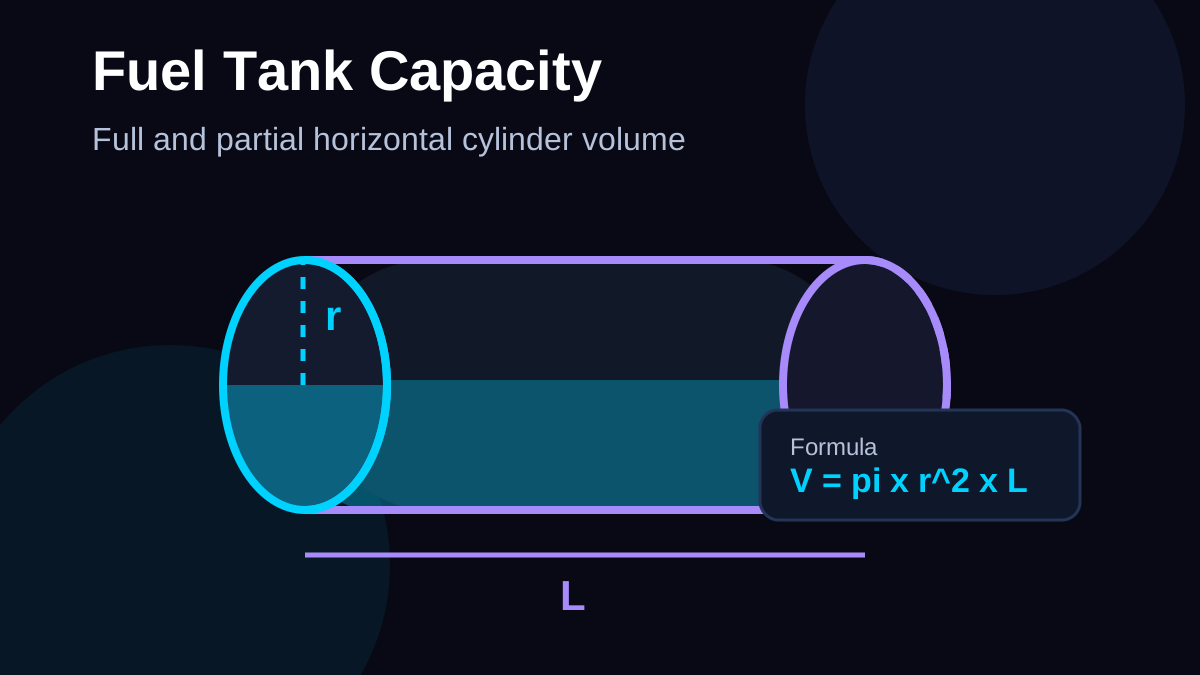

Fuel tank capacity calculation starts with a familiar cylinder formula: V = π x r2 x L. If a round truck tank is 22 inches in diameter and 48 inches long, the radius is 11 inches, so V = 3.14159 x 112 x 48 = 18,246 in3. Divide by 231, because 1 US gallon = 231 in3, and you get 79.0 gallons.
That is the clean math. The real world is messier. Car tanks are often molded around exhaust pipes and suspension parts. Truck tanks are usually closer to true cylinders. Aircraft tanks may live inside wings, where "capacity" becomes a manual-and-calibration question as much as a geometry question.
The Full Cylindrical Fuel Tank Volume Formula
I like fuel tank math because it exposes the difference between a spec sheet and a tape measure. A manual might say 36 gallons. A driver might pump 31.4 gallons. A mechanic might measure the tank shell and get 37 gallons. All three numbers can be honest.
For a full cylindrical fuel tank volume, use:
V = π x r2 x L
Here, r is the inside radius, and L is the length of the cylinder. I personally measure diameter first because it is easier to hook a tape across a round end than to guess the center point. Divide the diameter by 2, then run the formula. You can also use our cylinder volume calculator or the page for cylinder volume using diameter when you already have diameter.
For the geometry reasoning behind the constant itself, see understanding pi, the hidden constant behind every cylinder.
Use the same units throughout. Inches give cubic inches. Centimeters give cm3. Then convert: 1 L = 1,000 cm3, 1 US gal = 3.785 L = 231 in3, and 1 ft3 = 7.48 gallons. The NIST units reference is worth bookmarking if you do a lot of unit work.
Interactive Horizontal Fuel Tank Calculator
Most mistakes happen when the tank is half full. A half-height reading is half the fuel, yes. But a quarter-height reading is not a quarter of the fuel, because the curved ends make the cross-section area grow slowly at first and fastest near the middle.
Example 1: A Car Manual Capacity Versus Shape
Car fuel tanks are the least cylinder-like tanks in this article. I have crawled under enough cars to stop expecting neat geometry. Still, the capacity spec gives us a useful check.
A 2024 Toyota Camry SE listing shows a fuel tank capacity of 15.8 gallons. Convert that first:
15.8 gal x 231 in3/gal = 3,649.8 in3
15.8 gal x 3.785 L/gal = 59.8 L
If that were a perfect 38 cm diameter cylindrical fuel cell, the radius would be 19 cm. To hold 80 L, the needed length would be 80,000 / (3.14159 x 192) = 70.5 cm. That comparison is why I never use plain cylinder math for a molded passenger-car tank unless I am only estimating. For actual cars, the manual wins.
Example 2: Round Truck Tank Calculator Math
Now we are in friendlier territory. A side-mounted cylindrical truck tank often behaves like the geometry drawing. Suppose the tank is 22 inches across and 48 inches long:
Radius = 22 / 2 = 11 in
V = 3.14159 x 112 x 48
V = 3.14159 x 121 x 48 = 18,246 in3
Gallons = 18,246 / 231 = 79.0 gal
That is why a tank with those dimensions gets sold and talked about as roughly an 80-gallon tank. For comparison, Ford's 2024 F-150 online manual lists gasoline tank capacities of 23.0, 26.0, and optional 36.0 gallons. That optional 36.0 gallons is 36 x 3.785 = 136.3 L, or 36 x 231 = 8,316 in3.
If you are working with diesel, weight matters too. The geometric volume calculation is the same, but a full tank changes axle load. For tank shell weight, our cylinder weight calculator is the better tool.
Example 3: Aircraft Fuel Volume and Usable Fuel
Aircraft fuel is where I slow down and read the book twice. A Cessna 172S POH commonly lists total fuel capacity as 56.0 US gallons and usable fuel as 53.0 US gallons. The difference is not a rounding error; it is fuel the engine may not be able to use in normal operation.
Total fuel: 56.0 gal x 3.785 = 212.0 L
Usable fuel: 53.0 gal x 3.785 = 200.6 L
Per tank total: 28.0 gal x 231 = 6,468 in3
Could you model each wing tank as a cylinder? Usually, no. Wing tanks have awkward internal shapes, dihedral angle, vents, sumps, and unusable pockets. For learning geometry, use the horizontal cylinder calculator. For flight planning, use the POH, fuel gauges, calibrated dipsticks, and approved procedures. No geometry shortcut gets to overrule the manual.
Why Partial Fill Changes Everything
Here is the thing most guides skip: tank depth is not linear in a round horizontal tank.
For a horizontal cylinder with radius r, length L, and fuel depth y measured from the bottom, the partial volume is:
V = L x [r2 arccos((r - y) / r) - (r - y) x sqrt(2ry - y2)]
Same 22 inch by 48 inch truck tank, but now the fuel depth is 8 inches:
r = 11 in, y = 8 in, L = 48 in
Segment area = 112 x arccos(3 / 11) - 3 x sqrt(2 x 11 x 8 - 82)
Segment area = 124.89 in2
Volume = 124.89 x 48 = 5,994.9 in3
Gallons = 5,994.9 / 231 = 26.0 gal
Notice the depth is 8 / 22 = 36.4% of the tank height, but the fuel is only 26.0 / 79.0 = 32.9% of the tank. Big difference. If you want the quick version, use our volume in gallons page or cylinder tank calculator.
For background on the cylinder itself, Wolfram MathWorld's cylinder entry is clean and precise, and Math is Fun has a friendly visual explanation. I use both kinds of references: one for rigor, one for teaching.
FAQs
What is the formula for fuel tank capacity calculation?
For a full cylindrical fuel tank, use V = pi x r^2 x L. Radius and length must use the same unit, and the answer comes out in cubic units.
How do engineers calculate fuel in a horizontal cylindrical tank?
For a full horizontal cylinder, the formula is still pi x r^2 x length. For a partly filled tank, engineers calculate the circular segment area at the fuel depth, then multiply that area by the tank length.
Why does my car manual capacity not match what I pump at the station?
I get asked this a lot. The manual capacity includes the rated tank volume, but the pump only replaces what you actually used. The filler neck, reserve fuel, tank angle, shutoff behavior, and fuel expansion all change the number you see at the pump.
Can I use a truck tank calculator for an aircraft fuel tank?
Only if the tank shape is cylindrical or close to cylindrical. Many aircraft tanks sit inside wings, so their geometry is not a clean cylinder. In aviation, always use the aircraft POH or approved fuel tables for operational planning.
How many liters are in a 36 gallon truck tank?
A 36 US gallon tank holds about 136.3 liters because 1 US gallon = 3.785 liters. In cubic inches, that is 36 x 231 = 8,316 in^3.
What is cylindrical fuel tank volume in gallons?
Calculate volume in cubic inches, then divide by 231. For example, a 22 inch diameter tank that is 48 inches long holds pi x 11^2 x 48 = 18,246 in^3, or 18,246 / 231 = 79.0 gallons.
Does fuel type change the tank capacity calculation?
No. Gasoline, diesel, Jet A, and avgas use the same geometric volume math. Fuel type matters for weight, energy content, and safety handling, not for the cylinder volume formula itself.
What is usable fuel capacity?
Usable capacity is the fuel the engine can actually draw in normal operation. Aircraft manuals often separate total capacity from usable capacity because a small amount can remain trapped or unavailable in the tanks.
Need the fast answer? Use our online cylinder volume calculator, then convert the result with the fuel unit you actually need.