Tank Calculation · June 4, 2026
Horizontal Tank Dip Stick Chart: Inches to Gallons Math
Calculate liquid volume in a horizontal cylinder from dip stick depth. Uses circular segment geometry to get exact gallons and litres at any fill level.

- What a Dip Stick Chart Actually Does
- The Formula for Partial Volume in a Horizontal Cylinder
- Step 1 — The Cross-Sectional Segment Area
- Step 2 — Multiply by Length
- Why the Dip Stick Is Not Linear
- Worked Example 1 — Metric Heating Oil Tank
- Worked Example 2 — Imperial Inch-to-Gallon Table
- Worked Example 3 — Standard 55-Gallon Steel Drum
- The Universal Fractional-Fill Table
- How to Build Your Own Inch-by-Inch Dip Chart
- A Note on Tank Ends (Read This for Accuracy)
- Common Mistakes
- Frequently Asked Questions
- How do you calculate fuel in a horizontal tank?
- Why does my fuel gauge drop slowly then fast?
- What is the formula for a partially filled horizontal cylinder?
- How many gallons per inch are in a horizontal tank?
- Can I use one chart for any tank?
- How do I make a dip stick for my tank?
- Do rounded tank ends affect the chart?
- What’s the difference between a vertical and horizontal tank chart?
- Sources & Verification
A dip stick chart converts the depth of fluid in a horizontal tank into a volume, using the partial-volume formula for a cylinder lying on its side:
V = L × [ r² × arccos((r − h) / r) − (r − h) × √(2rh − h²) ]Here r is the tank radius, L is its length, and h is the fluid depth your dip stick reads (from the bottom of the tank). The angle from arccos is in radians. Quick check: a 24-inch-diameter, 48-inch-long tank reads about 18.4 gallons at a 6-inch depth — not the 23.5 gallons a “quarter full” guess would suggest. That gap is the whole point of this article, and our cylinder volume calculator does this math for you in one step. If you need to refresh your understanding of basic cylinder geometry, check out our guide on the cylinder volume formula.
What a Dip Stick Chart Actually Does
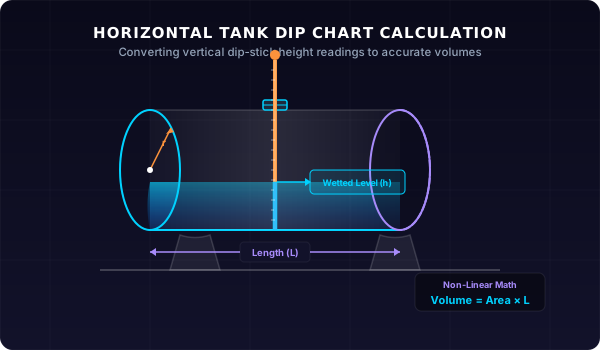
A dip stick (or “tank stick” / “gauge stick”) is a marked rod you lower into a tank until it touches the bottom. The wetted length tells you the fluid depth. A dip chart then maps each depth reading to a volume — inch 1 = X gallons, inch 2 = Y gallons, and so on.
The problem is that depth and volume do not rise together in a straight line. A vertical tank is easy: double the depth, double the volume. A horizontal cylinder is not, because the cross-section is a circle. Near the bottom and top the tank is “pinched,” and through the middle it is at its widest. Your chart has to account for that curve, and the only honest way to do it is the geometry below.
The Formula for Partial Volume in a Horizontal Cylinder
Step 1 — The Cross-Sectional Segment Area
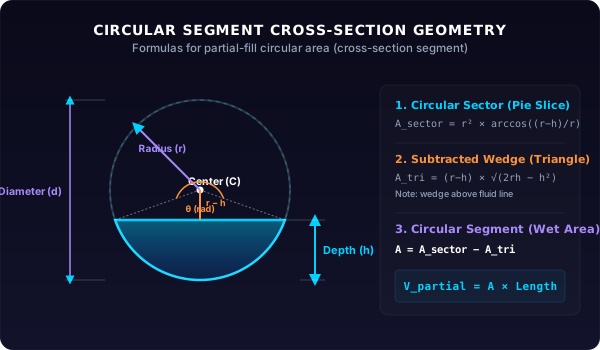
When fluid sits at depth h in a circle of radius r, the wet portion is a circular segment. Its area is:
A = r² × arccos((r − h) / r) − (r − h) × √(2rh − h²)The arccos term gives the pie-slice (sector) area; the second term subtracts the triangular wedge above the fluid line so you are left with just the segment. This is the standard circular-segment formula documented at Wolfram MathWorld.
Step 2 — Multiply by Length
A horizontal tank is just that segment extruded along its length, so:
V = A × LTwo sanity checks confirm the formula behaves. At half full (h = r): arccos(0) = π/2, the second term vanishes, and A = πr²/2 — exactly half the circle. At completely full (h = 2r): arccos(−1) = π and A = πr² — the whole circle. The formula passes both endpoints, so we can trust the values in between.
Why the Dip Stick Is Not Linear
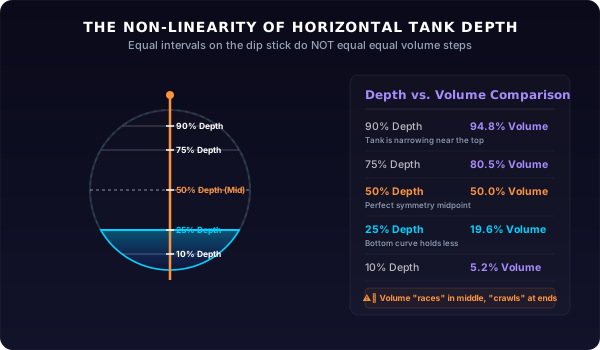
This is the part most guides skip, and it is worth understanding. Picture filling an empty horizontal tank. The first inch of depth covers only a thin, narrow strip near the bottom curve, so it holds very little. As fluid climbs toward the centerline, each new inch spans the widest part of the circle and adds the most volume. Past the halfway mark, each inch again covers less, because the tank is closing back in toward the top.
In practical terms: a tank reading 25% on the dip stick (by depth) holds only about 19.6% of its volume. The fluid level “races” through the middle of a horizontal tank and “crawls” near the ends. If you have ever watched a horizontal fuel gauge sit on full for ages and then plummet, that geometry is the reason. The Universal Fractional-Fill Table further down puts exact numbers to it.
Worked Example 1 — Metric Heating Oil Tank
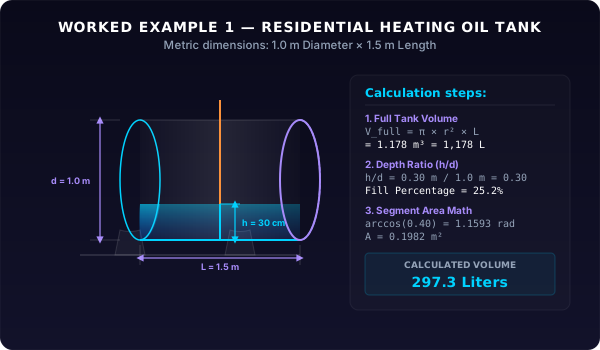
A common residential horizontal oil tank with a 1.0 m diameter (r = 0.5 m) and L = 1.5 m.
- Full volume:
π × 0.5² × 1.5 = 1.178 m³ = 1,178 L - Dip reading:
h = 0.30 m (r − h) / r = 0.20 / 0.50 = 0.4, soarccos(0.4) = 1.15928 rad√(2 × 0.5 × 0.3 − 0.3²) = √0.21 = 0.45826 mA = 0.5² × 1.15928 − 0.20 × 0.45826 = 0.28982 − 0.09165 = 0.19817 m²V = 0.19817 × 1.5 = 0.29725 m³ = 297.3 L(rounded to 1 decimal)
So a 30 cm reading on a tank that stands 100 cm tall gives 297 L, which is 25.2% of capacity — not 30%. The bottom curve is why. If you only need the answer for a single depth, our cylinder tank calculator returns it directly. For calculating the overall capacity of your tank first, you can read about how engineers calculate fuel tank capacity.
Worked Example 2 — Imperial Inch-to-Gallon Table
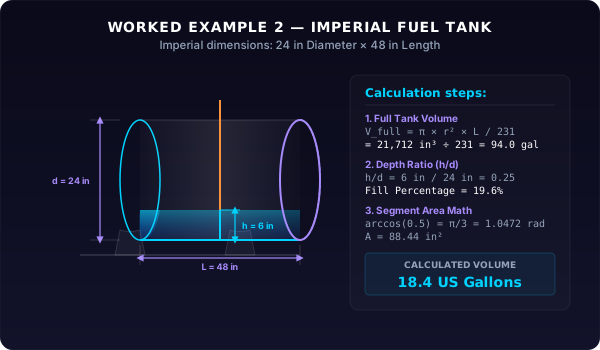
A 24-inch-diameter (r = 12 in), 48-inch-long cylindrical fuel tank.
- Full volume:
π × 12² × 48 = 21,712 in³ ÷ 231 = 94.0 gallons(1 US gallon = 231 in³, per NIST) - Dip reading:
h = 6 in (r − h) / r = 6/12 = 0.5, soarccos(0.5) = π/3 = 1.04720 rad√(2 × 12 × 6 − 6²) = √108 = 10.39230 inA = 144 × 1.04720 − 6 × 10.39230 = 150.797 − 62.354 = 88.443 in²V = 88.443 × 48 = 4,245 in³ ÷ 231 = 18.4 gallons
Repeating this at every inch produces a fuel tank inch-to-gallon table for this specific tank:
| Dip (in) | Gallons | Dip (in) | Gallons |
|---|---|---|---|
| 3 | 6.4 | 15 | 56.9 |
| 6 | 18.4 | 18 | 67.6 |
| 9 | 32.0 | 21 | 81.4 |
| 12 | 47.0 | 24 | 94.0 |
Notice the spacing: from 9 to 12 inches you add 15 gallons, but from 21 to 24 inches you add only about 12.6. Same three inches of stick, different volumes — exactly the non-linearity described above.
Worked Example 3 — Standard 55-Gallon Steel Drum
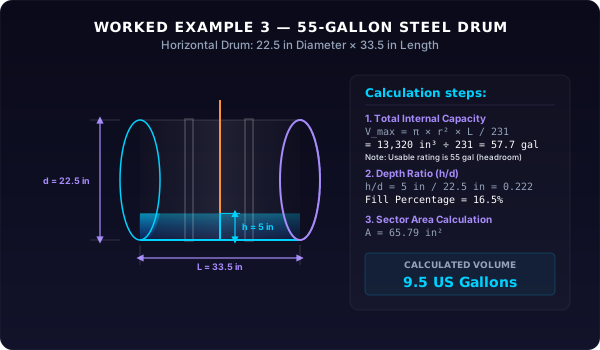
Here is a verifiable object you may have on hand. A US tight-head steel drum measures roughly 22.5 inches in diameter and 33.5 inches tall (industry-standard dimensions). Laid on its side, that is r = 11.25 in and L = 33.5 in.
- Full internal volume:
π × 11.25² × 33.5 = 13,320 in³ ÷ 231 = 57.7 gallons
A small but useful fact: a “55-gallon” drum actually holds closer to 57–58 gallons of total internal space. The nominal 55 is a usable fill rating that leaves headroom, which is why your chart should always be built from measured dimensions rather than the label.
- Dip reading:
h = 5 in (r − h) / r = 6.25 / 11.25 = 0.5556, soarccos(0.5556) = 0.98176 rad√(2 × 11.25 × 5 − 5²) = √87.5 = 9.35414 inA = 11.25² × 0.98176 − 6.25 × 9.35414 = 124.255 − 58.463 = 65.792 in²V = 65.792 × 33.5 = 2,204 in³ ÷ 231 = 9.5 gallons
A 5-inch reading on a 22.5-inch-diameter drum is 22.2% of the depth but only 16.5% of the volume.
The Universal Fractional-Fill Table
This is the most useful tool here, and it removes the need to redo the trigonometry for every tank. Because the fill percentage depends only on the ratio of fluid depth to total diameter (h ÷ d), one table covers every horizontal cylindrical tank ever built. Find your depth-to-diameter ratio, read the percentage, multiply by your tank’s full volume.
| Depth ÷ Diameter (h/d) | % of Full Volume | h/d | % of Full Volume |
|---|---|---|---|
| 0.05 | 1.9% | 0.55 | 56.4% |
| 0.10 | 5.2% | 0.60 | 62.7% |
| 0.15 | 9.4% | 0.65 | 68.8% |
| 0.20 | 14.2% | 0.70 | 74.8% |
| 0.25 | 19.6% | 0.75 | 80.5% |
| 0.30 | 25.2% | 0.80 | 85.8% |
| 0.35 | 31.2% | 0.85 | 90.6% |
| 0.40 | 37.4% | 0.90 | 94.8% |
| 0.45 | 43.6% | 0.95 | 98.1% |
| 0.50 | 50.0% | 1.00 | 100% |
The table is perfectly symmetric around the 50% midpoint — the volume gained from 0% to 10% depth equals the volume gained from 90% to 100% depth. To test it: Example 2 had h/d = 6/24 = 0.25, the table says 19.6%, and 19.6% × 94.0 gal = 18.4 gal — matching the long-hand result exactly.
How to Build Your Own Inch-by-Inch Dip Chart
You only need two measurements and a few minutes.
- Measure the inside diameter and length. Use the internal dimensions, not the outside, so wall thickness doesn’t inflate your numbers. Halve the diameter to get
r. - Calculate full volume with
V = π × r² × L, then convert to your preferred unit (÷ 231for US gallons from cubic inches;÷ 1000for liters from cm³). - Pick your interval. One inch (or 2 cm) is typical for fuel and oil tanks.
- For each depth, look up
h/din the Universal Table above and multiply by full volume — or run eachhthrough the partial-volume formula for exact figures. - Mark the stick at each depth, label it with the volume, and seal it against fluid.
To skip the arithmetic entirely, feed your radius and height into the free cylinder volume calculator and read results in gallons or liters. You can also use our volume unit conversion guide to convert between other units like cubic feet, barrels, or cubic meters.
A Note on Tank Ends (Read This for Accuracy)
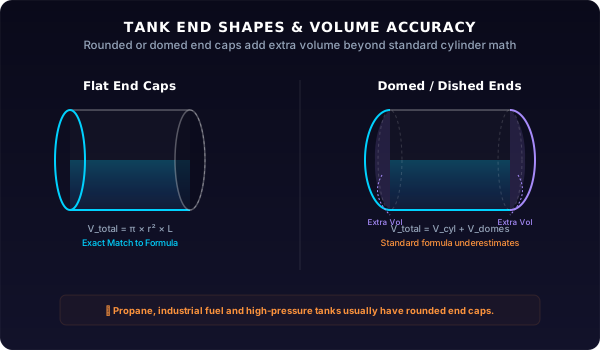
The formula assumes a true cylinder with flat ends. Many real tanks — propane vessels, large fuel tanks — have dished, domed, or hemispherical ends that add a little extra capacity beyond the straight-sided cylinder. For a quick household oil or water tank, the flat-end formula is close enough. For domestic water setups, you can refer to how to calculate water tank capacity at home. For commercial fuel inventory or regulated storage, factor in the end caps or use the manufacturer’s calibrated chart. Being honest about this limit is what keeps a chart trustworthy. If your tank has a complex configuration, such as a cylinder with conical bottom, different math will apply.
Common Mistakes
- Measuring depth from the centerline instead of the bottom.
his always the wetted depth from the lowest point of the tank. - Using degrees in the
arccosterm. The formula needs radians. Most calculators have a DEG/RAD switch — set it to RAD. - Assuming the chart is linear. Equal stick intervals never mean equal volume intervals in a horizontal tank.
- Using outside dimensions. Wall thickness can throw a large tank off by gallons.
Frequently Asked Questions
How do you calculate fuel in a horizontal tank?
Measure the fluid depth with a dip stick, then apply V = L × [r² × arccos((r−h)/r) − (r−h)√(2rh − h²)], or look up your depth-to-diameter ratio in a fractional-fill table and multiply by the tank’s full volume.
Why does my fuel gauge drop slowly then fast?
A horizontal cylinder is widest through its middle, so the fluid level moves slowly there (large volume per inch) and quickly near the top and bottom (small volume per inch). The level appears to “stick” near full and then fall rapidly.
What is the formula for a partially filled horizontal cylinder?
The fluid volume is the circular-segment area times the tank length: A = r² × arccos((r−h)/r) − (r−h)√(2rh − h²), then V = A × L. For a tank with r = 12 in, L = 48 in, and h = 6 in, that gives about 4,245 in³ (18.4 gallons).
How many gallons per inch are in a horizontal tank?
It varies by inch — that is the key feature. In the 24-inch tank above, the inch from 9” to 12” adds about 15 gallons, while the inch from 21” to 24” adds only about 12.6. There is no single “gallons per inch” figure for a horizontal cylinder.
Can I use one chart for any tank?
Yes — use a depth-to-diameter (h/d) percentage table. The fill percentage is identical for all horizontal cylinders; you just multiply by each tank’s own full volume.
How do I make a dip stick for my tank?
Measure the internal diameter and length, calculate full volume, then for each depth interval look up the h/d percentage (or use the exact formula) and multiply by full volume. Mark each depth on a clean rod with its corresponding volume and seal the markings.
Do rounded tank ends affect the chart?
Yes, slightly. Dished or hemispherical ends hold a little more than flat ends. For small domestic tanks the difference is minor; for commercial storage, account for the end caps or use a manufacturer-calibrated chart.
What’s the difference between a vertical and horizontal tank chart?
A vertical cylinder is linear — volume rises in direct proportion to depth, so its chart has even spacing. A horizontal cylinder is non-linear because its cross-section is a circle, so its chart spacing tightens near the top and bottom. Compare both with our cylinder volume calculator.
Sources & Verification
Circular-segment and cylinder geometry referenced from Wolfram MathWorld. Unit conversions (1 US gallon = 231 in³) follow NIST. The 55-gallon steel drum dimensions are US industry-standard tight-head specifications. All calculations were performed independently and cross-checked against the Universal Fractional-Fill Table for internal consistency (Example 2 at h/d = 0.25 confirms the 19.6% table value).
Author: CylinderVolume-Calculator.com Editorial Team
Published: June 4, 2026
Last reviewed: June 4, 2026
Fact-checked by: CVC Editorial Team
This article was drafted with AI assistance and reviewed for accuracy before publishing. All calculations were independently verified.