Guides · May 23, 2026
Cylinder with Conical Bottom: Total Combined Tank Volume
Calculate volume for composite cylindrical tanks with conical bottoms. Combines pi r2 h1 + 1/3 pi r2 h2 for breweries, silos and chemical hoppers.
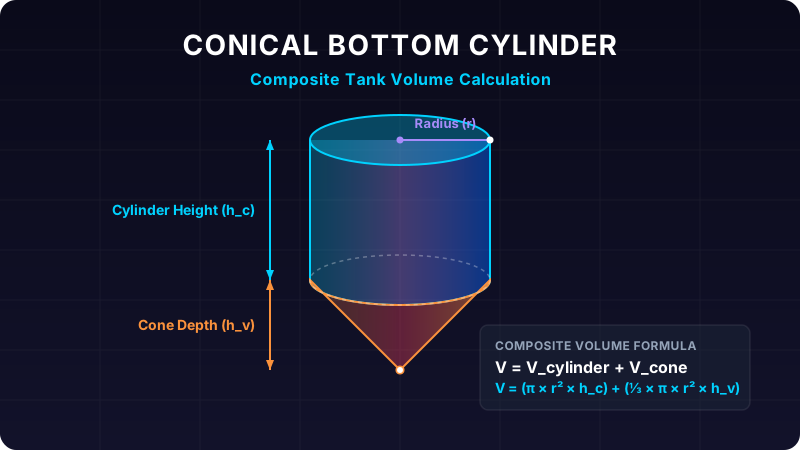

- The Geometry: Understanding the Composite Structure
- The Formula: Combining Cylinder and Cone Volumes
- The Component Formulas
- The Unified Equation
- 3 Real-World Worked Examples
- Example 1: Agricultural Silo Capacity (Imperial Units)
- Example 2: Brewery Conical Fermenter (Metric to Liters)
- Example 3: Micro Craft Brewing Yeast Brink (Inches to Gallons)
- Material Expansion & Bulking: The Industrial Edge Case
- 1. The Angle of Repose (The Top Cone)
- 2. The Material Volumetric Expansion (Bulking Factor)
- Common Mistakes When Calculating Conical Cylinders
- 1. Halving the Diameter but Forgetting to Square It
- 2. Confusing Total Height with Sectional Heights
- 3. Mixing Up Outer and Inner Dimensions
- Frequently Asked Questions
- How do you find the volume of a cylinder with a cone bottom?
- Why is a cone volume formula exactly one-third of a cylinder?
- How do I calculate volume if my cone bottom is cut off flat?
- What is a common angle for silo and hopper bottom cones?
- Can I use this formula for a horizontal tank with rounded ends?
- How does air space or “headspace” alter actual tank capacity?
- Sources & Verification Note
The total volume of a cylinder with a conical bottom is calculated using the formula V = (π × r² × h_c) + (⅓ × π × r² × h_v), where r is the internal radius, h_c is the height of the cylindrical section, and h_v is the depth of the conical cone. For instance, a standard Meridian 1615 grain silo (radius 8.0 feet, cylinder height 15.0 feet, cone depth 4.5 feet) yields a total capacity of approximately 3,317.5 cubic feet. This specific layout is structural: the cylindrical upper portion provides max volume per footprint, while the bottom cone relies on gravity for complete, unassisted drainage.
Whether you are calculating the capacity of an industrial farm silo, a conical fermentation tank in a commercial brewery, or an aggregate hopper on a construction site, blending these two distinct geometric shapes requires exact measurements. Let’s break down the math step-by-step so you can accurately predict your tank’s total capacity. (If you need to calculate concrete requirements for cylindrical forms, read our circular sonotube concrete guide for a complete walkthrough.)
The Geometry: Understanding the Composite Structure
A conical-bottom container is a composite geometric solid. To find its capacity, we cannot treat it as a single uniform shape. Instead, we divide it horizontally into two discrete volumetric zones:
- The Upper Zone (Cylinder): This section has a constant circular cross-section from its top rim down to the weld line where the wall begins to slope inward.
- The Lower Zone (Cone): This section tapers from the full diameter of the cylinder down to a specific discharge point or vertex.

Because both sections share the exact same internal radius (r) at the point where they meet, you only need to collect three critical physical dimensions to compute the absolute volume.
The Formula: Combining Cylinder and Cone Volumes
To determine the total volume (V_total), we calculate the volume of the cylinder (V_c) and the volume of the cone (V_v) independently, then sum them together.
The Component Formulas
- Cylinder Volume: V_c = π × r² × h_c
- Cone Volume: V_v = ½ × π × r² × h_v (No, remember a cone is exactly ⅓ of a cylinder’s volume!)
- Correct Cone Volume: V_v = ⅓ × π × r² × h_v
The Unified Equation
V_total = (π × r² × h_c) + (⅓ × π × r² × h_v)Where:
- π (Pi): Approximately 3.14159 (we round to 3.1416 for practical work).
- r (Radius): Distance from the center of the tank to the inside wall (r = Diameter ÷ 2).
- h_c (Height of Cylinder): The vertical distance of the straight side walls only.
- h_v (Height of Cone Depth): The vertical depth from the bottom of the cylinder to the lowest discharge point.
If you have already measured your container using its outer circumference or if you only have its diameter, you can quickly convert those figures using our cylinder volume using diameter tool or check the calculate from circumference module before plugging your dimensions into the composite formula. You can check out our complete visual proof of why a cone’s volume is exactly 1/3 of a cylinder to see this ratio mathematically proven.

3 Real-World Worked Examples
When doing industrial calculations, matching your units precisely prevents catastrophic storage overfills or supply shortages. Let’s walk through three distinct real-world applications using certified manufacturer specifications.

Example 1: Agricultural Silo Capacity (Imperial Units)
Let’s find the volume of a standard industrial grain silo used for wheat storage, modeled tightly after commercial farm cooperative dimensions.
- Object: Heavy-duty steel grain silo
- Diameter: 18.0 feet (Radius r = 9.0 feet)
- Cylinder Height (h_c): 32.0 feet
- Cone Depth (h_v): 6.0 feet
Step 1: Cylindrical Section Volume Formula (V_c)
V_c = π × r² × h_c
V_c = 3.14159 × 9.0² × 32.0
V_c = 3.14159 × 81.0 × 32.0 = 8,143.01 cubic feet
Step 2: Conical Bottom Volume Formula (V_v)
V_v = ⅓ × π × r² × h_v
V_v = ⅓ × 3.14159 × 9.0² × 6.0
V_v = 0.33333 × 3.14159 × 81.0 × 6.0 = 508.94 cubic feet
Step 3: Total Volume and Conversion to Bushels
V_total = 8,143.01 + 508.94 = 8,651.95 cubic feet (rounded to 2 decimal places)Real-World Translation: Agricultural grain is measured in bushels. Per NIST handbook guidelines, one cubic foot of space holds roughly 0.80356 standard US bushels.
Silo Capacity = 8,651.95 × 0.80356 ≈ 6,952.4 Bushels(If you are preparing the ground or excavating soil for a silo foundation, see how much dirt comes out of a borehole to estimate your excavation volume.)
Example 2: Brewery Conical Fermenter (Metric to Liters)
Commercial beer brewing relies heavily on Cylindroconical Fermenters (CCVs). The bottom cone is usually built to a steep 60° angle to allow dense yeast cells to settle perfectly for easy extraction.
- Object: 20-BBL Commercial Fermentation Tank (interior dimensions)
- Radius (r): 0.75 meters
- Cylinder Height (h_c): 2.10 meters
- Cone Depth (h_v): 1.30 meters
Example Step 1: Cylindrical Section Volume (V_c)
V_c = 3.14159 × 0.75² × 2.10
V_c = 3.14159 × 0.5625 × 2.10 = 3.711 cubic meters
Example Step 2: Conical Bottom Volume (V_v)
V_v = ⅓ × 3.14159 × 0.75² × 1.30
V_v = 0.33333 × 3.14159 × 0.5625 × 1.30 = 0.766 cubic meters
Step 3: Total Volume and Conversion to Liters
V_total = 3.711 + 0.766 = 4.477 cubic metersSince 1 cubic meter = 1,000 liters, we convert the volume instantly:
Total Capacity = 4.477 × 1,000 = 4,477 LitersTo see how this profile splits if you are adapting it to custom production lines, you can experiment with our dedicated volume in liters tracker.
Example 3: Micro Craft Brewing Yeast Brink (Inches to Gallons)
Smaller scale operations use compact conical hoppers or vessels called yeast brinks to collect harvestable components.
- Object: Stainless steel yeast collection hopper
- Diameter: 16.0 inches (Radius r = 8.0 inches)
- Cylinder Height (h_c): 18.0 inches
- Cone Depth (h_v): 12.0 inches
Step 1: Calculate the Straight-Wall Volume (V_c)
V_c = 3.14159 × 8.0² × 18.0
V_c = 3.14159 × 64.0 × 18.0 = 3,619.11 cubic inches
Step 2: Calculate the Lower Sloped Volume (V_v)
V_v = ⅓ × 3.14159 × 8.0² × 12.0
V_v = 0.33333 × 3.14159 × 64.0 × 12.0 = 804.25 cubic inches
Step 3: Combined Volume and Liquid Gallon Conversion
V_total = 3,619.11 + 804.25 = 4,423.36 cubic inchesTo determine fluid capacity, apply the standard volumetric conversion factor (1 US Liquid Gallon = 231 cubic inches):
Gallon Capacity = 4,423.36 ÷ 231 ≈ 19.15 GallonsFor fast structural planning across varied systems, keep our volume in gallons processing system saved.
Material Expansion & Bulking: The Industrial Edge Case
When calculators tell you the exact geometric boundaries of your vessel, they assume you are storing an ideal, non-compressible liquid that fills every millimeter perfectly. But if you are using a conical cylinder tank or silo to hold solid dry materials—such as coarse gravel, dry sand, grain, or plastic pellets—the actual amount of material you can fit shifts dramatically based on two major factors:
1. The Angle of Repose (The Top Cone)
Dry material poured into a container from an overhead chute never flattens out perfectly. It piles up into a conical mound at the top. The slope of this pile is dictated by the material’s Angle of Repose. Because of this, you may have an empty “dead zone” at the top corners of your cylinder, or a positive mountain extending above the top rim.
2. The Material Volumetric Expansion (Bulking Factor)
If you are calculating how much loose soil or aggregate extracted from a borehole can fit into a conical waste skip or container, you must account for the bulking factor. Undisturbed material tightly packed in the earth expands significantly when broken apart.
This type of bulk material expansion is also critical when determining backfill volumes for underground pipes, such as when calculating gravel for a culvert pipe or figuring out the volume of cylindrical pile foundations.

| Material Type | Average Angle of Repose | Loose Swell / Expansion Factor |
|---|---|---|
| Dry Wheat / Grain | 25° - 28° | 1.02 - 1.05 (Minimal settling) |
| Dry Clean Sand | 30° - 34° | 1.10 - 1.15 (Spreads moderately) |
| Excavated Soil / Clay | 35° - 40° | 1.25 - 1.40 (Expands up to 40%!) |
| Crushed Limestone | 38° - 45° | 1.30 - 1.35 (High air void ratio) |
How to use this data: If you are excavating a borehole or pit that amounts to 100 cubic feet of solid earth, and dumping it into a conical disposal hopper, you will need a hopper volume of at least 125 to 140 cubic feet to contain it safely without spilling over the side walls.
Common Mistakes When Calculating Conical Cylinders
Through helping thousands of operators manage tank volumes, our editorial team notices students and field technicians consistently repeating three mathematical errors.

1. Halving the Diameter but Forgetting to Square It
It is common to measure a tank’s diameter, divide by 2 to get the radius, and then multiply by 2 instead of raising it to the power of 2 (r²).
- The Correct Way: If your radius is 5 ft, r² is 5 × 5 = 25 sq ft.
- The Mistake: Accidentally entering 5 × 2 = 10 sq ft, which immediately slashes your calculated capacity by more than half!
2. Confusing Total Height with Sectional Heights
Many field diagrams list the “Total Height” from ground to top rim. If you plug that total height value directly into the cylinder height variable (h_c) while also calculating the cone volume, you are counting the cone section twice! Always separate the straight side wall height from the bottom slope depth.
3. Mixing Up Outer and Inner Dimensions
Steel storage units possess thick walls, external insulation blankets, and interior structural ribs. If you run your measurements along the outside shell of a concrete silo or insulated fermentation tank, your volume will read significantly higher than the space inside. Always subtract structural wall thicknesses before running calculations. If you need to quickly gauge how structural steel weight influences the physical frame regardless of capacity, check our cylinder weight calculator.
Frequently Asked Questions
How do you find the volume of a cylinder with a cone bottom?
To find the total volume, calculate the cylindrical upper portion using V = π × r² × h_c and the conical lower portion using V = ⅓ × π × r² × h_v. Add both values together to secure the grand total. Ensure all measurements share the exact same unit base (inches, feet, or meters) before starting.
Why is a cone volume formula exactly one-third of a cylinder?
Geometrically, if you construct a cylinder and a cone with the exact same radius and vertical height, the cone will always hold precisely ⅓ of the fluid volume of the cylinder. This fundamental mathematical truth can be cleanly proven through calculus integration and holds true regardless of scale. You can compare these core ratios explicitly using our cylinder vs cone volume visual analysis page.
How do I calculate volume if my cone bottom is cut off flat?
If the bottom cone tapers but cuts off flat before reaching a sharp tip, you are dealing with a frustum rather than a true cone. To find that volume, you must subtract the missing tip volume from your total cone calculation or use a specialized conic frustum formula.
What is a common angle for silo and hopper bottom cones?
Industrial silos storing dry feed or grains generally feature a 45° or 60° bottom cone angle. Sticky substances, damp aggregates, or powdered materials require a steep 60° angle to prevent “bridging,” where material wedges tightly together over the discharge gate rather than dropping cleanly through.
Can I use this formula for a horizontal tank with rounded ends?
No. This formula is meant strictly for vertically oriented cylindrical structures with a conical bottom. For horizontal configurations containing curved or elliptical end caps, you will need to head over to our specialized horizontal cylinder calculator page.
How does air space or “headspace” alter actual tank capacity?
In fermentation and liquid chemical storage, you must never fill a container to its absolute top edge. Breweries leave roughly 20 to 25% of a tank’s cylinder height empty as “headspace” or “ullage” to safely contain active foam and gas expansion during fermentation.
Sources & Verification Note
- Standard volume calculations and geometric derivations verified via Wolfram MathWorld Cylinder Profiles and Khan Academy Geometry Systems.
- Volumetric weight conversions and liquid definition standards referenced per the National Institute of Standards and Technology (NIST).
- Material weight and angle of repose values verified through the structural engineering reference catalog at The Engineering Toolbox.