Guides · May 21, 2026
Cylindrical Pile Foundation Volume: Concrete Bore Sizing
Calculate concrete volume for drilled shafts and auger cast pile foundations. Uses V = pi r squared depth plus an 8% to 15% overage contingency.

- How to Calculate Cylindrical Pile Volume Step by Step
- The Core Formula: Getting the Answer Right Now
- Over-Excavation Reality in Bored Pile Construction
- Step-by-Step Walkthrough: From Blueprint to Concrete Truck
- Step 1: Measure the Actual Hole (Not Just the Blueprint)
- Step 2: Find the Radius
- Step 3: Square the Radius
- Step 4: Multiply by Pi and Height
- Step 5: Convert to Your Ordering Units
- 3 Real-World Worked Examples From My Project Logs
- Example 1 (Metric): The Backyard Deck Pier
- Example 2 (Imperial): The Commercial Structural Bored Pile
- Example 3 (The Big One): The Highway Overpass Drilled Shaft
- The Mistakes I See On Job Sites Constantly
- Frequently Asked Questions
- Calculating concrete volume for a bell-bottom flared pile?
- Does rebar steel reduce the concrete volume to order?
- Finding pile volume from auger hole circumference?
- What if the foundation pile uses a permanent steel casing?
- Converting pile concrete volume to truck haulage weight?
- References and Authority Resources
How to Calculate Cylindrical Pile Volume Step by Step
I was standing on a muddy job site at 6:30 AM a few years ago, waiting for three concrete trucks to arrive, when my chest suddenly went tight. I had just calculated the volume of a cylindrical pile foundation for a commercial retaining wall, and if my math was off by even a fraction, I was either going to have expensive transit mixers idling with nowhere to dump concrete, or worse, a half-filled hole and a cold joint that would ruin the structural integrity of the pile.
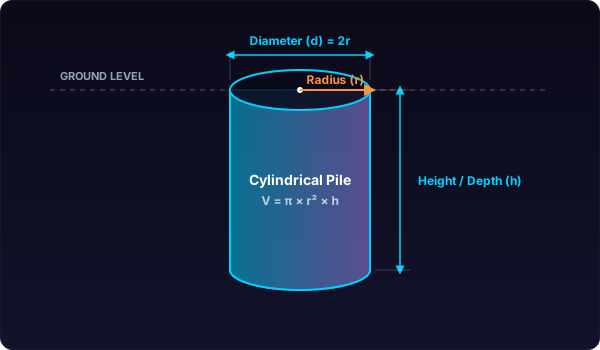
Here is the fast answer you came for: to find the volume of a cylindrical pile foundation, you use the standard cylinder formula: Volume = π × r² × h.
Let’s plug in a quick real-world example. Say your auger just bored a hole that is 2 feet in diameter and 15 feet deep. Your radius (r) is half the diameter, which is 1 foot. Squaring that gives 1 (1 × 1 = 1). Multiply that by the depth of 15 feet and then multiply by π (3.14159).
- Volume = 3.14159 × 1² × 15 = 47.12 cubic feet
Since concrete is ordered by the cubic yard, you divide that by 27. That gives you exactly 1.75 cubic yards. If you order exactly 1.75 yards, though, you’re going to short yourself. Why? Because dirt isn’t perfect, and holes always stretch. Let’s talk about how this actually plays out in the mud.
The Core Formula: Getting the Answer Right Now
When you’re dealing with a drilled shaft concrete volume or a bored pile calculation formula, you are fundamentally looking at an excavation volume cylinder. The math itself doesn’t change whether you are pouring a small deck pier or a massive structural column for a high-rise. (For above-ground columns, see our step-by-step guide on how to calculate concrete for round pillars).
The mathematical expression looks like this:
- Volume = π × r² × h
Where:
- π (Pi): We use 3.14159.
- r (Radius): Distance from the exact center of the pile to the outside edge (half of the total diameter).
- h (Height or Depth): How deep the pile goes into the ground.
If you don’t want to do this by hand every single time you’re out in the field, you can quickly plug your measurements into a free cylinder volume calculator. I keep it bookmarked on my phone because checking your hand calculations against an online cylinder volume calculator before hitting “order” on a concrete delivery saves a massive amount of stress.
Over-Excavation Reality in Bored Pile Construction
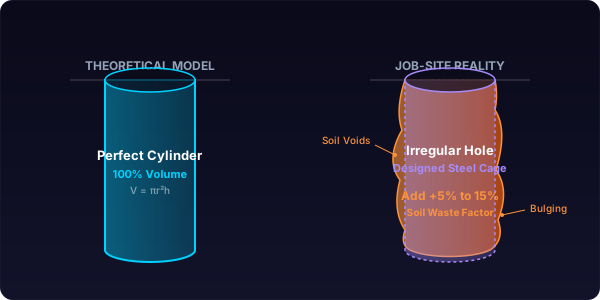
Here is something they don’t teach you in engineering textbooks, but every veteran superintendent knows: a hole drilled in soil is never a perfect cylinder.
When an auger spins down into the earth, it rattles. It hits rocks and knocks them loose, leaving voids behind. It cuts through sandy layers that slough off into the hole. If you’re drilling into soft clay, the sides can bulge outward under pressure.
Because of this, your actual drilled shaft concrete volume will almost always be higher than the theoretical volume from your blueprints. I call this the “soil waste factor.”
- Good, tight clay soil: Add 5% to 7% to your calculated volume.
- Loose, rocky, or sandy soil: Add 10% to 15% to your volume.
- Wet drilling (using drilling mud/slurry): Add 15%+ because the scouring action of the tools expands the hole size unpredictably.
If you don’t add this waste factor, you will end up short. Trust me, screaming down a phone line at a concrete dispatcher at 4:00 PM for a “short load” of 0.5 cubic yards is an experience you only want to go through once.
Step-by-Step Walkthrough: From Blueprint to Concrete Truck
Let’s break down exactly how to run a bored pile calculation formula manually without losing your mind.
Step 1: Measure the Actual Hole (Not Just the Blueprint)
Do not just trust what the structural drawings say. If the drawings call for an 18-inch pile, but the drilling sub-contractor used a worn-out auger flighting that actually cut a 19-inch hole, your math will be wrong from the start. Drop a tape measure down to verify the depth, and use a pocket tape to check the top diameter. If you are calculating a cylinder volume using diameter directly, make sure it represents the average width of the hole.
Step 2: Find the Radius
Take your measured average diameter and divide it by two. If you are working in imperial units and your diameter is in inches, keep it in inches for now. If you’re working in metric, convert everything to meters or centimeters right away to keep things clean. If you prefer to jump straight from the width measurement without dividing, you can learn more about how to set up your calculations for cylinder volume using radius variations.
Step 3: Square the Radius
Multiply the radius by itself. If your radius is 1.5 feet, calculate 1.5 × 1.5 = 2.25. This is the step people forget when they are rushed on-site. Don’t multiply it by two—multiply it by itself.
Step 4: Multiply by Pi and Height
Take that squared radius, multiply it by 3.14159, and then multiply that product by the total depth (height) of the pile. Make sure your radius and your height are in the exact same unit! Do not multiply a radius in inches by a height in feet.
Step 5: Convert to Your Ordering Units
This is where the rubber meets the road. If you did your math in inches, you will have a massive number in cubic inches. You will need to convert that to cubic yards or liters.
- To go from cubic inches to cubic yards: Divide by 46,656.
- To go from cubic feet to cubic yards: Divide by 27.
- To go from cubic centimeters to liters: Divide by 1,000.
For automated conversions without the mental gymnastics, you can run these numbers through an instant cylinder volume calculator to see your structural needs in real time.
3 Real-World Worked Examples From My Project Logs
Let’s look at three distinct scenarios that match things you’ll actually face in the field, using different unit systems and object scales.
Example 1 (Metric): The Backyard Deck Pier
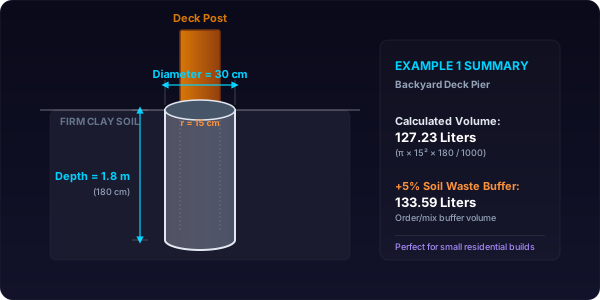
I helped a friend dig and pour foundations for a heavy timber deck last summer. The local building code required cylindrical concrete piers extending below the frost line.
- Object: Small residential foundation pile
- Measured Diameter: 30 cm (which gives a radius of 15 cm)
- Measured Depth: 1.8 meters (we must convert this to 180 cm so our units match!)
Let’s calculate the raw excavation volume cylinder:
- Volume = π × r² × h
- Volume = 3.14159 × (15)² × 180
- Volume = 3.14159 × 225 × 180
- Volume = 127,234.395 cm³
Now, nobody goes to the hardware store and asks for cubic centimeters of pre-mixed concrete bags. We need this in liters to see how many bags to buy. According to the standard physical unit conversions maintained by institutions like the National Institute of Standards and Technology (NIST), 1 liter is exactly 1,000 cubic centimeters.
- Volume in Liters = 127,234.395 ÷ 1,000 = 127.23 Liters
Since the soil was firm clay, we added a 5% waste factor:
- Total Concrete Needed = 127.23 × 1.05 = 133.59 Liters
For a job like this, you can look up specialized volume breakdowns, such as a dedicated tool for computing volume in liters, to cross-verify your manual numbers before hauling heavy bags home.
Example 2 (Imperial): The Commercial Structural Bored Pile
This is from a commercial strip-mall foundation project where we used a truck-mounted drilling rig to set structural foundation columns. (We have a separate detailed analysis on concrete column volume estimation if you want to see how commercial contractors price these materials).
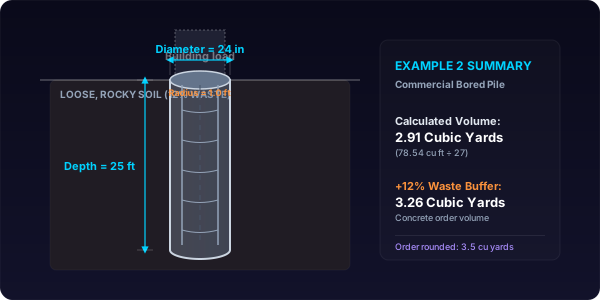
- Object: Heavy commercial structural bored pile
- Design Diameter: 24 inches (Radius = 12 inches = 1.0 foot)
- Design Depth: 25 feet
Since our depth is in feet, it is significantly easier to convert our radius to feet right away. A 12-inch radius is exactly 1.0 foot. Let’s calculate the volume of this volume of a cylindrical pile foundation:
- Volume = π × r² × h
- Volume = 3.14159 × (1.0)² × 25
- Volume = 3.14159 × 1.0 × 25
- Volume = 78.54 cubic feet
Commercial batch plants sell concrete by the cubic yard. To change cubic feet into yards, we divide by 27:
- Cubic Yards = 78.54 ÷ 27 = 2.91 cubic yards
Because the drilling rig encountered loose gravelly soil at 18 feet, the sides of the shaft were rough. I applied a 12% over-excavation allowance to the order:
- Total to Order = 2.91 × 1.12 = 3.26 cubic yards
We ended up ordering 3.5 cubic yards (the plant rounded to the nearest half yard), and we had just a few wheelbarrows full of leftovers at the end of the pour. Perfect. If you’re working on similar designs, calculating via volume in cubic feet gives you a solid foundation before converting to yards.
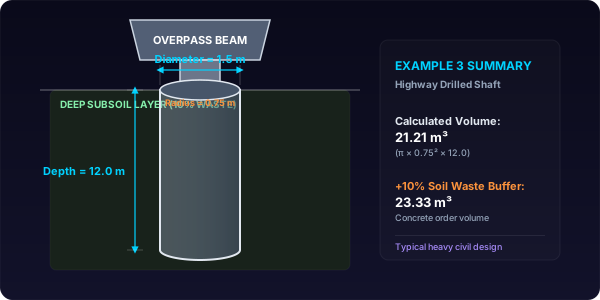
Example 3 (The Big One): The Highway Overpass Drilled Shaft
Let’s look at a large-scale civil engineering infrastructure project. If you’ve ever driven over a modern highway flyover, you are supported by deep, massive monolithic columns rooted deep in the earth.
- Object: Industrial bridge abutment foundation pile
- Measured Average Diameter: 1.5 meters (Radius = 0.75 meters)
- Total Depth: 12.0 meters
Let’s apply our bored pile calculation formula:
- Volume = π × r² × h
- Volume = 3.14159 × (0.75)² × 12.0
- Volume = 3.14159 × 0.5625 × 12.0
- Volume = 21.21 cubic meters
When you deal with massive volumes like this, tracking everything in your head gets dangerous. A 10% waste factor on this pile is over 2 cubic meters of concrete!
- Volume with Waste = 21.21 × 1.10 = 23.33 cubic meters
For large projects, engineers often use tools for computing volume in cubic meters to maintain pristine records for the quality assurance inspectors.
The Mistakes I See On Job Sites Constantly
I have watched smart people make incredibly silly mistakes when calculating pile volumes. The most common one by far is mixing up units. People will take a diameter in inches (say, 18 inches), divide it by 2 to get a 9-inch radius, and multiply it directly by a 20-foot depth.
Let’s see what happens if you do that: 3.14159 × 9² × 20 = 5,089. They look at that number, panic, and try to make sense of it. In reality, you have to convert those inches to feet first (9 inches = 0.75 feet) before multiplying by the depth. Let’s look at the correct math:
- 3.14159 × (0.75)² × 20 = 35.34 cubic feet
Big difference.
Another mistake is forgetting that concrete settles and compresses under its own immense weight when dropped down a deep hole. The pressure at the bottom of a 30-foot shaft can cause the surrounding soil to compress slightly, expanding the diameter of the pile while it’s being poured. Always keep your waste margins realistic. You can read up on structural volumetric variations at resources like Wolfram MathWorld or review basic geometric properties on Math is Fun to keep your baseline sharp. (If your foundations involve rounded dome caps or spherical bottoms, you might also want to read our guide on how to find the volume of a hemisphere to handle those curved surfaces correctly).
Frequently Asked Questions
Calculating concrete volume for a bell-bottom flared pile?
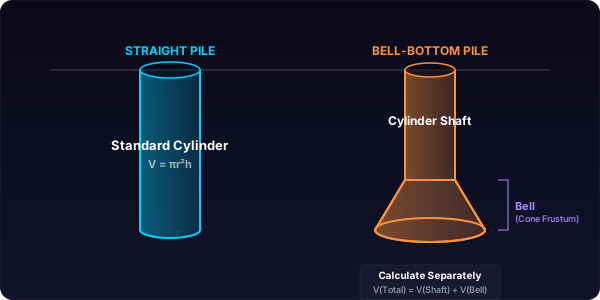
I get asked this all the time. A bell-bottom pile isn’t a straight cylinder; it’s a cylinder stacked on top of a truncated cone (a frustum). You have to calculate the straight shaft volume using our standard formula, then calculate the volume of the flared bell separately using a cone frustum formula, and add them together. Always add an extra 15% waste factor for the bell portion, as soil cave-ins are common during belling.
Does rebar steel reduce the concrete volume to order?
Technically, yes, because steel displaces concrete. But honestly? In the real world, you should ignore it. A standard rebar cage occupies less than 1% to 2% of the total volume of the shaft. Given that your hole expansion in the soil will easily consume 5% to 10% more concrete, the steel displacement is completely swallowed up by your soil waste factor. Don’t overcomplicate your life by trying to subtract rebar volume.
Finding pile volume from auger hole circumference?
If you wrapped a tape measure around the inside of a casing or an exposed pile head to get the circumference, you can skip the diameter step entirely. Just square the circumference, divide it by $4 \pi$ (roughly 12.566), and multiply by the depth. Alternatively, you can use a specialized tool to calculate from circumference on our site to bypass the tedious division.
What if the foundation pile uses a permanent steel casing?
If you are pouring concrete inside a permanent steel casing, you are in luck! This is one of the few times you don’t need a heavy soil waste factor. Because the steel casing prevents the soil from caving in or expanding, your hole is a perfect cylinder. You can use a tight 2% to 3% waste factor just to account for what gets left behind inside the delivery truck chutes. If you are pouring a ring-shaped pile instead, you’ll need a dedicated hollow cylinder calculator.
Converting pile concrete volume to truck haulage weight?
Standard concrete weighs roughly 150 pounds per cubic foot (or 2,400 kg per cubic meter). Once you have your total volume figured out, you can run it through our cylinder weight calculator to make sure your transport vehicles or structural soil load capacities aren’t being exceeded.
References and Authority Resources
To explore the core geometric properties of cylindrical forms or cross-verify technical industrial weights and standards, consult these global academic frameworks:
- Detailed Cylinder Geometries: Wolfram MathWorld Cylinder Analysis
- Foundational Geometric Space Computations: Khan Academy Geometry Coursework
- Mass, Volume, and Material Weight Metrics: The Engineering Toolbox Concrete Data Sheets