Geometry · May 20, 2026
Volume of a Hemisphere Calculator: V = 2 over 3 pi r3
Calculate hemisphere volume using V = 2/3 pi r cubed. Learn dome, bowl and tank head capacity with worked radius and diameter examples in litres.
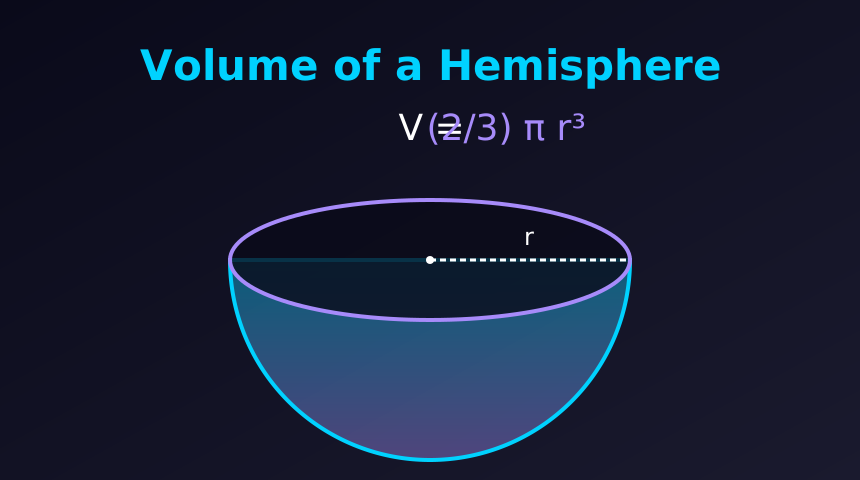

- Hemisphere Volume Formula and Real-World Math
- Where Does the Formula Come From?
- Quick formula reference
- Worked Example 1: A Stainless Steel Mixing Bowl (Metric)
- Worked Example 2: A Dome Skylight (Imperial)
- Worked Example 3: A Hemispherical Water Tank
- Bonus Example: A Decorative Garden Gazing Ball
- Hemisphere vs. Half Hemisphere — Don’t Get Tripped Up
- What If You Only Know the Circumference?
- Common Mistakes I See All the Time
- How a Hemisphere Relates to a Cylinder and Cone
- Frequently Asked Questions
- What is the volume of a hemisphere formula?
- How do you find the volume of a hemisphere with diameter?
- What’s the volume of a hemisphere with a radius of 7 cm?
- Is the volume of a hemisphere exactly half the volume of a sphere?
- What is the difference between a hemisphere and a half hemisphere?
- How do I calculate the volume of a hemispherical bowl?
- Can I use a cylinder volume calculator for a hemisphere?
- What units does hemisphere volume come out in?
- How is the hemisphere formula derived?
- Why is the hemisphere volume (2/3)πr³ and not (2/3)πr²h?
Hemisphere Volume Formula and Real-World Math
The volume of a hemisphere is (2/3)πr³ — exactly half the volume of a full sphere. And here’s a quick way to make that real: grab a mixing bowl from your kitchen. I measured one of mine — about 20 cm across the rim, so a 10 cm radius. Plug that in: V = (2/3) × π × 10³ = (2/3) × π × 1,000 = 2,094.4 cm³, which is roughly 2.09 liters. I filled it with water and checked with a measuring jug. Dead on. That’s the kind of thing that makes math satisfying.
In this guide, I’ll walk you through the hemisphere volume formula step by step, show you how to use it on real objects — bowls, domes, tanks — and clear up the stuff that trips people up. If you are analyzing composite tanks with hemispherical dome heads, compare 3D shapes with our cylinder vs cone calculator or explore surface area relationships with the cylinder geometry calculator.
Where Does the Formula Come From?
You don’t need to know the derivation to use the formula, but understanding where the volume formula comes from makes it click better. Let’s see why it’s (2/3)πr³ and not some random expression.
Start with the volume of a full sphere:
V(sphere) = (4/3)πr³
A hemisphere is literally half a sphere. So:
V(hemisphere) = (1/2) × (4/3)πr³ = (4/6)πr³ = (2/3)πr³
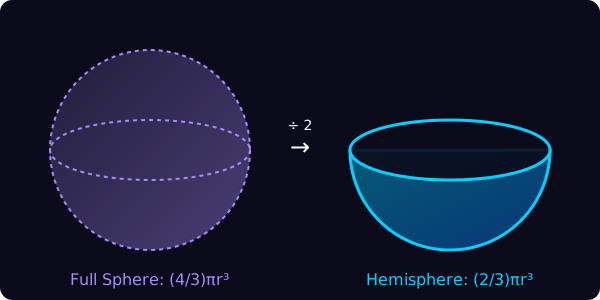
That’s it. The (2/3) isn’t arbitrary — it falls directly out of cutting a sphere in half. If you want to dig into the calculus behind the sphere formula itself, Khan Academy’s geometry section has a great walkthrough using integration. But for everyday calculations, just remember (2/3)πr³ and you’re set. You might also want to check our guide on understanding pi, the hidden constant to see why π shows up in all these round shapes.
Quick formula reference
| What you know | Formula |
|---|---|
| Radius (r) | V = (2/3)πr³ |
| Diameter (d) | V = (2/3)π(d/2)³ = (π × d³) / 12 |
| Circumference (C) | r = C / (2π), then V = (2/3)πr³ |
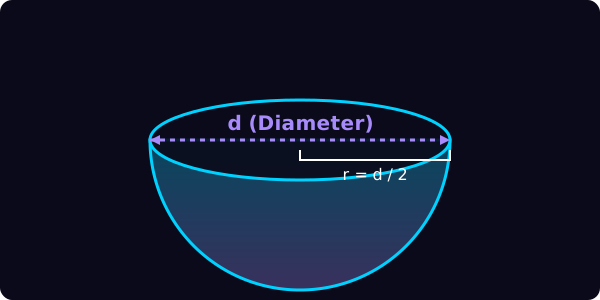
I personally find it easier to measure diameter and divide by two. Trying to find the exact center of a round object to measure the radius directly? Annoying. Just measure straight across the widest point. If you agree, you might also find our guide on how to find the radius of a cylinder very useful.
Worked Example 1: A Stainless Steel Mixing Bowl (Metric)
This is the example I use when I’m explaining hemispheres to anyone, because everyone has a bowl.
Object: A medium stainless steel mixing bowl Measured diameter: 24 cm → radius = 12 cm
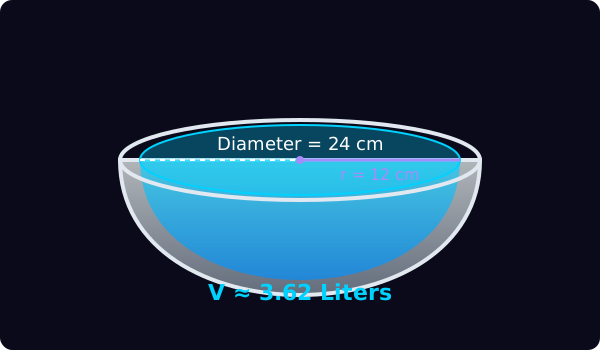
Step 1: Cube the radius. 12³ = 12 × 12 × 12 = 1,728 cm³
Step 2: Multiply by π. 1,728 × 3.14159 = 5,428.67 cm³
Step 3: Multiply by 2/3. 5,428.67 × (2/3) = 3,619.11 cm³
Step 4: Convert to liters (1 L = 1,000 cm³). 3,619.11 ÷ 1,000 = 3.62 liters
That tracks. Most medium mixing bowls hold about 3–4 liters. The bowl isn’t a perfect hemisphere — the walls are slightly steeper near the rim — but the math gets you within 5–10%. Close enough for cooking.
Worked Example 2: A Dome Skylight (Imperial)
I helped a friend spec out a polycarbonate dome skylight for his workshop last summer. The opening was 30 inches across — a perfect hemisphere shape sitting on a flat flange.
Object: Acrylic dome skylight Diameter: 30 in → radius = 15 in
Step 1: Cube the radius. 15³ = 15 × 15 × 15 = 3,375 in³
Step 2: Multiply by π. 3,375 × 3.14159 = 10,602.88 in³
Step 3: Multiply by 2/3. 10,602.88 × (2/3) = 7,068.58 in³
Step 4: Convert to gallons (1 US gal = 231 in³). 7,068.58 ÷ 231 = 30.60 gallons
Step 5: Convert to cubic feet (1 ft³ = 1,728 in³). 7,068.58 ÷ 1,728 = 4.09 ft³
Why did we need this? He was calculating the air volume above the skylight to size a vent fan. The hemisphere added about 4 cubic feet of space that wasn’t accounted for in the original room volume estimate. Small, but it mattered for the BTU calculation. If you’re doing similar calculations, you can explore other volume and surface area formulas for your space.
Worked Example 3: A Hemispherical Water Tank
Here’s the thing — hemispherical tanks are more common than people realize. The bottom of many vertical cylindrical tanks is a hemisphere (called a “dished head” or “hemispherical head” in engineering). I’ve run into this calculating usable volume in brewery tanks and water storage systems.
Object: Small hemispherical bottom section of a water tank Interior diameter: 1.2 m → radius = 0.6 m
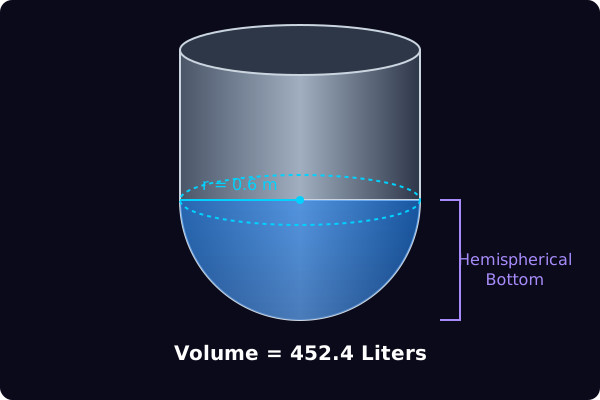
Step 1: Cube the radius. 0.6³ = 0.6 × 0.6 × 0.6 = 0.216 m³
Step 2: Multiply by π. 0.216 × 3.14159 = 0.6786 m³
Step 3: Multiply by 2/3. 0.6786 × (2/3) = 0.4524 m³
Step 4: Convert to liters (1 m³ = 1,000 L). 0.4524 × 1,000 = 452.4 liters
So the hemispherical bottom alone holds about 452 liters. Most people forget to add this to the main cylindrical section when they estimate total tank capacity. If you’re calculating the full tank — cylinder body plus hemispherical bottom — check out our guide on how to calculate water tank capacity at home to see how the cylindrical parts are handled. I’ve seen people underestimate their tank capacity by 15–20% because they ignored the dished ends.
Bonus Example: A Decorative Garden Gazing Ball
This one’s just fun. My neighbor has one of those mirrored gazing balls in her garden. I asked if I could measure it. She looked at me like I was nuts. Worth it.
Object: 12-inch diameter garden gazing ball (hollow, but let’s calculate the full hemisphere) Diameter: 12 in → radius = 6 in
V = (2/3) × π × 6³ V = (2/3) × π × 216 V = (2/3) × 678.58 V = 452.39 in³
Convert to gallons: 452.39 ÷ 231 = 1.96 gallons
So half of that gazing ball could hold just under 2 gallons of water. Not that you’d want to. But now you know.
Hemisphere vs. Half Hemisphere — Don’t Get Tripped Up
I see this confusion more than I should. A “half hemisphere” is a quarter of a sphere — not the same thing at all.
| Shape | Fraction of Sphere | Formula |
|---|---|---|
| Full Sphere | 1 | (4/3)πr³ |
| Hemisphere | 1/2 | (2/3)πr³ |
| Quarter Sphere | 1/4 | (1/3)πr³ |
If someone asks you for the “volume of half a hemisphere,” they probably mean a quarter-sphere. Just divide the hemisphere formula by 2:
V(quarter-sphere) = (1/3)πr³
But always double-check what they actually mean. Context matters.
What If You Only Know the Circumference?
Sometimes you can’t easily measure the diameter — like if you’re wrapping a tape measure around a dome or a bowl’s rim. No problem. The circumference of the circular base is C = 2πr, so:
r = C / (2π)
Then plug that radius into V = (2/3)πr³.
Quick example: A round planter with a circumference of 94.2 cm.
r = 94.2 / (2 × 3.14159) = 94.2 / 6.2832 = 15.0 cm
V = (2/3) × π × 15³ = (2/3) × π × 3,375 = (2/3) × 10,602.88 = 7,068.58 cm³ ≈ 7.07 liters
Common Mistakes I See All the Time
Forgetting to halve the diameter. The formula uses radius, not diameter. I’ve graded homework where students plugged 20 cm straight into r³ when the diameter was 20 cm. That gives you 8× the correct answer. Huge error.
Using the sphere formula instead. If you use (4/3)πr³, you’ve calculated a full sphere. Your answer will be exactly double. Easy to catch if you sanity-check against real life, but easy to miss if you’re just cranking numbers.
Mixing units. Radius in centimeters but expecting liters directly? Doesn’t work. You get cm³ first, then divide by 1,000 for liters. Keep your units consistent and convert at the end. I always recommend writing units next to every number in your calculation — it’s a habit that catches mistakes before they cost you.
How a Hemisphere Relates to a Cylinder and Cone
This is one of my favorite math relationships. Take a cylinder, a hemisphere, and a cone — all with the same radius and the same height (where height = radius for the hemisphere and cone). Their volumes have a beautiful ratio:
- Cone: (1/3)πr³
- Hemisphere: (2/3)πr³
- Cylinder: πr³
That’s a 1 : 2 : 3 ratio. The hemisphere is always exactly double the cone and two-thirds of the cylinder. Read more on this amazing relationship in why a cone’s volume is exactly 1/3 of a cylinder. And if you’re curious about the cylinder itself, our explainer on what is a cylinder goes over its geometric properties.
I actually demonstrated this once with a plastic cone, a bowl, and a cylindrical vase, all roughly the same radius. Filled the cone with rice, poured it into the bowl — needed exactly two cones to fill it. Three cones for the cylinder. Math works.
Frequently Asked Questions
What is the volume of a hemisphere formula?
V = (2/3)πr³, where r is the radius of the hemisphere. That’s exactly half the volume of a full sphere.
How do you find the volume of a hemisphere with diameter?
Divide the diameter by 2 to get the radius, then use V = (2/3)πr³. Or use the shortcut: V = (πd³)/12. Same answer either way — I just find the two-step version harder to mess up.
What’s the volume of a hemisphere with a radius of 7 cm?
V = (2/3) × π × 7³ = (2/3) × π × 343 = (2/3) × 1,077.57 = 718.38 cm³. That’s about 0.72 liters — roughly the volume of a cereal bowl.
Is the volume of a hemisphere exactly half the volume of a sphere?
Yes. Always. No exceptions. If V(sphere) = (4/3)πr³, then V(hemisphere) = (1/2)(4/3)πr³ = (2/3)πr³. I get asked this a lot, and I think the doubt comes from people second-guessing whether “hemisphere” includes the flat circular base or not. It doesn’t matter — volume is volume. The flat face doesn’t add interior space.
What is the difference between a hemisphere and a half hemisphere?
A hemisphere is half a sphere. A “half hemisphere” — if we take the term literally — is a quarter of a sphere, with volume (1/3)πr³. This trips up almost everyone the first time they see it. If a problem says “half hemisphere,” read it carefully and figure out if they mean a quarter-sphere or just a hemisphere described loosely.
How do I calculate the volume of a hemispherical bowl?
Measure the inner diameter across the top of the bowl. Divide by 2 for the radius. Then use V = (2/3)πr³. Keep in mind that most bowls aren’t perfect hemispheres — they’re usually slightly deeper or shallower — so your answer will be approximate. For everyday use (like figuring out serving sizes), it’s close enough.
Can I use a cylinder volume calculator for a hemisphere?
Not directly, since a cylinder and a hemisphere have different formulas. But you can use our online cylinder volume calculator for the cylindrical portion of a tank and then calculate the hemispherical end separately. Add the two together for a total.
What units does hemisphere volume come out in?
Whatever cubic unit you fed in. Radius in cm → volume in cm³. Radius in inches → volume in in³. Radius in meters → volume in m³. Then convert: 1,000 cm³ = 1 liter, 231 in³ = 1 US gallon, 1 m³ = 1,000 liters. I always recommend doing the math in one unit system and converting at the very end.
How is the hemisphere formula derived?
It comes from the sphere volume formula, V = (4/3)πr³, which itself is derived using calculus (integrating circular cross-sections from the base to the top). Halving the sphere formula gives V = (2/3)πr³.
Why is the hemisphere volume (2/3)πr³ and not (2/3)πr²h?
Because for a hemisphere, the height is the radius — they’re the same value. So h = r, and (2/3)πr²h becomes (2/3)πr² × r = (2/3)πr³. You’ll sometimes see textbooks write it the long way to show the connection to other solid formulas, but in practice, the single-variable version is what everyone uses.