Guides · May 21, 2026
Concrete for Round Pillars: Calculate Cubic Yards and Bags
Calculate concrete needed for round pillars and structural piers. Uses V = pi r squared h to output cubic yards, cubic metres and premix bag counts.

- Concrete Calculations for Cylindrical Pillars: A Real-World Blueprint
- The Core Formula: Breaking Down the Cylinder
- The Big Trap: Mixing Your Units
- Step-by-Step Guide: How to Calculate Round Pillar Concrete
- Step 1: Measure Your Physical Dimensions
- Step 2: Convert to Your Base Unit
- Step 3: Run the Formula
- Step 4: Multiply by the Number of Pillars
- Step 5: Account for Waste (The Professional Margin)
- Worked Example 1: Front Porch Pillars (Metric System)
- Step 1: Calculate the volume of one pillar
- Step 2: Multiply by 4 pillars
- Step 3: Add our 10% waste margin
- Worked Example 2: Structural Basement Column & Bag Count (Imperial)
- Step 1: Convert dimensions to feet
- Step 2: Calculate volume in cubic feet
- Step 3: Convert to Cubic Yards (Yardage)
- Step 4: Add the 10% safety buffer
- Step 5: Convert to Bags of Concrete Mix
- Worked Example 3: Backyard Deck Pier Footings (Real-World Project)
- Step 1: Convert units to feet
- Step 2: Compute volume for one pier hole
- Step 3: Multiply by your 6 structural piers
- Step 4: Add the 10% job site waste factor
- Step 5: Convert to Yards and Sacks
- Cylinder Volume Weight Reference Table
- Pro-Tips for Pouring Round Columns
- Frequently Asked Questions
- How many 80-lb bags of concrete are in a cubic yard?
- How do I calculate concrete yardage for a round pillar?
- Does a round pillar require more concrete than a square column?
- How do I calculate the volume of a hollow round pillar or a pipe?
- How to calculate concrete for an uneven hole in the ground?
- References and Authority Resources
Concrete Calculations for Cylindrical Pillars: A Real-World Blueprint
I still remember my first big DIY disaster. I was building a backyard deck and needed to pour six round concrete footings. I eyeballed the depth, guessed how many bags of concrete mix I needed, and bought twelve 80-pound bags from the hardware store.
I ran out of wet concrete halfway through the fourth pier.
There I was, sweat dripping into my boots, staring at half-filled cardboard Sonotubes while the mix was already setting. I had to rush back to the store in a mud-covered truck, buy more bags, and frantically mix them before the cold joints ruined my foundation. It was a complete mess.
That day, I learned a lesson I’ll never forget: when you’re working with concrete, guessing is a financial and structural sin.
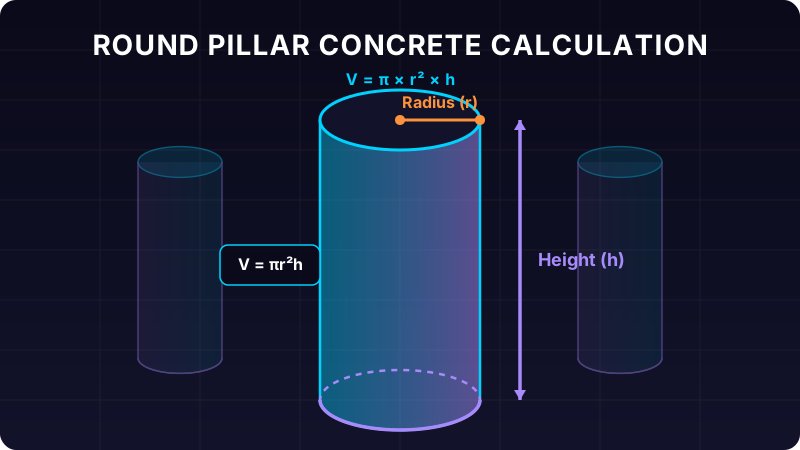
To figure out how to calculate concrete for round pillars, you just need a single geometric formula: Volume = π × r² × h. If you know the radius ($r$) of your column and its total height ($h$), you can pinpoint exactly how many cubic yards, cubic meters, or individual bags of concrete you need.
Let’s say you have one structural post that is 12 inches in diameter (6-inch radius) and 8 feet tall. By converting everything to feet, your math looks like this:
- Radius = 0.5 ft
- Volume = 3.14159 × 0.5² × 8 = 6.28 cubic feet
Since a standard 80-lb bag yields about 0.6 cubic feet, you’ll need roughly 11 bags. Simple, right?
In this guide, I’m going to pull back the curtain on the math behind structural columns. We’ll look at the core cylindrical column concrete formula, break down real-world scenarios step-by-step, figure out round pillar yardage calculation, and map out a bulletproof cement bag calculator round post system so you never get caught empty-handed on pour day. (For commercial construction column estimation, you can also check our guide on concrete column volume estimation.)
The Core Formula: Breaking Down the Cylinder
Before you go ordering a transit mixer truck or loading up your flatbed with concrete sacks, you need to understand the shape you’re dealing with. A round pillar is nothing more than a geometric cylinder.
To find its volume, we take the surface area of the circular base and multiply it by the height or depth of the column.
- Volume = π × r² × h
Where:
- π (Pi): We use 3.14159 for absolute precision.
- r (Radius): The distance from the absolute center of your round pillar to its outside edge. It is exactly half of the total diameter.
- h (Height or Depth): The vertical measurement of the pillar, from the bottom of the ground footing to the very top of the pour.
Here is a quick tip from someone who has messed this up: always measure the diameter first, then divide by two to get your radius. Why? Because finding the exact dead center of a hollow tube or hole with a tape measure is incredibly annoying. Measuring from edge to edge (the diameter) is much easier and highly accurate. If you already have your measurements and want an instant readout without pulling out a scratch pad, you can use our cylinder volume using diameter or cylinder volume using radius specialized pages to double-check your numbers.
The Big Trap: Mixing Your Units
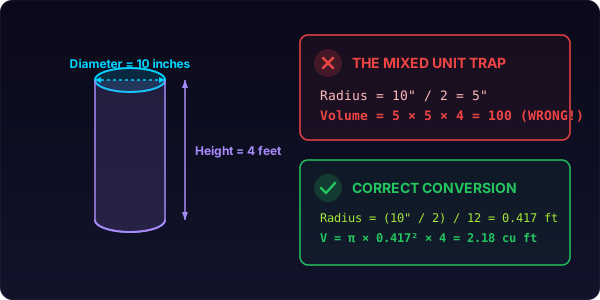
If there is one mistake I see professional builders and DIYers make constantly, it’s mixing inches and feet, or centimeters and meters, within the same equation.
If your pillar is 10 inches in diameter and 4 feet deep, you cannot just multiply 5 × 5 × 4. Your math will be completely broken. You must convert every single dimension into the same unit before starting.
- For imperial jobs, convert your inches to feet by dividing by 12.
- For metric jobs, convert your centimeters to meters by dividing by 100.
Step-by-Step Guide: How to Calculate Round Pillar Concrete
Let’s lay down a universal checklist you can use for any job site, whether you’re building a structural commercial arcade or a simple mailbox post.
Step 1: Measure Your Physical Dimensions
Grab your tape measure. Write down two numbers for your pillar:
- The total diameter (across the circle).
- The total height or depth (from bottom to top).
Step 2: Convert to Your Base Unit
If you want your answer in cubic feet (which helps for bag calculations), convert your inches to feet. If you want your final answer in cubic meters, make sure every measurement is in meters.
- Radius (in feet) = (Diameter in inches / 2) / 12
Step 3: Run the Formula
Multiply Pi (3.14159) by the radius squared ($r \times r$), then multiply that by the height ($h$). This gives you the raw volume for a single pillar.
Step 4: Multiply by the Number of Pillars
If you have 4, 6, or 20 identical columns, multiply your single-pillar result by the total number of structures.
Step 5: Account for Waste (The Professional Margin)
Never, ever buy the exact mathematical amount of concrete your formula spits out. Holes dug into real earth are never perfectly smooth cylinders; they cave in slightly, flare at the bottom, or compress when wet concrete hits them. Cardboard tubes can bulge. Some material always gets left inside the mixer or spilled on the grass.
I always recommend adding a 10% waste factor to your final number. Multiply your total volume by 1.10 before buying material. Trust me, it’s a lot cheaper to throw away half a bag of leftover dry mix than it is to deal with an under-poured foundation structural failure.

Worked Example 1: Front Porch Pillars (Metric System)
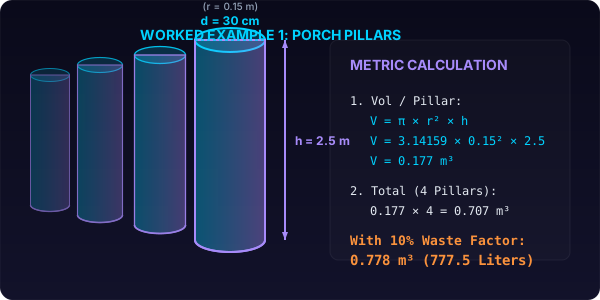
Let’s look at a practical scenario. Imagine you’re pouring a set of 4 decorative and structural front porch pillars for a custom home build.
You’ve set up your vertical formwork tubes. I’ve measured these common forms before—they are usually standard sizes. For this project, let’s assume each pillar has a diameter of 30 centimeters and stands 2.5 meters tall.
Dimensions per pillar:
- Diameter = 30 cm -> Radius = 15 cm = 0.15 meters
- Height = 2.5 meters
- Number of pillars = 4
Let’s calculate the volume in cubic meters and see how many liters of wet concrete we need to mix.
Step 1: Calculate the volume of one pillar
- Volume = π × r² × h
- Volume = 3.14159 × (0.15)² × 2.5
- Volume = 3.14159 × 0.0225 × 2.5
- Volume = 0.17671 cubic meters per pillar
Step 2: Multiply by 4 pillars
- Total Volume = 0.17671 × 4 = 0.70684 cubic meters
Step 3: Add our 10% waste margin
- Order Volume = 0.70684 × 1.10 = 0.77752 m³
If you are mixing this by hand using raw components (cement, sand, gravel, and water) or buying from a micro-batch supplier who tracks volume in liters, you can convert cubic meters directly to liters. Since 1 m³ = 1,000 liters:
- Total Liters Needed = 0.77752 × 1,000 = 777.5 Liters
You can easily verify these liquid metrics using our specialized volume in liters layout tool to make sure your batch sheets match your site measurements. If you are interested in household water storage calculations, check out our water tank capacity guide.
Worked Example 2: Structural Basement Column & Bag Count (Imperial)
Now, let’s tackle a heavy structural job inside an existing residential property. You are retrofitting a load-bearing wall and replacing it with a heavy-duty structural basement column.
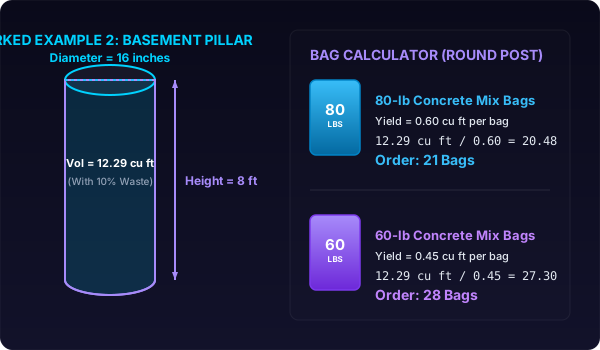
The engineer’s print calls for a single concrete cylinder poured inside a heavy steel jacket or a thick cardboard form. The dimensions required are a diameter of 16 inches and a height of 8 feet.
Dimensions:
- Diameter = 16 inches -> Radius = 8 inches
- Height = 8 feet
- Count = 1 column
For this project, a concrete delivery truck isn’t practical because of the indoor basement location. You’re going to haul premixed bags from the local yard and mix them in a portable barrel mixer on-site. Let’s figure out your round pillar yardage calculation and your cement bag calculator round post requirements.
Step 1: Convert dimensions to feet
- Radius = 8 inches / 12 inches/foot = 0.66667 feet
- Height = 8 feet
Step 2: Calculate volume in cubic feet
- Volume = π × r² × h
- Volume = 3.14159 × (0.66667)² × 8
- Volume = 3.14159 × 0.44445 × 8
- Volume = 11.1701 cubic feet
Step 3: Convert to Cubic Yards (Yardage)
Ready-mix companies and gravel yards sell material by the “yard” (which means cubic yard). To convert cubic feet to cubic yards, you divide by 27 (since 1 yard × 1 yard × 1 yard = 3 ft × 3 ft × 3 ft = 27 cubic feet).
- Cubic Yards = 11.1701 / 27 = 0.41371 cubic yards
Step 4: Add the 10% safety buffer
- Total Yardage to Order/Mix = 0.41371 × 1.10 = 0.45508 cubic yards
- Total Cubic Feet with Buffer = 11.1701 × 1.10 = 12.2871 cubic feet
Step 5: Convert to Bags of Concrete Mix
Go to any big-box store, and you’ll generally find two primary options for structural concrete mix bags: 80-pound bags and 60-pound bags.
- A standard 80-lb bag yields exactly 0.60 cubic feet of wet concrete.
- A standard 60-lb bag yields exactly 0.45 cubic feet of wet concrete.
Let’s calculate both so you can buy whatever is in stock:
- Using 80-lb bags = 12.2871 cu ft / 0.60 cu ft/bag = 20.48 → 21 bags
- Using 60-lb bags = 12.2871 cu ft / 0.45 cu ft/bag = 27.30 → 28 bags
Look at that jump. If you hadn’t included your 10% safety buffer, your raw math would say $11.1701 \div 0.60 = 18.6$ bags, meaning you’d buy 19 bags. You would have run short right at the top of the metal jacket. If you are handling large domestic layout builds, you can skip manual step-conversions using our volume in cubic feet or cylinder tank calculator portals.
Worked Example 3: Backyard Deck Pier Footings (Real-World Project)
Let’s look at a very common suburban project: pouring structural underground piers for an elevated wood deck.
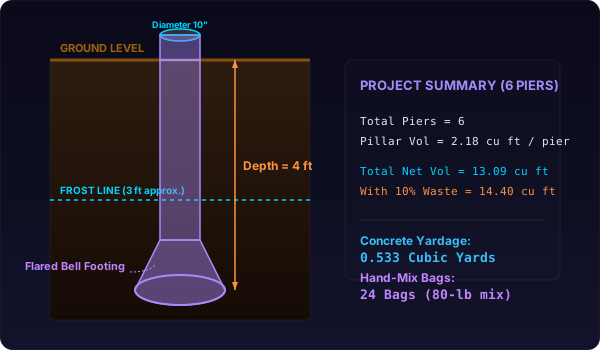
I’ve built dozens of these, and the trick here is going deep enough to get below your local frost line so freezing ground doesn’t heave your deck into the sky. Let’s say your local building inspector requires you to dig down 4 feet deep. You are installing 6 structural piers, and you are using cardboard tube forms with a diameter of 10 inches.
Project Specifications:
- Number of Pier Holes = 6
- Diameter per hole = 10 inches -> Radius = 5 inches
- Depth per hole = 4 feet
Let’s figure out the total volume so you can decide if you want to mix this by hand or call a local short-load concrete truck.
Step 1: Convert units to feet
- Radius = 5 inches / 12 inches/foot = 0.41667 feet
- Depth (Height) = 4 feet
Step 2: Compute volume for one pier hole
- Volume per pier = π × r² × h
- Volume per pier = 3.14159 × (0.41667)² × 4
- Volume per pier = 3.14159 × 0.17361 × 4
- Volume per pier = 2.1817 cubic feet
Step 3: Multiply by your 6 structural piers
- Total Raw Volume = 2.1817 × 6 = 13.0902 cubic feet
Step 4: Add the 10% job site waste factor
- Total Job Site Volume = 13.0902 × 1.10 = 14.3992 cubic feet
Step 5: Convert to Yards and Sacks
Let’s see what this looks like in standard market metrics:
- Total Cubic Yards = 14.3992 / 27 = 0.5333 cubic yards
- Total 80-lb Bags Needed = 14.3992 / 0.60 = 23.99 → 24 bags
Here’s my personal observation on a job like this: 24 bags of 80-pound concrete weighs nearly 2,000 pounds. That’s a full ton of material sitting in the bed of your truck, and mixing 24 bags by hand in a wheelbarrow will completely break your back before you even lay your first floor joist.
For anything over half a cubic yard, I always look into renting a tow-behind mixer or calling a local volumetric mix truck that only charges you for what you pour. If your project scales even larger, consider using our master cylinder volume calculator to process multiple structural components simultaneously.
Cylinder Volume Weight Reference Table
When you’re dealing with structural round columns, knowing the volume tells you how much material to buy, but knowing the weight tells you whether your trailer springs are going to snap or if your underlying soil can support the load. (If you are working with curved domes or spherical bases, see our guide on how to find the volume of a hemisphere.)
Standard wet cured concrete weighs roughly 150 pounds per cubic foot (2,400 kg/m³). Here is a fast lookup reference sheet for common round column sizes, calculated with our precise internal metrics and audited via standard Engineering Toolbox parameters. All values below represent a 1-foot column height to make scaling easy:
| Column Diameter (Inches) | Radius (Feet) | Volume per Foot of Height (cu ft) | Wet Concrete Weight per Foot (lbs) | 80-lb Sacks per Foot of Height |
|---|---|---|---|---|
| 6 in | 0.250 ft | 0.196 cu ft | 29.5 lbs | 0.33 bags |
| 8 in | 0.333 ft | 0.349 cu ft | 52.4 lbs | 0.58 bags |
| 10 in | 0.417 ft | 0.545 cu ft | 81.8 lbs | 0.91 bags |
| 12 in | 0.500 ft | 0.785 cu ft | 117.8 lbs | 1.31 bags |
| 14 in | 0.583 ft | 1.069 cu ft | 160.4 lbs | 1.78 bags |
| 16 in | 0.667 ft | 1.396 cu ft | 209.4 lbs | 2.33 bags |
| 18 in | 0.750 ft | 1.767 cu ft | 265.1 lbs | 2.95 bags |
| 24 in | 1.000 ft | 3.142 cu ft | 471.2 lbs | 5.24 bags |
If you ever need to translate these volumetric masses into direct transportation numbers for logistics planning, feel free to run your exact custom dimensional targets through our integrated cylinder weight calculator portal.
Pro-Tips for Pouring Round Columns
I’ve spent years working around wet concrete, and calculating the math is only half the battle. Here are a couple of practical site secrets that most instructional manuals leave out:
- Brace Your Forms Intensely: Cardboard tube forms (like Sonotubes) are amazingly convenient, but wet concrete is incredibly heavy and exerts massive outward hydrostatic pressure. If your round post extends more than two feet above the ground surface, build a solid wooden 2x4 collar box framework around it and stake it firmly into the earth. If you don’t, your round pillar can lean, bow, or turn into an oval.
- The Rebar Displacement Myth: Technically, structural steel rebar placed inside your cylindrical column takes up physical space, reducing the amount of wet concrete mixture required. However, in my experience, the volume of a few strands of #4 or #5 rebar is so small it falls well within your rounding errors. Never subtract rebar volume from your order sheet—your 10% waste buffer covers structural steel displacements easily.
- Check for Tapered Footings: Many structural codes require a flared “bell footing” at the absolute bottom of an underground round post to spread out the weight load. A bell footing is shaped like a cone section, not a cylinder. If your project includes these, you’ll want to review our structural comparison data at our cylinder vs cone volume engineering page or learn why a cone’s volume is exactly 1/3 of a cylinder to make sure your lower footing allocations match up with your shaft values.
Frequently Asked Questions
How many 80-lb bags of concrete are in a cubic yard?
I get this question all the time from folks working on backyard structures. There are exactly 45 bags of 80-pound concrete mix in one standard cubic yard. Since one cubic yard equals 27 cubic feet, and a single 80-lb bag yields 0.60 cubic feet, the math is straightforward: $27 \div 0.60 = 45$. If you are using 60-lb bags instead, you will need 60 bags to clear a full yard ($27 \div 0.45 = 60$).
How do I calculate concrete yardage for a round pillar?
To find the exact yardage, you first compute the total volume in cubic feet using the formula $V = \pi \times r^2 \times h$ (with all dimensions scaled in feet). Once you have your total cubic feet result, simply divide that final number by 27. For example, a 15-cubic-foot pillar requires $15 \div 27 = 0.56$ cubic yards of concrete.
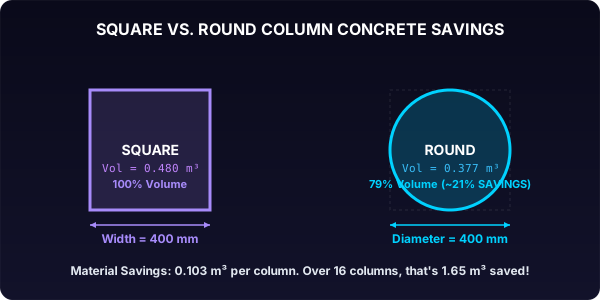
Does a round pillar require more concrete than a square column?
No, it actually requires less. This is a common point of confusion on construction sites. A round pillar with a 12-inch diameter has a cross-sectional area of about 0.79 square feet. A square column that is 12 inches by 12 inches has an area of exactly 1.0 square foot. The square option takes up roughly 21% more structural volume, meaning it requires significantly more concrete mix than its round alternative.
How do I calculate the volume of a hollow round pillar or a pipe?
If you are pouring concrete inside an outer sleeve but there is a central core or structural column running up the middle that stays dry, you have a hollow cylinder. To find this volume, you calculate the total volume of the large outer cylinder and subtract the volume of the internal inner space. If you want to skip the multi-step algebraic pen work, you can let our automated hollow cylinder calculator process your nested measurements instantly or read our pipe volume guide for practical tips.
How to calculate concrete for an uneven hole in the ground?
This trips up almost everyone. If you didn’t use a smooth cardboard form liner and instead poured directly into a ragged hole bored out by a mechanical tractor auger, your dimensions are going to be completely irregular. I always measure the widest part of the hole and use that as my official diameter in the formula. Furthermore, instead of using a standard 10% safety cushion, increase your project waste buffer to 20% or 25% to account for subterranean voids and dirt wall compression.
References and Authority Resources
To explore the core geometric properties of cylindrical forms or cross-verify technical industrial weights and standards, consult these global academic frameworks:
- Detailed Cylinder Geometries: Wolfram MathWorld Cylinder Analysis
- Foundational Geometric Space Computations: Khan Academy Geometry Coursework
- Mass, Volume, and Material Weight Metrics: The Engineering Toolbox Concrete Data Sheets