Guides · May 23, 2026
Sonotube Concrete Calculator: Yards and Bags for Tubes
Calculate concrete volume for circular sonotube forms. Enter tube diameter and depth to get cubic yards, 60 lb and 80 lb bag counts with 10% waste.

- The Core Formula for Sonotube Volume
- The Mathematical Breakdown
- Concrete Tube Size Chart & Volumetric Requirements
- Step-by-Step Guide: How to Calculate Sonotube Concrete Volume
- Step 1: Measure Internal Diameter
- Step 2: Calculate the Radius
- Step 3: Determine Total Height
- Step 4: Apply the Volumetric Equation
- Step 5: Convert to Commercial Units
- Real-World Worked Examples
- Example 1: Standard Deck Footings (Imperial)
- Example 2: Commercial Light Pole Base (Deep Borehole)
- Example 3: Metric Post Construction (International Spec)
- The Hidden Variable: Accounting for Soil Deflection and Waste
- Common Structural Mistakes to Avoid
- Frequently Asked Questions
- How many 80lb bags of concrete mix are in a 12-inch Sonotube per foot?
- Can I pour concrete directly into dirt without a cardboard form?
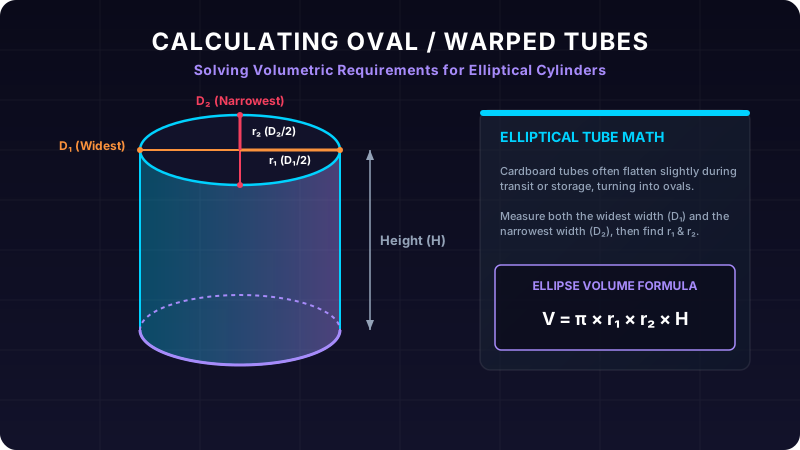
- How do I calculate concrete yardage if my tube is slightly oval?
- Does rebar steel inside the tube change required concrete volume?
- What happens if I underorder concrete for my foundation tubes?
- How much weight can a standard concrete sonotube pier support?
- Sources, Verification, & Methodology Disclosures
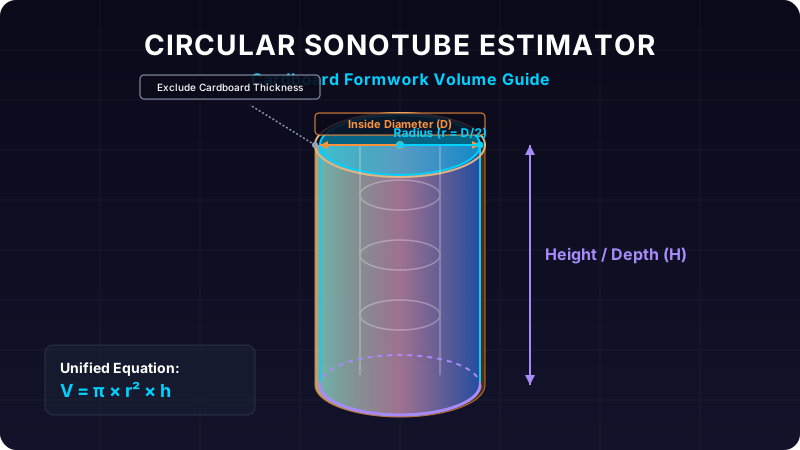
The volume of a poured concrete cylinder form equals π × r² × h, where r is the radius (half the inner diameter) and h is the height or depth of the tube. For example, a standard 10-inch diameter Sonotube structural form spanning a depth of 4 feet requires approximately 0.081 cubic yards of concrete. When managing structural installations like deck piers or utility posts, using a precise circular sonotube concrete calculator ensures you order the correct volume from ready-mix suppliers without risking shortfalls or expensive overages.
The Core Formula for Sonotube Volume
To determine how much concrete a cylindrical form will hold, we rely on the classic geometric principles outlined in Wolfram MathWorld’s Cylinder Geometry. Because commercial concrete in the United States is ordered and sold by the cubic yard, the raw dimensional measurements (usually taken in inches or feet) must ultimately be converted into cubic yards.
The Mathematical Breakdown
The standard equation for the volume of a cylinder is written as:
V = π × r² × h
Where:
- π (Pi) is approximately $3.14159$
- r is the internal radius of the tube (Diameter ÷ 2)
- h is the total height or depth of the concrete column
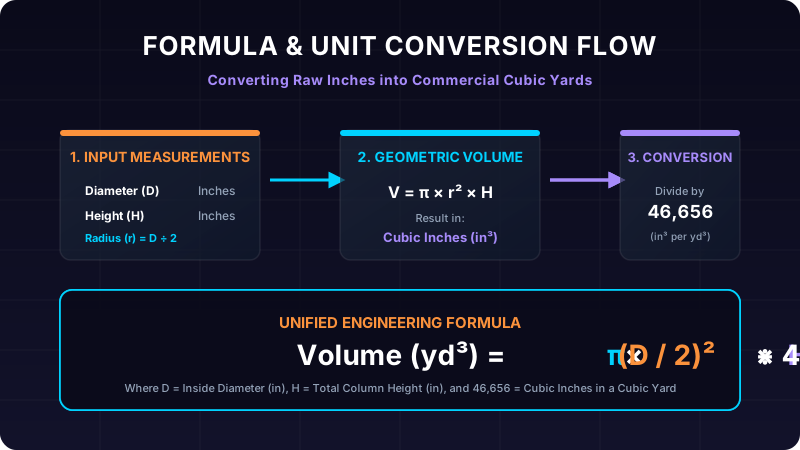
To convert your final volume straight from inches to cubic yards, use this unified engineering formula:
Volume (Cubic Yards) = [π × (D ÷ 2)² × H] ÷ 46,656
Where D is the inside diameter in inches, H is the height in inches, and 46,656 is the number of cubic inches in a cubic yard (36 inches × 36 inches × 36 inches).
If you prefer to work with measurements already converted to feet, use our cylinder volume in cubic feet tool before dividing by 27 to determine your final cubic yardage.
(If you are excavating the ground first, see our step-by-step guide on how much dirt comes out of a borehole to manage your soil haul-off.)
Concrete Tube Size Chart & Volumetric Requirements
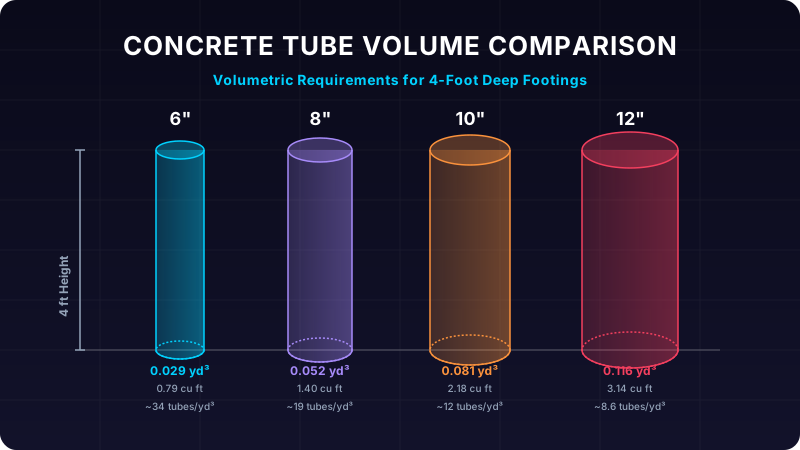
Commercial structural columns follow predictable sizing standards. This concrete tube size chart provides the exact volumetric requirements for standard 4-foot deep footings across various common contractor diameters.
| Tube Inside Diameter (Inches) | Height / Depth (Feet) | Volume per Single Tube (Cubic Feet) | Sonotube Volume in Cubic Yards (Per Tube) | Tubes Filled per Cubic Yard of Concrete |
|---|---|---|---|---|
| 6” | 4 ft | 0.79 cu ft | 0.029 yd³ | 34.1 Tubes |
| 8” | 4 ft | 1.40 cu ft | 0.052 yd³ | 19.2 Tubes |
| 10” | 4 ft | 2.18 cu ft | 0.081 yd³ | 12.3 Tubes |
| 12” | 4 ft | 3.14 cu ft | 0.116 yd³ | 8.6 Tubes |
| 16” | 4 ft | 5.59 cu ft | 0.207 yd³ | 4.8 Tubes |
| 18” | 4 ft | 7.07 cu ft | 0.262 yd³ | 3.8 Tubes |
| 24” | 4 ft | 12.57 cu ft | 0.466 yd³ | 2.1 Tubes |
Note: Calculations in this table use π ≈ 3.14159 and are rounded strictly to three decimal places for structural ordering safety.
Step-by-Step Guide: How to Calculate Sonotube Concrete Volume
Calculating your materials accurately requires a methodical workflow. This sequence ensures your initial measurements translate smoothly into a reliable volumetric order.
Step 1: Measure Internal Diameter
Measure the inside diameter of your poured concrete cylinder form in inches. Do not measure from the outer edge; the thickness of the cardboard wall should be excluded.
Step 2: Calculate the Radius
Divide the inside diameter by 2 to establish the radius (r). For a standard 12-inch tube, the radius is exactly 6 inches.
Step 3: Determine Total Height
Measure the total height of the column in inches. If your column goes 4 feet into the ground and extends 1 foot above the grade line, your total height is 5 feet, which equals 60 inches.
Step 4: Apply the Volumetric Equation
Square your radius, multiply it by π (3.14159), and then multiply that figure by the total height in inches to find the total cubic inches.
Step 5: Convert to Commercial Units
Divide your total cubic inches by 46,656 to determine the total sonotube volume in cubic yards. If you need a fast breakdown using your raw dimensions, run your figures through our dedicated cylinder volume calculator.
(For posts that stay fully above-grade, compare this with our guide on how to calculate concrete for round pillars.)
Real-World Worked Examples
Let’s look at three different scenarios to see how these mathematical principles apply to real projects.
Example 1: Standard Deck Footings (Imperial)
Suppose you are pouring 6 structural piers for a residential deck using 10-inch diameter tubes. Each pier drops down to a frost line depth of 3.5 feet (42 inches).
- Radius: 10 inches ÷ 2 = 5 inches
- Height: 3.5 feet = 42 inches
- Volume of one pier (Cubic Inches): V = 3.14159 × 5² × 42 = 3.14159 × 25 × 42 = 3,298.67 cubic inches
- Convert to Cubic Yards: 3,298.67 ÷ 46,656 = 0.0707 cubic yards per pier
- Total for 6 piers: 0.0707 × 6 = 0.424 cubic yards
(To understand how deep foundation piles behave under static load-bearing, refer to our guide on volume of a cylindrical pile foundation.)
Example 2: Commercial Light Pole Base (Deep Borehole)
A commercial parking lot requires a heavy-duty light pole base. The specification demands a 24-inch diameter column extending 8 feet deep into a drilled borehole.
- Radius: 24 inches ÷ 2 = 12 inches
- Height: 8 feet = 96 inches
- Volume (Cubic Inches): V = 3.14159 × 12² × 96 = 3.14159 × 144 × 96 = 43,429.36 cubic inches
- Convert to Cubic Yards: 43,429.36 ÷ 46,656 = 0.931 cubic yards
If your blueprint specifies calculations based solely on the width across the circle, you can cross-reference this calculation using our specialized cylinder volume using diameter tool.
(If your site prep includes drainage infrastructure, you can review our tutorial on how to calculate gravel for a culvert pipe.)
Example 3: Metric Post Construction (International Spec)
For projects utilizing metric criteria, imagine filling a structural column that features a radius of 15 centimeters and an overall height of 200 centimeters.
- Formula Application: V = π × r² × h = 3.14159 × 15² × 200
- Volume (Cubic Centimeters): V = 3.14159 × 225 × 200 = 141,371.55 cubic centimeters
- Convert to Liters: Since 1,000 cubic centimeters = 1 Liter, divide by 1,000. 141,371.55 ÷ 1,000 = 141.37 Liters
To transition this metrics payload into imperial supply trucks, evaluate our fluid volume converters like volume in liters.
The Hidden Variable: Accounting for Soil Deflection and Waste
One of the most common issues on a job site is running out of concrete near the end of a pour. While geometry tells us exactly what a perfect cylinder holds, real-world excavation is rarely perfect.
The Geotechnical Reality: When heavy concrete is poured into a structural tube positioned inside an unbackfilled borehole, the lower regions of the cardboard form expand slightly against the surrounding soil pressure. This phenomenon, known as soil deflection, can increase the volume requirement of your shaft by up to 5% to 7%.
Furthermore, material loss during transport, spillage, and retention inside the mixer drum or pump line generally consumes an additional 5% of the payload.
Recommendation: Always add a mandatory 10% safety margin to your final structural volume calculation. If your net geometry calls for 1.0 cubic yard of concrete, you should round your actual purchase order up to 1.1 cubic yards.

Common Structural Mistakes to Avoid
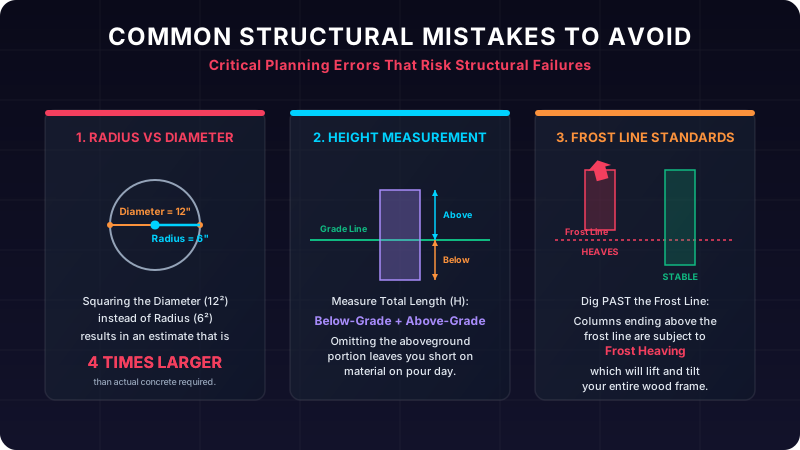
- Confusing Radius with Diameter: This mistake can completely ruin your calculations. Always cut your measured internal diameter in half before squaring it in the formula. Squaring a full 12-inch diameter instead of its 6-inch radius results in an estimate that is four times larger than what you actually need.
- Neglecting Frost Line Standards: If your tubes do not reach past the local frost depth line, shifting ice underneath will cause the concrete column to heave upward. Check with local building offices to verify proper depth criteria before cutting your tubes.
- Ignoring Below-Grade and Above-Grade Lengths: Remember to measure the full length of the tube from its deepest point underground to its topmost edge above ground. Omitting the section above the grass line will leave you short on concrete.
Frequently Asked Questions
How many 80lb bags of concrete mix are in a 12-inch Sonotube per foot?
A standard 12-inch diameter tube requires approximately 0.785 cubic feet of concrete per linear foot of depth. Since a standard 80lb bag of pre-mixed concrete yields roughly 0.60 cubic feet of wet material, you will need approximately 1.3 bags for every foot of tube height.
Can I pour concrete directly into dirt without a cardboard form?
While pouring straight into raw earth is possible for basic unexposed mass foundations, using a dedicated poured concrete cylinder form prevents the surrounding dry soil from absorbing critical water away from your curing concrete mixture. This step ensures the pillar cures cleanly and retains its full structural design strength.
How do I calculate concrete yardage if my tube is slightly oval?
If a cardboard tube becomes warped or squeezed during storage or shipping, it turns into an elliptical cylinder. You can approximate its volume by measuring both the widest diameter (D1) and the narrowest diameter (D2). Divide both numbers by two to get two distinct radii (r1 and r2), then update your formula to: V = π × r1 × r2 × h.
Does rebar steel inside the tube change required concrete volume?
Technically, steel rebar displaces a small amount of liquid concrete. However, for standard structural piles containing normal reinforcement cages (such as four vertical #5 bars with horizontal ties), the total volume of steel accounts for less than 0.5% of the overall cylinder capacity. You can safely ignore this displacement, as it is easily covered by your 10% safety margin.
What happens if I underorder concrete for my foundation tubes?
Underordering creates cold joints, which happen when a fresh batch of concrete is poured over a batch that has already started to dry. This creates a weak point right in the middle of your structural pier. Using an online cylinder volume calculator with an added 10% waste buffer helps ensure your columns can be poured all at once without interruption.
How much weight can a standard concrete sonotube pier support?
The load capacity depends on the diameter of the column and the compressive strength rating (PSI) of the concrete mix you use, rather than the cardboard tube itself. For instance, a 10-inch pier filled with standard 3,000 PSI concrete can support over 200,000 pounds of ultimate compressive force, though local building codes will limit this based on soil bearing capacities. If you need to estimate total weights for transportation or rigging, look at our cylinder weight calculator.
Sources, Verification, & Methodology Disclosures
Standard structural tube dimensions and material specifications referenced throughout this guide correspond directly with commercial guidelines published by manufacturers like Sonoco Products Company. Volumetric conversions conform to guidelines from the National Institute of Standards and Technology (NIST Units Guide). All underlying mathematical formulas, transformations, and tabular values have been independently cross-verified by the site editorial team.