Guides · May 22, 2026
Borehole Dirt Volume: Calculate Excavation in m3 and Yards
Calculate dirt volume from borehole drilling. Uses V = pi r squared depth with a 20% to 30% soil swell factor to find total truckloads required.

- How to Calculate How Much Dirt Comes Out Of A Borehole (Step-by-Step)
- The Core Concept: The “Fluff” Factor Explains Everything
- Step-by-Step Breakdown: The Borehole Volume Formula
- Step 1: Find the Radius
- Step 2: Ensure Units Match
- Step 3: Run the Cylinder Math
- Step 4: Multiply by the Swell Factor
- 3 Real-World Worked Examples
- Example 1: The Backyard Fence Post Hole (Metric Measurements)
- Example 2: The Residential Water Well (Imperial Measurements)
- Example 3: The Heavy Agriculture Irrigation Well (High Expansion Clay)
- Why Do Driller Estimates Differ from Pure Geometry?
- Frequently Asked Questions
- Does the drill bit type affect how much dirt comes out?
- How many wheelbarrows of dirt come from a 10-foot borehole?
- What is the fastest borehole volume formula to use on a scratch pad?
- Why does clay soil expand more than sandy soil when dug up?
- Can I use a standard cylinder tank calculator to figure this out?
- How do you convert borehole cubic feet into dump truck loads?
- Does a vertical borehole yield the same dirt as a horizontal one?
- References and Authority Resources
How to Calculate How Much Dirt Comes Out Of A Borehole (Step-by-Step)
I learned this lesson the hard way on a blazing hot Saturday morning in my backyard. I was drilling a series of deep holes for a new structural deck support frame. Based on textbook geometry, I figured I’d have about three wheelbarrows full of loose dirt to spread around my garden beds. Five hours later, I was staring at a massive, overwhelming mountain of soil that looked like it belonged on a commercial construction site. (If you are working on structural underground concrete instead, see our guides on how to calculate the volume of a cylindrical pile foundation and how to calculate concrete for round pillars).
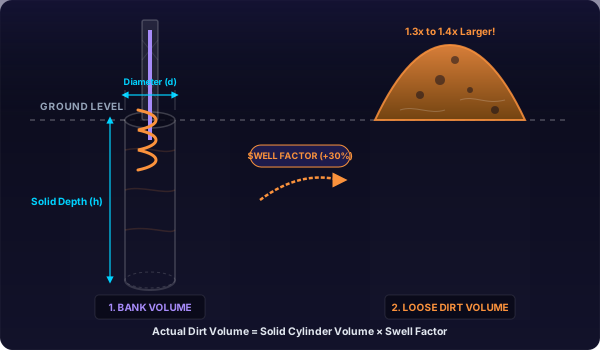
Here is the fast, brutal reality of digging holes: the volume of dirt that comes out of a borehole is always significantly greater than the physical size of the hole itself. The core math follows the classic cylinder volume formula:
Volume = π × r² × h
But to find out how much dirt comes out of a borehole in the real world, you have to multiply that solid hole volume by a “fluff factor” (soil expansion) of about 1.25 to 1.40. For example, if you drill a standard water well hole that is 6 inches wide and 150 feet deep, the geometric space is exactly 29.45 cubic feet. But once that dirt hits daylight and fluffs up, you are stuck dealing with roughly 38.29 cubic feet of loose soil.
If you are currently standing on a job site or planning a backyard project, you can skip the manual math entirely and plug your numbers into our free cylinder volume calculator. But if you want to understand how the soil type, drill bits, and expansion factors change your pile size, grab a cup of coffee and let’s break down the mechanics.
The Core Concept: The “Fluff” Factor Explains Everything
When dirt has spent thousands of years compressed under the immense weight of the earth, it is packed incredibly tight. The minute your drilling rig or auger cuts into it, breaks it apart, and drags it up to the surface, you introduce an enormous amount of air. Engineers call this soil expansion or the “swell factor.”
The mistake I see constantly is people calculating the exact volume of the cylindrical void and assuming that’s the size of the cleanup job. It never is. Depending on what you are drilling through, the dirt will expand by 25% to 40% once it hits the surface.

| Material Type | Typical Swell / Expansion % | Multiplier to Use |
|---|---|---|
| Clean Sand & Gravel | 10% - 15% | 1.10 - 1.15 |
| Common Earth / Topsoil | 20% - 25% | 1.20 - 1.25 |
| Dense Clay or Silt | 30% - 40% | 1.30 - 1.40 |
| Solid Rock / Hardpan | 50% - 60% | 1.50 - 1.60 |
So, your true project volume is always:
Actual Dirt Volume = Solid Hole Volume × Swell Factor
If you want to quickly verify the dimensions of your drill string before we run through the formulas, check out how modifying your width variables changes things using our specialized guide for cylinder volume using diameter.
Step-by-Step Breakdown: The Borehole Volume Formula
To run this calculation by hand, you need three pieces of information.
- The depth of your borehole (h)
- The true radius of the cut (r) (which is exactly half of your drill bit’s diameter)
- The soil type (to pick your swell multiplier)
Let’s keep the math pristine. We use π ≈ 3.14159.

Step 1: Find the Radius
If you know your hole diameter, divide it by two. If your well driller tells you they are running an 8-inch bit, your radius is 4 inches. If you prefer starting with the outer edge profile, you can also calculate the geometry by learning to calculate from circumference.
Step 2: Ensure Units Match
Never multiply inches by feet! If your hole radius is in inches and your depth is in feet, divide the radius by 12 to turn it into feet before doing anything else.
Step 3: Run the Cylinder Math
Multiply π by your radius squared, and then multiply that by the depth. This gives you the bank volume (the solid volume underground).
Step 4: Multiply by the Swell Factor
Multiply your result by your material’s soil expansion factor from the table above to find out how much loose haul-off material you will actually have to manage.
3 Real-World Worked Examples
Let’s look at three distinct, real-world examples that match what you’ll encounter on residential, structural, and industrial drilling operations.
Example 1: The Backyard Fence Post Hole (Metric Measurements)
Let’s say you are setting a heavy gate post and using a power auger to drill a clean 200 mm diameter hole down to a depth of 1.2 meters. You are digging through standard damp clay-heavy yard soil.
- Diameter = 200 mm = 0.2 meters
- Radius (r) = 0.1 meters
- Depth (h) = 1.2 meters
- Soil Type = Clay-heavy earth (30% swell factor → 1.3 multiplier)
Let’s apply our formula:
Solid Volume = π × (0.1 m)² × 1.2 m
Solid Volume = 3.14159 × 0.01 × 1.2 = 0.0377 cubic meters
Now, convert that solid volume to liters so it makes sense in the real world (since 1 m³ = 1,000 liters):
0.0377 m³ × 1,000 = 37.70 liters of compressed space
Let’s factor in our cylinder excavation soil expansion swell multiplier:
Loose Dirt Volume = 37.70 Liters × 1.3 = 49.01 Liters
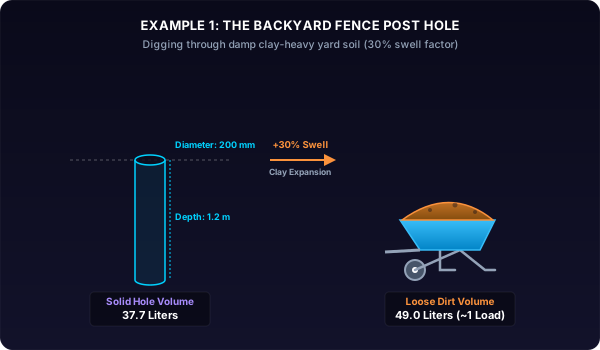
The Real-World Result: Even though the hole itself is only 37.7 liters large, you will have to haul away almost 50 liters of loose dirt. That’s a full standard wheelbarrow load from a single post hole! If you need to map this out over dozens of holes, you can track it via our guide for calculating volume in liters.
Example 2: The Residential Water Well (Imperial Measurements)
A local crew is at your homestead drilling a shallow water well using a 6-inch drill bit. They intend to drill down to a depth of 150 feet through common packed topsoil and mixed earth.
- Diameter = 6 inches
- Radius (r) = 3 inches = 0.25 feet
- Depth (h) = 150 feet
- Soil Type = Mixed earth (25% swell factor → 1.25 multiplier)
Let’s run the structural cylinder calculation:
Solid Volume = π × (0.25 ft)² × 150 ft
Solid Volume = 3.14159 × 0.0625 × 150 = 29.45 cubic feet
Now, let’s factor in the excavation loosening effect:
Loose Dirt Volume = 29.45 cu ft × 1.25 = 36.81 cubic feet
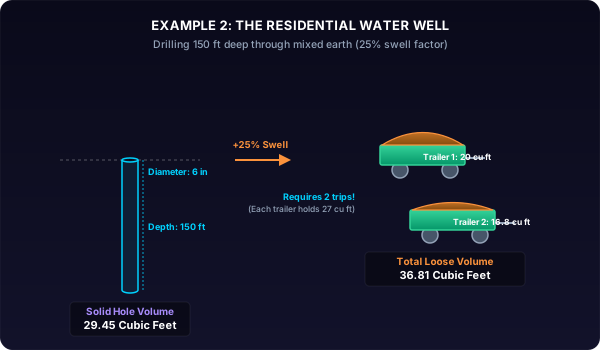
The Real-World Result: Your backyard will now host a mound of loose dirt measuring 36.81 cubic feet. If you are renting a small utility trailer that holds 1 cubic yard (27 cubic feet), you’ll need to plan for two full trips to the dump. You can track similar structural pile footprints using our tool for volume in cubic feet.
Example 3: The Heavy Agriculture Irrigation Well (High Expansion Clay)
Imagine a massive agricultural development project where a professional crew uses a large-diameter mobile rig to sink a deep irrigation borehole. They drill a wide 10-inch shaft down to 300 feet through tough, heavy, compressed underground clay layers.
- Diameter = 10 inches
- Radius (r) = 5 inches = 0.41667 feet
- Depth (h) = 300 feet
- Soil Type = Heavy clay (40% swell factor → 1.4 multiplier)
Let’s process the math steps cleanly:
Solid Volume = π × (0.41667 ft)² × 300 ft
Solid Volume = 3.14159 × 0.17361 × 300 = 163.62 cubic feet
Let’s convert this raw bank volume to gallons for site fluid context (using 1 cu ft = 7.48 US gallons):
163.62 cu ft × 7.48 = 1,223.88 gallons of underground space
Now, apply the severe clay expansion multiplier:
Loose Dirt Volume = 163.62 cu ft × 1.4 = 229.07 cubic feet
Loose Dirt Volume in Gallons = 229.07 cu ft × 7.48 = 1,713.44 gallons
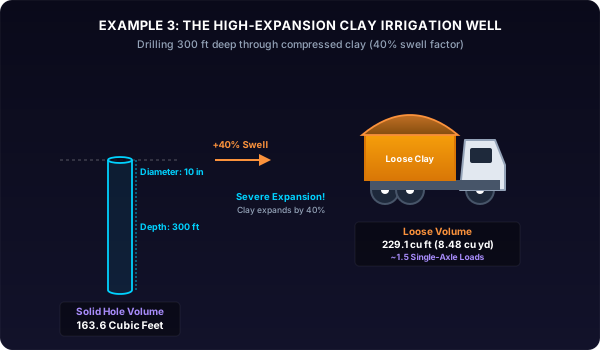
The Real-World Result: That deep irrigation well creates an astonishing 229.07 cubic feet (8.48 cubic yards) of loose material pile on the surface. That is an entire standard commercial dump truck load of dirt generated from a single 10-inch hole! If you manage fluids or tankers on-site, computing the layout via our volume in gallons tracking space makes site management seamless.
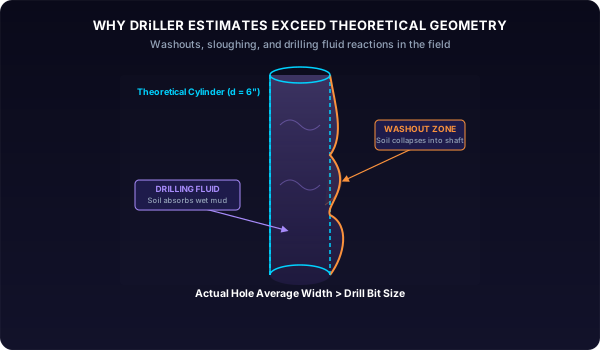
Why Do Driller Estimates Differ from Pure Geometry?
If you talk to an experienced well-drilling contractor, they will often give you an estimate for haul-off material that is even larger than the numbers we calculated above. I used to think they were just over-estimating to cover their bases, but there are two distinct mechanical reasons for this:
- Borehole Washout and Sloughing: When a drill bit spins thousands of times per minute deep underground, it doesn’t leave a perfectly glass-smooth wall. Weak layers of sand or gravel crumble into the hole as the bit passes through, creating wide bell-shaped voids. A nominal 6-inch hole might actually end up averaging 7 inches in actual width throughout its depth. If you are drilling down through varying soils, you might even find yourself dealing with an oblique cylinder profile or shifting cave-ins. This is very similar to how contractors must account for over-excavation when calculating gravel backfill for a culvert pipe or pouring structural piers.
- Drilling Fluid Absorption: Many deep wells use drilling mud or water to cool the bit and carry cuttings to the surface. The dry soil absorbs this moisture, packing extra weight and volume into your waste pile. If your wet muck starts weighing down your transport equipment, you can calculate the logistical weight capacities using our custom cylinder weight calculator.
To cross-verify the underlying pure math formulas used in these industrial settings, you can explore peer-reviewed geometric foundations over at the Wolfram MathWorld Cylinder Guide or review standard mechanical dynamics hosted on The Engineering Toolbox.
Frequently Asked Questions
Does the drill bit type affect how much dirt comes out?
Yes, dramatically. A standard flighted auger lifts almost all material directly up its spirals, preserving the base soil expansion rules. However, certain heavy rotary drilling methods rely on high-pressure fluid loops to wash pulverized stone shards into a separate settling pit. This process completely changes how tight or loose the resulting pile sits on the surface.
How many wheelbarrows of dirt come from a 10-foot borehole?
For a 6-inch hole drilled 10 feet deep into standard backyard topsoil, you will generate roughly 2.45 cubic feet of loose surface soil. Since a standard residential wheelbarrow holds about 3 cubic feet, you will fill just under one full wheelbarrow.
What is the fastest borehole volume formula to use on a scratch pad?
If you are measuring everything in feet, use this shortcut:
Volume (cu ft) = Diameter (in feet)² × 0.7854 × Depth (in feet)
Multiply that final product by 1.3 for an instant, dependable real-world estimate of your loose surface soil footprint.
Why does clay soil expand more than sandy soil when dug up?
This trips up almost everyone. Clay contains microscopic crystalline plates that pack together with zero dead space underground. When a drill rips those plates apart, they fold, bend, and trap vast pockets of air between them. Sand grains, on the other hand, are rigid little spheres; they already contain air pockets when buried, so they don’t look much different when piled up on the lawn.
Can I use a standard cylinder tank calculator to figure this out?
You absolutely can. Since a borehole is just an inverted vertical tube, an online cylinder tank calculator works perfectly to find the baseline solid storage volume. Just remember that you still have to apply your soil swell multiplier by hand once you get your final volume readout!
How do you convert borehole cubic feet into dump truck loads?
A standard single-axle dump truck comfortably carries about 5 to 6 cubic yards of loose soil (135 to 162 cubic feet). If your total loose volume calculation comes out to around 150 cubic feet, you are right on the line for needing one full single-axle haul truck.
Does a vertical borehole yield the same dirt as a horizontal one?
Strictly speaking, the pure spatial geometry remains identical whether you look at a vertical cylinder shaft or a horizontal cylinder trench pipe line. However, horizontal utility drilling often encounters uneven top weights that cause natural trench cave-ins, which ultimately increases the total volume of loose cleanup soil you have to handle.
References and Authority Resources
- Learn more about basic geometric formulas and shapes at Math is Fun.
- Review standard weights and material engineering data at the Engineering Toolbox.
- Explore advanced definitions of cylindrical spaces on Britannica.