Guides · May 15, 2026
Volume Unit Conversion Guide: cm3, Litres, Gallons, ft3
Convert volume units across metric and imperial systems. Includes exact multipliers for cm3 to litres, cubic inches to gallons, and m3 reference tables.

- A Complete Volume Unit Conversion Guide: cm³, Liters & Gallons
- Why These Three Units Keep Showing Up Everywhere
- The Core Conversion Factors You Actually Need
- Worked Example 1: A 2-Liter Soda Bottle (Metric to Everything)
- Worked Example 2: A 55-Gallon Steel Drum (Imperial to Metric)
- Worked Example 3: 1600 cc Motorcycle Engine Conversions
- The Mistake I See Constantly: US Gallons vs Imperial Gallons
- When to Use Which Unit
- Quick-Reference Conversion Table
- A Real Scenario: How Much Paint Do I Need?
- Common Conversion Mistakes (And How to Avoid Them)
- Frequently Asked Questions
- How many cm³ are in a liter?
- How do I convert cubic inches to gallons?
- Is cc the same as cm³?
- Why are US and UK gallons different?
- How do I convert m³ to gallons?
- What’s the easiest way to remember liter-to-gallon conversion?
- Can I use these conversions for any shape, not just cylinders?
- How many liters is a standard bathtub?
- What does “1 cm³ = 1 mL” actually mean?
A Complete Volume Unit Conversion Guide: cm³, Liters & Gallons
Here’s the short version: 1 liter = 1,000 cm³ = 0.2642 US gallons. That single line has saved me more time than I’d like to admit. I was once standing in a hardware store staring at a water tank labeled “50 liters” and trying to figure out if that was enough for my rooftop setup — which I’d measured in gallons. Pulled out my phone, did the math, and realized I needed about 13.2 gallons. Done. No stress.
But here’s the thing — most people trip up not because the math is hard, but because they mix up which conversion goes which way. Or they forget that a “gallon” in the US isn’t the same as a “gallon” in the UK. So let me walk you through the whole system, unit by unit, with real objects you can actually picture. If you want to skip straight to the numbers, convert dimensions directly with our cylinder volume in liters calculator, calculate US capacity with the cylinder volume in gallons calculator, or convert between systems using the liters to gallons converter.
Why These Three Units Keep Showing Up Everywhere
Cubic centimeters, liters, and gallons — these aren’t random. They show up because they each dominate a different context:
- Cubic centimeters (cm³ or cc): Medicine, engine displacement, small lab measurements. When your doctor says a syringe holds 5 cc, that’s 5 cm³.
- Liters (L): Beverages, fuel tanks, water storage, cooking — basically anything liquid in metric countries.
- Gallons (gal): Fuel, pools, water heaters, paint — the go-to in the US for anything bigger than a bottle.
I personally think the metric system makes conversions way easier (everything’s a power of 10), but if you live in the US or work with American specs, you will hit gallons. No way around it.
The Core Conversion Factors You Actually Need
Forget memorizing a giant table. These five relationships cover 90% of what you’ll ever need:
| Conversion | Factor |
|---|---|
| 1 liter | = 1,000 cm³ |
| 1 m³ | = 1,000 liters |
| 1 US gallon | = 3.785 liters |
| 1 US gallon | = 231 in³ |
| 1 ft³ | = 7.48 US gallons |
That’s it. Everything else is just chaining these together. Want cm³ to gallons? Go cm³ → liters → gallons. Want cubic inches to liters? Go in³ → gallons → liters (or use 1 in³ = 16.387 cm³ and then divide by 1,000).
I keep this list taped inside my toolbox. Seriously. It’s faster than Googling it every time.
Worked Example 1: A 2-Liter Soda Bottle (Metric to Everything)
Let’s start simple. You’ve got a 2-liter soda bottle — everyone’s seen one.
Liters to cm³:
2 L × 1,000 = 2,000 cm³
Liters to US gallons:
2 L ÷ 3.785 = 0.5283 gallons
So roughly half a gallon. That checks out — if you’ve ever poured a 2-liter bottle into a gallon jug, it fills it about halfway. I’ve done this at a barbecue and it’s a surprisingly good way to visualize the conversion.
Liters to cubic inches:
2,000 cm³ ÷ 16.387 = 122.05 in³
Or the other way: 0.5283 gal × 231 = 122.04 in³. Same answer (tiny rounding difference). Always a good sign when two paths give you the same number.
If you want to calculate volume in liters for any cylinder, that page does the conversion automatically.
Worked Example 2: A 55-Gallon Steel Drum (Imperial to Metric)
I helped a friend figure out how much rainwater his collection drum could hold. Standard 55-gallon drum — you see them everywhere.
Gallons to liters:
55 gal × 3.785 = 208.175 liters
That’s a lot of water. About 208 one-liter bottles.
Gallons to cm³:
208.175 L × 1,000 = 208,175 cm³
Let’s verify with the drum’s dimensions. A standard 55-gallon drum is roughly 57.15 cm (22.5 in) in diameter and 85.09 cm (33.5 in) tall. So the radius is 28.575 cm.
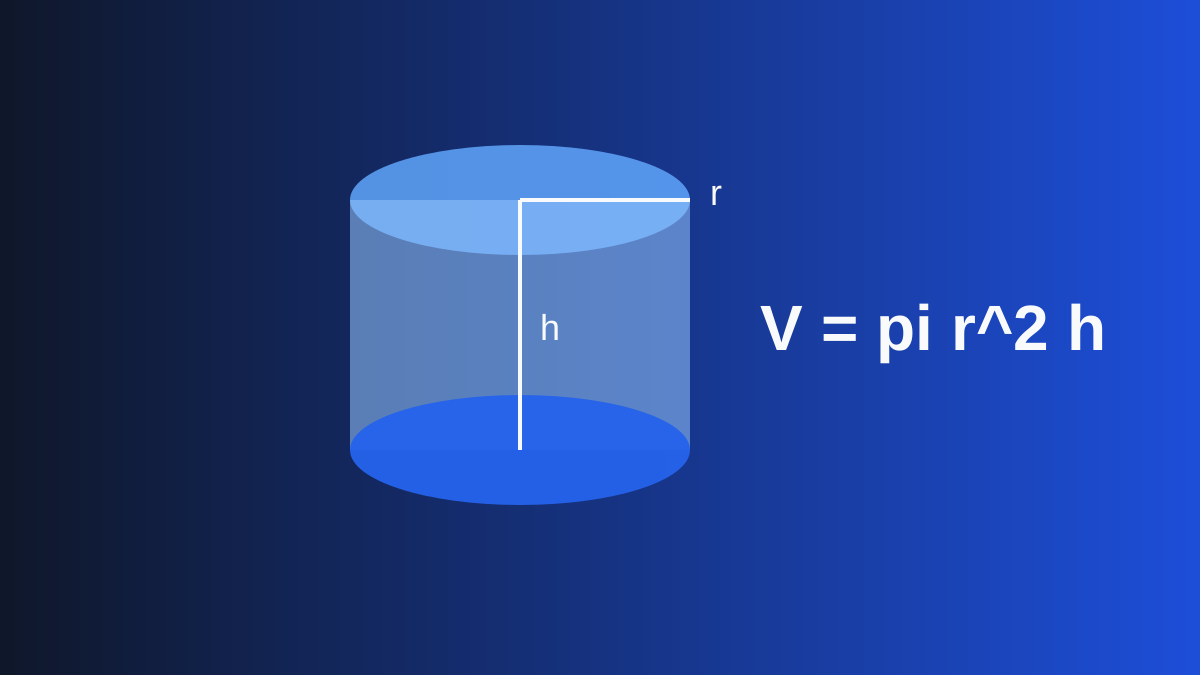
V = π × r² × h = π × 28.575² × 85.09
V = 3.14159 × 816.53 × 85.09
V = 3.14159 × 69,480.8
V = 218,246 cm³ ≈ 218.2 liters ≈ 57.7 gallons
Wait — that’s bigger than 55 gallons? Yep. The stated capacity is usable volume. The drum has a rolled rim at the top and a slight taper, so you lose some space. I see this confusion all the time. The geometric volume of the cylinder is always a bit more than the rated capacity. This is exactly why I always recommend calculating with actual internal dimensions when precision matters.
You can double-check any drum or tank with our cylinder tank calculator.
Worked Example 3: 1600 cc Motorcycle Engine Conversions
Engine displacement is always given in cc — which is just cm³ by another name. My neighbor rides a BMW R 1250 GS, and I got curious about the actual volume.
cc to liters:
1,254 cc ÷ 1,000 = 1.254 liters
cc to gallons:
1,254 ÷ 1,000 ÷ 3.785 = 0.3313 gallons
So the total swept volume of both cylinders is barely a third of a gallon. When you think about it that way, internal combustion engines are kind of incredible — they’re making serious power from a tiny amount of space.
If you’re into engine math, the engine cylinder volume calculator lets you plug in bore and stroke directly.
The Mistake I See Constantly: US Gallons vs Imperial Gallons
This trips up almost everyone who works with international specs. A US gallon and an Imperial (UK) gallon are not the same.
| Unit | Liters | cm³ |
|---|---|---|
| 1 US gallon | 3.785 L | 3,785 cm³ |
| 1 Imperial gallon | 4.546 L | 4,546 cm³ |
The Imperial gallon is about 20% bigger. So if you’re reading a British spec sheet that says “10 gallons,” that’s 45.46 liters, not 37.85. I once ordered a fuel tank based on US gallon assumptions when the manufacturer was using Imperial. Off by almost 8 liters. Lesson learned.
Unless someone specifies “Imperial,” assume US gallons in American contexts. Everywhere else, ask.
When to Use Which Unit
Here’s my personal rule of thumb after years of doing this:
Use cm³ (or cc) when:
- You’re dealing with medical doses (syringes, IV bags)
- Engine displacement
- Small lab volumes
- 3D printing (infill volume)
- Anything under about 1 liter
Use liters when:
- Water tanks, aquariums, fuel tanks
- Cooking and recipes (metric)
- Anything between 1 and 1,000 liters
- You’re in a metric country and talking to normal humans
Use gallons when:
- You’re in the US and dealing with pools, hot tubs, water heaters
- Paint (sold by the gallon in the US)
- Fuel economy discussions
- Anything where US building codes or specs apply
For quick conversions on any cylindrical container, our free cylinder volume calculator outputs in all of these units at once.
Quick-Reference Conversion Table
I made this table for my own workshop. It covers the conversions people actually need:
| From | To cm³ | To Liters | To US Gallons | To in³ |
|---|---|---|---|---|
| 1 cm³ | 1 | 0.001 | 0.000264 | 0.06102 |
| 1 liter | 1,000 | 1 | 0.2642 | 61.024 |
| 1 US gallon | 3,785 | 3.785 | 1 | 231 |
| 1 in³ | 16.387 | 0.01639 | 0.004329 | 1 |
| 1 ft³ | 28,317 | 28.317 | 7.481 | 1,728 |
| 1 m³ | 1,000,000 | 1,000 | 264.2 | 61,024 |
Pro tip: if you’re ever stuck, just remember that 1 cm³ = 1 mL. That single fact bridges the gap between “volume of a shape” and “volume of a liquid” in metric. It’s elegant. I wish Imperial had something that clean.
For full breakdowns in specific units, check out volume in gallons, volume in cubic inches, or our detailed guide on how to calculate cylinder capacity in gallons and cubic feet.
A Real Scenario: How Much Paint Do I Need?
Let me tie this together with something practical. You’ve got a cylindrical column in a lobby — 30 cm in diameter, 3 meters tall — and you need to know how much paint it takes to coat the inside (let’s say it’s a hollow decorative column and you’re sealing it).
First, the interior volume:
Radius = 15 cm, height = 300 cm
V = π × 15² × 300 = π × 225 × 300 = 3.14159 × 67,500 = 212,058 cm³
In liters: 212,058 ÷ 1,000 = 212.06 liters
In gallons: 212.06 ÷ 3.785 = 56.03 gallons
Now, you don’t need to fill it with paint — you just need to know the interior surface area for coating. But I included the volume because the contractor asked me “how many gallons would it take to fill this thing?” and I happened to know. The point is: converting between units is the easy part once you know the volume in any unit.
If you’re working with a hollow cylinder calculator, you can get the wall volume directly.
Common Conversion Mistakes (And How to Avoid Them)
Mistake 1: Dividing when you should multiply (or vice versa). Going from liters to cm³? Multiply by 1,000 (you’re going to a smaller unit, so the number gets bigger). Going from cm³ to liters? Divide. I always do a gut check: “Should this number be bigger or smaller?”
Mistake 2: Forgetting to cube your length conversions. 1 meter = 100 cm. But 1 m³ ≠ 100 cm³. It’s 100 × 100 × 100 = 1,000,000 cm³. This one catches even engineers off guard sometimes.
Mistake 3: Mixing up radius and diameter. Formulas use radius. Measurements in the real world usually give you diameter (it’s easier to measure across something than to find the center). Always divide by 2 first. Our cylinder volume using diameter page handles this automatically if you don’t want to think about it.
For the official definitions of these units, NIST’s units page is the gold standard reference.
Frequently Asked Questions
How many cm³ are in a liter?
Exactly 1,000. No rounding needed — it’s a clean, defined relationship. One of the few conversions that’s truly precise.
How do I convert cubic inches to gallons?
Divide by 231. So if you’ve got a cylinder that’s 462 in³, that’s exactly 2 gallons. I use this one constantly when sizing pipe volumes on job sites, and it’s worth just committing 231 to memory.
Is cc the same as cm³?
Yes, identical. “cc” is shorthand for cubic centimeter. You’ll hear it more in medical and automotive contexts (“a 600cc engine,” “a 10cc syringe”), but it’s the exact same unit. I get this question all the time, and it’s nice that the answer is simple for once.
Why are US and UK gallons different?
Historical reasons, basically. The US gallon was based on the wine gallon (231 in³), while the Imperial gallon was defined as the volume of 10 pounds of water (277.42 in³). The Imperial gallon is about 20% larger. If you’re reading specs from a British source, don’t assume it matches US measurements. I learned this the hard way — see my fuel tank story above.
How do I convert m³ to gallons?
Multiply by 264.172. So 1 m³ = about 264 US gallons. A cubic meter of water weighs 1,000 kg (1 metric ton), which is a useful sanity check. If you’re working with large tanks, m³ is usually the most practical unit. Khan Academy’s geometry section has solid background on volume concepts if you want to dig deeper.
What’s the easiest way to remember liter-to-gallon conversion?
I think of it this way: roughly 4 liters per gallon. The exact number is 3.785, but “about 4” gets you in the ballpark instantly. For quick estimates — like figuring out if a 20-liter tank is big enough for a 5-gallon need — that mental shortcut is plenty.
Can I use these conversions for any shape, not just cylinders?
Absolutely. Volume is volume — the unit conversion is the same whether you’re dealing with a cylinder, a cube, a sphere, or an irregular blob. The formula to calculate volume changes by shape, but once you have a number in cm³, converting to liters or gallons works the same way every time.
How many liters is a standard bathtub?
A typical bathtub holds about 150–300 liters (40–80 US gallons), depending on size. I measured mine once by timing the faucet flow rate — it took about 12 minutes at roughly 15 L/min, giving me about 180 liters. Not exactly scientific, but close enough to settle a water bill argument.
What does “1 cm³ = 1 mL” actually mean?
It means the metric system was designed so that volume of a shape (cm³) and volume of a liquid (mL) use the same scale. One cubic centimeter of space holds exactly one milliliter of water. This is genuinely one of the most elegant things about metric. There’s no equivalent shortcut in Imperial — you just have to memorize that 231 in³ = 1 gallon and move on. Math is Fun has a nice visual breakdown of this concept.
Still working out a volume conversion? Plug your dimensions into our online cylinder volume calculator and get results in cm³, liters, gallons, and more — instantly.