Guides · June 11, 2026
Transformer Cylindrical Tank Oil Capacity: Sizing Formulas
Calculate transformer tank oil volume in litres and gallons. Uses V = pi r squared h with temperature expansion factors for conservator tank sizing.

- The formula and the numbers you need
- Worked example 1 — metric conservator tank
- Worked example 2 — imperial conservator tank
- Worked Example 3: Oil Thermal Expansion and Conservator Size
- Sizing the conservator: where the “10% rule” comes from
- Worked example 4 — the horizontal-cylinder fill trap (edge case)
- Common mistakes to avoid
- Frequently Asked Questions
- What is the formula for transformer tank oil capacity?
- How much does transformer oil expand when heated?
- Why is the conservator tank cylindrical?
- How big should a conservator tank be?
- How do I calculate the oil weight from tank volume?
- Does the oil level rise evenly in a horizontal conservator?
- What temperature range should I use for expansion calculations?
- Can I use this method for ester or synthetic transformer fluids?
- Sources and verification
The oil capacity of a cylindrical transformer tank is found with the standard cylinder volume formula, V = π × r² × h, where r is the internal radius and h is the length (or height) of the tank. Quick check: a horizontal conservator tank 0.6 m in diameter (radius 0.3 m) and 1.5 m long holds π × 0.3² × 1.5 ≈ 0.424 m³, or about 424 litres when completely full. Most working tanks are only part-filled, and the oil itself expands as the transformer heats up — both of which we’ll calculate below.
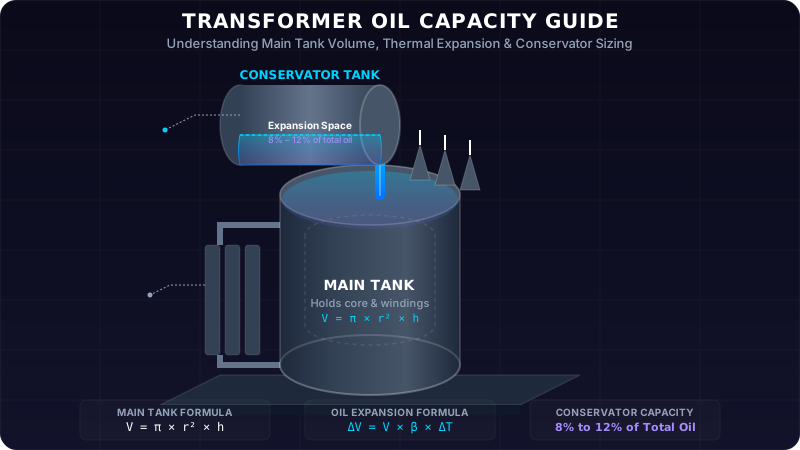
Transformer oil capacity matters for two practical jobs: estimating how much insulating oil a tank holds for filling, top-ups or spill containment, and sizing the conservator tank so it can absorb the oil’s thermal expansion without overflowing. This guide covers both, with metric and imperial worked examples and the expansion math that ties them together. You can verify any result with our free cylinder volume calculator.
The formula and the numbers you need
A transformer’s main tank, radiators and conservator are all essentially cylinders, so the volume work starts from one equation:
V = π × r² × h

V = volume
r = internal radius (diameter ÷ 2)
h = length of a horizontal tank, or height of a vertical one
π ≈ 3.14159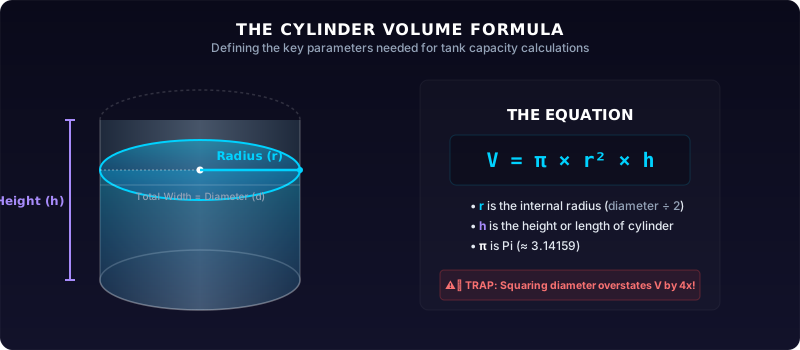
A few reference values used throughout this article:
| Quantity | Value | Source / note |
|---|---|---|
| Mineral transformer oil expansion coefficient (β) | ≈ 0.00075 / °C | Typical mineral oil; published range ~0.00065–0.00078 / °C |
| Transformer oil density | ≈ 0.87 kg/L | Varies ~0.86–0.89 by oil type and temperature |
| Conservator tank size | 8–12% of total oil volume | Common utility design practice |
| Unit conversions | 1 m³ = 1,000 L · 1 L = 1,000 cm³ · 1 US gal = 3.785 L = 231 in³ · 1 in³ = 16.387 cm³ | NIST-standard conversions |
One point students and new engineers mix up constantly: the formula needs the radius, not the diameter. Transformer drawings almost always label the diameter, so halve it before squaring. Squaring the wrong number quadruples your error. Additionally, if a transformer is installed on a sloped pad or tilted during transport, the oil geometry changes; in those cases, you should refer to our guide on how to calculate the volume of a partially filled tilted cylinder.
Worked example 1 — metric conservator tank
A horizontal cylindrical conservator measures 0.6 m diameter × 1.5 m long.
- Radius: r = 0.6 ÷ 2 = 0.3 m
- V = π × r² × h = 3.14159 × (0.3)² × 1.5
- V = 3.14159 × 0.09 × 1.5
- V = 3.14159 × 0.135 = 0.424 m³ (rounded to 3 decimals)
- In litres: 0.424 m³ × 1,000 = 424 L
If that tank were filled with oil, its weight would be 424 L × 0.87 kg/L ≈ 369 kg. You can run the same density step on any tank with our cylinder weight calculator, or get the litre figure directly with the volume in litres tool.
Worked example 2 — imperial conservator tank
A conservator measures 24 inches diameter × 48 inches long.
- Radius: r = 24 ÷ 2 = 12 in
- V = 3.14159 × (12)² × 48
- V = 3.14159 × 144 × 48
- V = 3.14159 × 6,912 = 21,714.6 in³
- In US gallons: 21,714.6 ÷ 231 = 94.0 gallons
- Cross-check in litres: 21,714.6 × 16.387 ÷ 1,000 = 355.8 L (and 94.0 gal × 3.785 = 355.8 L ✓)
The two conversion routes agree, which is the sanity check worth doing every time. Convert any cylinder result with the volume in gallons tool.
Worked Example 3: Oil Thermal Expansion and Conservator Size
This is the part purely geometric guides skip. Oil expands measurably with temperature, and the conservator exists to swallow that expansion. The relationship is:
ΔV = V × β × ΔT

ΔV = change in oil volume
V  = oil volume at the starting temperature
β  = volumetric expansion coefficient (≈ 0.00075 / °C for mineral oil)
ΔT = temperature rise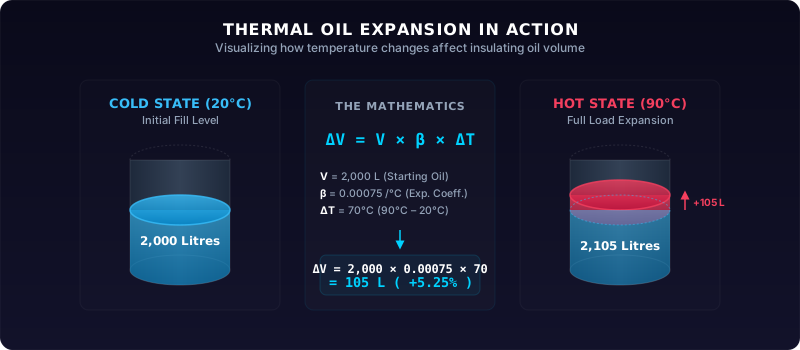
Take a transformer holding 2,000 L of mineral oil, filled cold at 20 °C, with a top-oil temperature of 90 °C at full load. ΔT = 70 °C.
- ΔV = 2,000 × 0.00075 × 70
- ΔV = 2,000 × 0.0525
- ΔV = 105 L
So the oil swells by 105 litres — about 5.25% of its volume — over that 70 °C swing. That single number is what a conservator has to accommodate. The expansion coefficient used here aligns with published values for mineral insulating oil (see Engineering Toolbox: volumetric thermal expansion).
Sizing the conservator: where the “10% rule” comes from
Utility practice sizes a conservator at roughly 8–12% of total oil volume, and that rule of thumb falls straight out of the expansion math above.
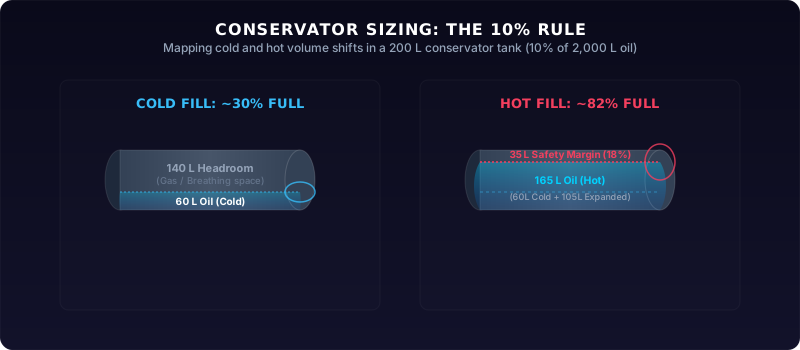
For our 2,000 L transformer, a 10% conservator is 200 L. Conservators are typically kept around 25–30% full of oil when cold, so it starts with about 60 L inside and 140 L of headroom. The oil’s 105 L expansion flows up into that space, leaving the conservator about 165 L full (≈ 82%) at peak temperature — comfortably below overflowing, with margin for a hotter day or a higher load.
That’s the whole logic of the rule: conservator volume must exceed the calculated expansion (ΔV), with a safety margin — practitioners commonly add 30–40% on top of the bare expansion figure. Size it too small and the oil bulges the main tank or vents through the breather; size the main tank volume right and the 8–12% band almost always covers it. Because the conservator is itself a cylinder, you can size a candidate tank with the cylinder tank calculator.
Worked example 4 — the horizontal-cylinder fill trap (edge case)
Here’s the mistake that catches people reading an oil-level gauge: in a horizontal cylindrical conservator, the oil level does not rise in proportion to volume. The cross-section is a circle, so geometry is nonlinear.
At exactly half the diameter, the tank is exactly 50% full by volume — that part is intuitive. But at one-quarter of the diameter in depth, the tank holds far less than 25% of its volume, because the circular cross-section is narrow near the bottom. To get the volume at a given oil depth d in a horizontal cylinder of radius r and length L, you need the circular-segment formula:
V = L × [ r² × cos⁻¹((r − d) / r) − (r − d) × √(2rd − d²) ]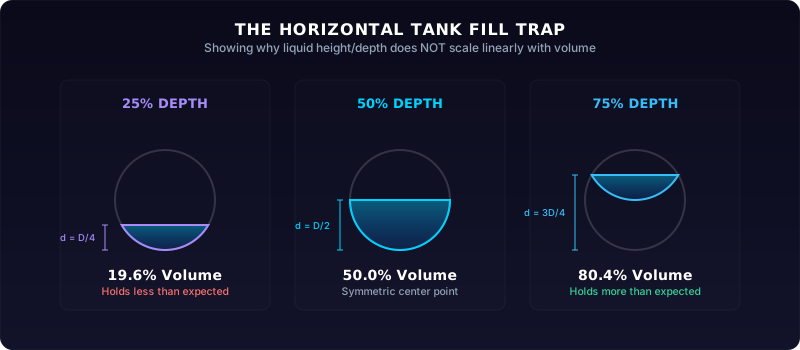
This is why two transformers with the same gauge reading can hold different oil quantities if their conservators differ in geometry. For partial-fill cases, use the horizontal cylinder calculator rather than scaling the full-tank figure by eye. If you are manually tracking levels using a dipstick or gauge, see our guide on horizontal tank dip stick chart & calculation to calibrate your measurements.
Common mistakes to avoid
- Using diameter instead of radius. The formula squares the radius. Plugging in the diameter overstates capacity by a factor of four.
- Ignoring oil expansion when sizing the conservator. A tank sized only for cold oil will overflow once it heats up. Always run ΔV = V × β × ΔT.
- Assuming a horizontal tank fills linearly with height. It doesn’t — use the circular-segment formula for any partial fill.
- Mixing imperial units. Cubic inches are not gallons. Divide in³ by 231 to reach US gallons before comparing.
Frequently Asked Questions
What is the formula for transformer tank oil capacity?
It’s the cylinder volume formula, V = π × r² × h, using the tank’s internal radius and length. Subtract the volume taken up by the core and windings if you need the oil-only figure.
How much does transformer oil expand when heated?
Mineral transformer oil expands about 0.075% per °C. Over a 70 °C rise, 2,000 L of oil gains roughly 105 L — about 5.25% of its volume. Always check the supplier’s data sheet, since esters and synthetic fluids differ.
Why is the conservator tank cylindrical?
A cylinder is structurally efficient for holding pressure and simple to fabricate from rolled steel plate, which is why both the main tank and the conservator are usually cylindrical. That also means one formula, V = π × r² × h, sizes them both. If you are interested in other open cylindrical structures, such as drainage channels or half-round pipes, check out our guide on water volume in a half pipe.
How big should a conservator tank be?
Common utility practice puts it at 8–12% of the transformer’s total oil volume. The lower bound is set by the calculated thermal expansion (ΔV); engineers then add a 30–40% margin for hot days and load peaks.
How do I calculate the oil weight from tank volume?
Multiply the volume in litres by the oil density, about 0.87 kg/L. So a 424 L tank of mineral oil weighs roughly 369 kg when full. For other tank shapes, our cylinder weight calculator handles the density step.
Does the oil level rise evenly in a horizontal conservator?
No. Because the cross-section is a circle, volume changes faster near the middle of the tank and slower near the top and bottom. A gauge reading at half-height means half-full, but readings near the bottom represent much less oil than they appear to.
What temperature range should I use for expansion calculations?
Use the realistic operating swing: the cold fill or ambient temperature as your start, and the maximum top-oil temperature at full load as your end. For many distribution transformers that’s roughly 20 °C up to 85–95 °C, giving a ΔT of 65–75 °C. Standards typically reference a 55–65 °C average winding rise, so confirm the figures against the transformer’s rating plate before sizing anything you’ll build.
Can I use this method for ester or synthetic transformer fluids?
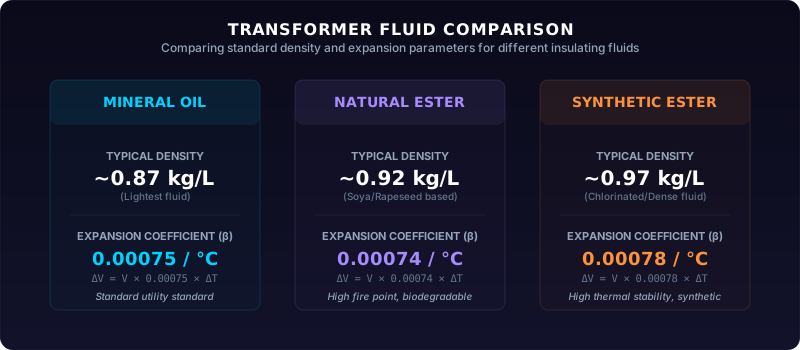
The volume formula is identical — only the constants change. Natural and synthetic esters have different densities and expansion coefficients from mineral oil, so pull β and density from that specific fluid’s data sheet before running the expansion calculation.
Sources and verification
The cylinder volume formula and unit conversions follow standard references including Wolfram MathWorld and NIST unit definitions. The transformer oil thermal expansion coefficient (~0.00075 /°C for mineral oil) is consistent with published engineering data, including Engineering Toolbox. Conservator sizing guidance (8–12% of total oil volume) reflects common utility and manufacturer design practice. All calculations in this article were independently verified, with each conversion cross-checked through two unit routes.
Author: CylinderVolume-Calculator.com Editorial Team
Published: 11 June 2026 · Last reviewed: 11 June 2026
Fact-checked by: CVC Editorial Team. This article was drafted with AI assistance and reviewed for accuracy by the editor; all calculations independently verified.