Guides · June 10, 2026
Partially Filled Tilted Cylinder: Volume at Any Angle
Calculate liquid volume in a tilted cylindrical tank. Combines tilt angle, liquid depth and radius with calculus slice integration for exact litres.

- The short answer
- Two setups people mean by “tilted cylinder”
- Case 1 — Tilted upright cylinder: V = π r² hc
- Why the tilt drops out (the one-line proof)
- When this formula stops being valid
- Case 2 — When the surface reaches the base: the cylindrical wedge
- Case 3 — Tilted horizontal tank (the sloped oil tank problem)
- The baseline: a level horizontal tank
- Reading a tilted horizontal tank correctly
- Worked examples
- Example 1 — Tilted drum, metric (wall-only, Case 1)
- Example 2 — Tilted 55-gallon drum, imperial (Case 1)
- Example 3 — Surface dipping to the base (Case 2, cylindrical wedge)
- Example 4 — Tilted horizontal oil tank (Case 3, cited method)
- Common mistakes to avoid
- Quick conversion reference
- Frequently Asked Questions
- Does tilting a cylinder change the volume of liquid inside?
- How do you calculate the volume of a tilted cylinder?
- Formula for a partially filled horizontal cylinder tank?
- Why does the tilt angle sometimes not matter?
- How do you measure liquid level in a tilted oil tank?
- What is a cylindrical wedge (ungula)?
- Can I use a regular cylinder volume calculator for a tilted tank?
- How accurate is averaging end depths on a tilted tank?
- Sources & verification
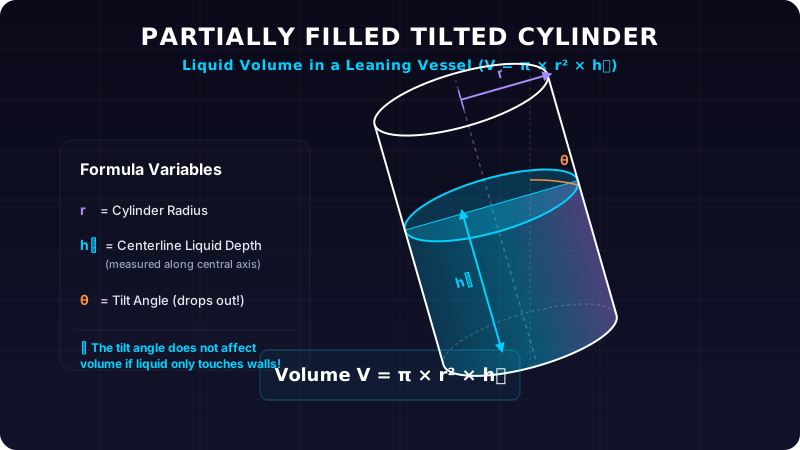
The volume of a partially filled tilted cylinder is usually simpler than it looks. If the liquid surface only touches the curved side wall — not the top or bottom — the volume equals V = π × r² × hc, where r is the radius and hc is the liquid depth measured along the cylinder’s central axis. The tilt angle drops out completely. Quick check: a drum of radius 11.25 in holding liquid 20 in deep at its axis contains π × 11.25² × 20 ≈ 7,952 in³ (about 34.4 US gallons) — tilted or not. The rest of this guide shows when that shortcut applies, and what to do when it doesn’t.
The short answer
There is one idea that does most of the work on this topic, and most calculators skip it:
As long as the liquid surface cuts only the curved wall of the cylinder — it covers the whole base and stays below the rim — the volume of liquid is exactly the same as if the liquid were sitting level at the depth you’d read on the central axis. Tilt angle makes no difference.
So before reaching for trigonometry, check one thing: does the slanted surface still go all the way around the wall? If yes, you only need the depth at the centre. That single insight turns a hard-looking problem into the standard cylinder volume formula.
Two setups people mean by “tilted cylinder”
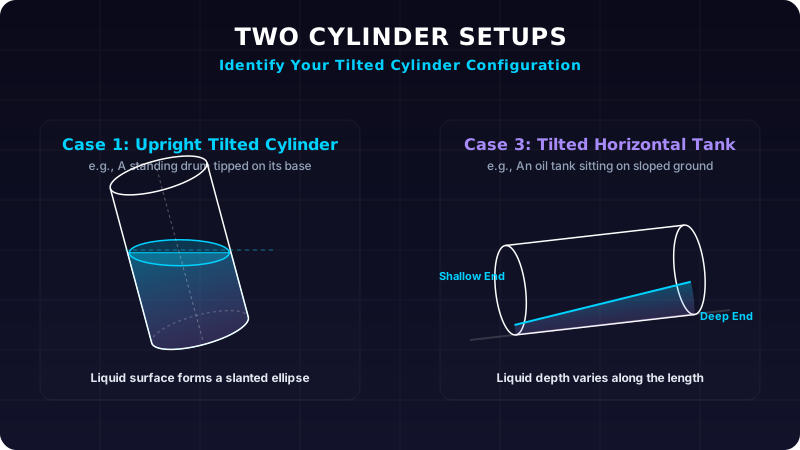
“Tilted cylinder” describes two different physical situations, and they use different math. Identify yours first:
- A standing (upright) cylinder that leans off vertical — like a drum tipped on its base, or a vertical storage vessel installed slightly out of plumb. The liquid surface becomes a slanted ellipse against the walls.
- A lying-down (horizontal) cylinder tilted along its length — like a horizontal fuel or oil tank on sloped ground, with one end higher than the other. The depth of liquid changes from one end of the tank to the other.
Case 1 is where the elegant shortcut lives. Case 3 (the tilted horizontal tank) needs a different approach. We’ll take them in order.
Case 1 — Tilted upright cylinder: V = π r² hc
When an upright cylinder leans and the liquid stays in contact with the wall all the way around, the answer is:
V = π × r² × h꜀- r = cylinder radius
- h꜀ = liquid depth measured straight down the central axis (the midpoint of the slanted surface)
- π ≈ 3.14159
Notice what is not in that formula: the tilt angle. That isn’t an approximation — it’s exact.
Why the tilt drops out (the one-line proof)
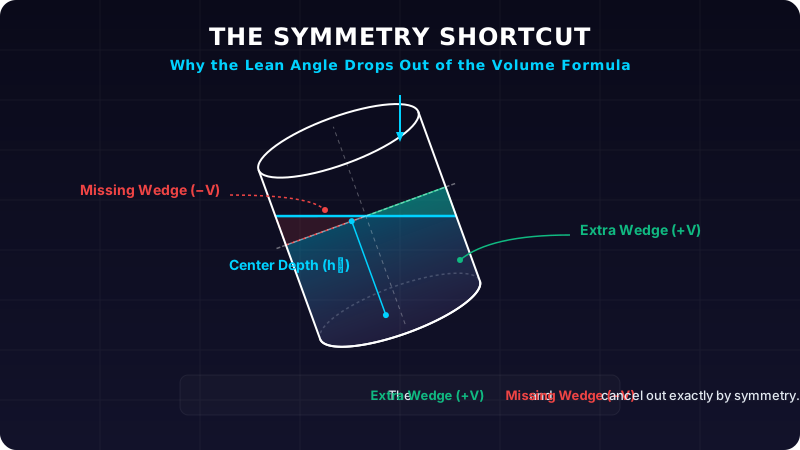
Picture the slanted liquid surface as a plane. Set the cylinder’s axis as the vertical reference. On the “high” side of the lean, there’s an extra wedge of liquid above the centre level; on the “low” side, there’s an identical wedge missing below it. By symmetry, the extra wedge on one side exactly fills in for the missing wedge on the other. They cancel, and you’re left with the volume of a level fill at the centre depth: π r² hc.
Mathematically, integrating the surface height (a + b·x) across the circular base gives a·πr² + b·∫x dA, and the second term is zero because x is symmetric about the centre. Only the centre height a = h꜀ survives. (For the formal treatment, see Wolfram MathWorld’s cylinder entry.)
(Note: For other complex tank geometry containing custom tapered bottoms, you can reference our detailed guide on calculating the volume of a cylinder with conical bottom.)
When this formula stops being valid
The shortcut holds only while the slanted surface touches just the curved wall. It breaks in two ways:
- The low edge dips below the base. If the lean is steep or the fill is shallow, the surface drops past the bottom on the low side and exposes part of the base. Now you have a cylindrical wedge — see Case 2.
- The high edge rises above the rim. If the tank is nearly full, the surface climbs over the top on the high side and the liquid is bounded by the top face. (Trick for this: compute the empty space above the liquid using the same wedge logic and subtract from the full volume.)
A quick safety check: if the surface’s lowest point still sits above the base and its highest point sits below the rim, you’re clear to use V = π r² hc. Need the simple level-fill version once you’ve confirmed it? The cylinder volume calculator using radius handles it directly.
Case 2 — When the surface reaches the base: the cylindrical wedge
If the liquid plane passes right through a diameter of the base and rises to a height H against the far wall — covering exactly half the base footprint — the shape of the liquid is a cylindrical wedge (also called an ungula or “hoof”). Its volume has a clean closed form:
V = (2 / 3) × r² × HThis is a classic result (verifiable by integration: V = (H/r)∫₀ʳ 2x√(r²−x²) dx = ⅔r²H). It’s handy for the moment a tilted, lightly filled vessel has liquid pooled on one side only, with bare base showing on the other.
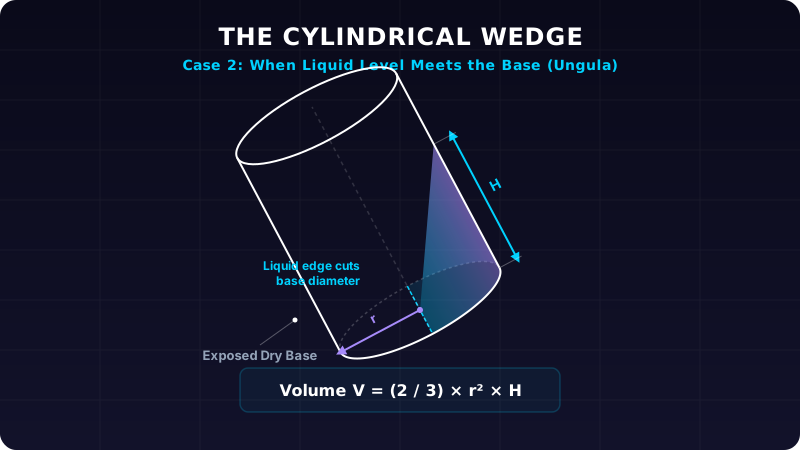
For partial cases between “wall-only” (Case 1) and the exact half-base wedge, the geometry is a partial ungula and the algebra gets heavy — in practice it’s faster to model it numerically or measure by displacement. But the two bookend formulas, π r² h꜀ and ⅔ r² H, cover the situations you’ll meet most often.
Case 3 — Tilted horizontal tank (the sloped oil tank problem)
This is the one that frustrates people with real fuel and oil tanks: a horizontal cylinder sitting on ground that isn’t level, so the liquid is deeper at one end than the other.
The baseline: a level horizontal tank
Start with the standard formula for a horizontal cylindrical tank that is not tilted. The liquid fills a circular segment of the cross-section to depth h, and that segment runs the full length L:
A = r² × cos⁻¹((r − h) / r) − (r − h) × √(2rh − h²)
V = A × L
Here the inverse cosine is in radians. This is the workhorse equation behind tank-strapping charts (see Engineering Toolbox for tank gauging references). If you are preparing charts or calibrating dip rods, read our full article on Horizontal Tank Dip Stick Chart Calculation to understand the math step-by-step.
Reading a tilted horizontal tank correctly
When that horizontal tank is tilted along its length, the depth varies linearly down the tank — shallow at the high end, deep at the low end. The honest answer is that the exact volume needs an integral of the segment area along the length, because segment area is non-linear in depth.

The practical method that gets you very close:
- Measure (or read) the liquid depth at the longitudinal midpoint of the tank — or average the depths at the two ends.
- Plug that midpoint depth into the segment formula above.
Because the depth profile is linear, the midpoint depth equals the average depth. This makes the segment-formula estimate a close approximation for small-to-moderate tilts. It is not mathematically exact (the non-linear segment area means ∫A(h) dL ≠ A(h_avg) × L), so for custody-transfer or billing accuracy, use a calibrated strapping table. For everyday inventory checks, midpoint depth is reliable.
(If you are installing large utility conduits or road crossings and need to backfill the trenches, read our guide on how to calculate gravel for a culvert pipe for practical excavations.)
Worked examples
Example 1 — Tilted drum, metric (wall-only, Case 1)
A cylindrical drum has radius r = 28.5 cm. It’s leaning, and the liquid depth measured down the central axis is h꜀ = 40 cm. The surface stays on the wall all the way around.
V = π × r² × h꜀
V = 3.14159 × (28.5)² × 40
V = 3.14159 × 812.25 × 40
V = 102,069 cm³  ≈ 102.07 L      (1 L = 1,000 cm³)
The tilt angle never entered the calculation — only the centre depth mattered. Convert the result with the volume in liters tool if you need other units.
Example 2 — Tilted 55-gallon drum, imperial (Case 1)
A standard 55-gallon steel drum has an outside diameter near 22.5 in, so r = 11.25 in. Liquid sits 20 in deep at the central axis while the drum leans.
V = π × r² × h꜀
V = 3.14159 × (11.25)² × 20
V = 3.14159 × 126.5625 × 20
V = 7,951.9 in³                  (rounded to 1 decimal)
V = 7,951.9 ÷ 231 ≈ 34.4 US gal  (1 US gallon = 231 in³)
Same drum standing perfectly level to the same 20 in centre depth: identical 34.4 gallons. That’s the centerline principle in action.
Example 3 — Surface dipping to the base (Case 2, cylindrical wedge)
The same drum (r = 11.25 in) is tilted enough that the liquid plane passes through a diameter of the base and rises to H = 12 in on the far wall, leaving the near half of the base exposed.
V = (2 / 3) × r² × H
V = (2 / 3) × (11.25)² × 12
V = (2 / 3) × 126.5625 × 12
V = (2 / 3) × 1,518.75
V = 1,012.5 in³  ≈ 4.38 US gal
Example 4 — Tilted horizontal oil tank (Case 3, cited method)
A horizontal cylindrical tank has r = 0.5 m and length L = 2 m. It sits on a slight slope; the depth read at the longitudinal midpoint is h = 0.3 m.
A = r² × cos⁻¹((r − h)/r) − (r − h) × √(2rh − h²)

(r − h)/r = (0.5 − 0.3)/0.5 = 0.4
cos⁻¹(0.4) = 1.1593 rad
√(2 × 0.5 × 0.3 − 0.3²) = √(0.30 − 0.09) = √0.21 = 0.4583

A = (0.5)² × 1.1593 − 0.2 × 0.4583
A = 0.25 × 1.1593 − 0.09165
A = 0.28983 − 0.09165 = 0.19818 m²

V = A × L = 0.19818 × 2 = 0.3964 m³  ≈ 396.4 L      (1 m³ = 1,000 L)
Because the midpoint depth represents the average, this is a close estimate of the true contents of the sloped tank.
Common mistakes to avoid
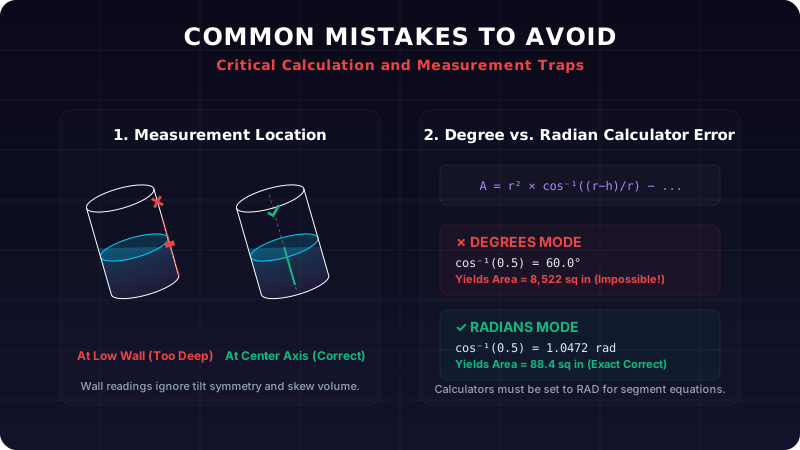
- Measuring depth at the wall instead of the axis. For Case 1 you need the depth at the centre, not where the surface meets the high or low wall.
- Forcing trigonometry where it isn’t needed. If the surface only touches the wall, the tilt angle is irrelevant — don’t compute it.
- Using degrees in the segment formula. The
cos⁻¹term is in radians. Using degrees will give a wildly wrong area. - Treating an averaged tilted-horizontal-tank reading as exact. It’s a strong approximation, not a guaranteed exact figure — use a calibrated chart for billing-grade accuracy.
- Confusing radius and diameter. A drum quoted as “22.5 in” is the diameter; halve it before squaring.
Quick conversion reference
| Convert | Multiply by |
|---|---|
| in³ → US gallons | ÷ 231 |
| in³ → liters | × 0.016387 |
| cm³ → liters | ÷ 1,000 |
| m³ → liters | × 1,000 |
| ft³ → US gallons | × 7.481 |
| ft³ → liters | × 28.317 |
Need a single number fast? The free cylinder volume calculator handles level fills, and volume in gallons converts on the fly.
Frequently Asked Questions
Does tilting a cylinder change the volume of liquid inside?
No — tilting the container doesn’t change the amount of liquid. What changes is the level reading. The volume is the same whether the cylinder is upright or leaning.
How do you calculate the volume of a tilted cylinder?
If the liquid surface touches only the curved wall, use V = π r² hc, where hc is the depth on the central axis. If the surface reaches the base on one side, use the cylindrical-wedge formula V = (2/3) r² H. For a tilted horizontal tank, use the circular-segment formula at the midpoint depth.
Formula for a partially filled horizontal cylinder tank?
The liquid forms a circular segment along the tank’s length: A = r² cos⁻¹((r − h)/r) − (r − h)√(2rh − h²), then V = A × L. For example, a tank with r = 0.5 m, L = 2 m, and h = 0.3 m holds about 396 liters.
Why does the tilt angle sometimes not matter?
Because the extra liquid on the high side of the lean exactly balances the missing liquid on the low side, as long as the surface still wraps around the whole wall. The two wedges cancel, leaving a plain level-fill volume at the centre depth.
How do you measure liquid level in a tilted oil tank?
Read the depth at the tank’s longitudinal midpoint, or average the readings at both ends since the depth varies linearly. Then apply the segment formula. For invoicing accuracy, use a calibrated strapping chart rather than a single dip.
What is a cylindrical wedge (ungula)?
It’s the solid you get when a plane slices through a cylinder along a chord of the base and rises to a height on the far side. When that chord is a full diameter and the far height is H, the volume is exactly (2/3) r² H — a result that traces back to Archimedes.
Can I use a regular cylinder volume calculator for a tilted tank?
Yes, in the common Case 1 situation: confirm the surface touches only the wall, then enter the centre-axis depth as the “height” in a standard calculator. The result is exact. Only switch methods if the surface reaches the base or rim.
How accurate is averaging end depths on a tilted tank?
For small to moderate tilts it’s a strong approximation — usually within a few percent. The catch is that segment area is non-linear in depth, so averaging depth and applying the segment formula isn’t perfectly exact. As tilt increases, error grows, and a calibrated tank chart becomes the better tool for precise inventory.
Sources & verification
The cylindrical wedge volume (V = ⅔ r² H) and the general cylinder geometry referenced here are standard results documented at Wolfram MathWorld and Math is Fun. The horizontal-tank segment formula is the widely used industry equation for tank gauging; see Engineering Toolbox for applied tank references. Standard 55-gallon steel drum dimensions (≈22.5 in outside diameter) are industry-standard. The centerline result (V = π r² hc for a surface touching only the curved wall) was verified by direct integration. All calculations in the worked examples were independently checked, with π = 3.14159 and rounding stated at each step.