Guides · June 10, 2026
Water Volume in a Half Pipe: Channel Flow and Capacity
Calculate water volume in half-round pipes and open culverts using V = 0.5 pi r squared L. Get litres, gallons and flow area for drainage channels.
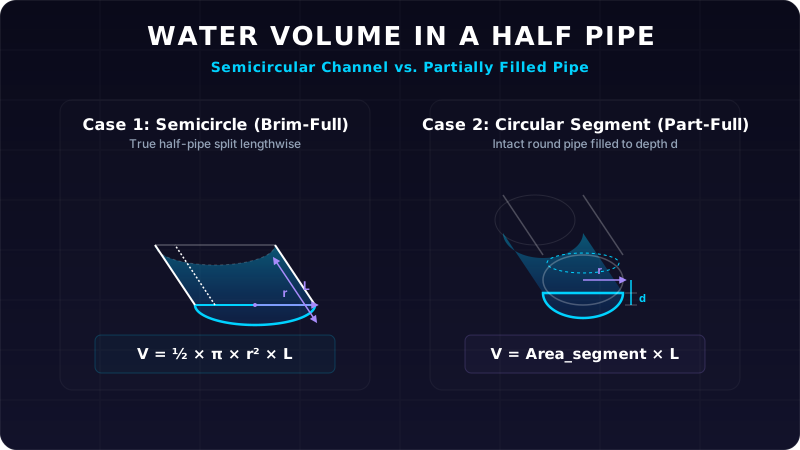

- First, what does “half pipe” actually mean?
- Formula 1 — A half pipe filled to the brim
- Worked example 1 (metric): a 150 mm half-round gutter
- Worked example 2 (imperial): a 4-inch PVC pipe cut in half
- Formula 2 — A partially filled pipe (the circular-segment method)
- Worked example 3 (metric): a culvert running part-full
- Worked example 4 (imperial, edge case): a gutter in heavy rain
- The physics: why half pipes are the best shape for drainage
- Common mistakes to avoid
- Unit conversion quick reference
- Frequently Asked Questions
- What is the formula for the volume of a half pipe?
- Is a half pipe the same as a half-full pipe?
- How do I calculate water volume in a partially filled pipe?
- How much water does a 6-inch half-round gutter hold?
- Why are drainage channels curved instead of square?
- Does a round pipe carry the most water when completely full?
- What is the difference between volume and flow rate here?
- Sources and verification
The volume of a half pipe filled to the brim is V = ½ × π × r² × L, where r is the radius of the original round pipe and L is its length. Quick check: a 6-inch half-round gutter (radius 3 in) running 30 ft holds about 22 gallons of water when brim-full. If the pipe is only partially filled, you switch to the circular-segment formula instead. For pipes that are tilted rather than perfectly horizontal, you should consult our guide on how to calculate the volume of a partially filled tilted cylinder. This guide covers both cases, with verified product specs, four worked examples, and the open-channel physics behind why half pipes drain so well.
First, what does “half pipe” actually mean?
The phrase gets used two ways, and the formula depends on which one you mean. Mixing them up is the single most common mistake on this topic.
- A pipe split lengthwise — a true half pipe, with a semicircular cross-section. Think of a round PVC pipe sliced down its centerline, a half-round rain gutter, or a curved drainage channel. Filled to the brim, its cross-section is a perfect half-circle.
- A round pipe that is only partly full — the pipe is whole, but water sits at the bottom to some depth d. Here the water’s cross-section is a circular segment, not a half-circle, so the brim-full formula no longer applies.
(Note: a skateboarder’s “half pipe” ramp is a different object — it has a flat floor between two quarter-pipe curves and is designed to shed water, so it isn’t a volume problem at all.)
We’ll handle each real case in turn.

Formula 1 — A half pipe filled to the brim
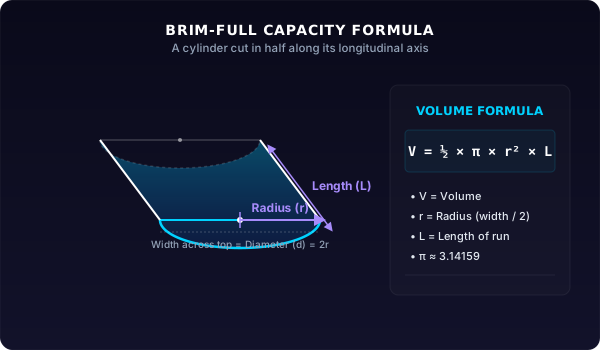
A half pipe is just a cylinder cut in half along its length. A full cylinder holds π × r² × L, so a half pipe holds exactly half of that:
V = ½ × π × r² × L- r = radius of the round pipe the half pipe came from (half its width across the open top)
- L = length of the channel
- π ≈ 3.14159
That single formula answers most “semi circular pipe capacity” questions. Two worked examples below — one metric, one imperial.
Worked example 1 (metric): a 150 mm half-round gutter
A standard 150 mm half-round gutter measures 150 mm across the open top, so its radius is half of that: r = 75 mm = 7.5 cm. Say you have a 6 m (600 cm) run and want its brim-full capacity.
V = ½ × π × r² × L
V = ½ × 3.14159 × (7.5 cm)² × 600 cm
V = ½ × 3.14159 × 56.25 × 600
V = ½ × 106,028.7 cm³
V = 53,014.3 cm³
Convert to liters (1 L = 1,000 cm³): ≈ 53.0 liters.
Sanity check: a full round pipe of the same radius and length holds π × 56.25 × 600 ≈ 106 L, and 53 L is exactly half. ✓
Worked example 2 (imperial): a 4-inch PVC pipe cut in half
Take a 4-inch nominal Schedule 40 PVC pipe. Its actual inside diameter is 4.026 in (per ASTM D1785), so the inside radius is r = 2.013 in. Slice a 10 ft (120 in) length down the middle to make a half pipe and fill it to the brim.
V = ½ × π × r² × L
V = ½ × 3.14159 × (2.013 in)² × 120 in
V = ½ × 3.14159 × 4.052 × 120
V = ½ × 1,527.6 in³
V = 763.8 in³
Convert to US gallons (1 gal = 231 in³): ≈ 3.31 gallons.
Sanity check: the intact pipe would hold about 6.61 gallons, and the half pipe holds half. ✓ (A pipe is technically a hollow cylinder calculator case if you account for wall thickness, but for the water inside you only need the inside radius.)
Formula 2 — A partially filled pipe (the circular-segment method)
When a round pipe runs part-full — the everyday reality for storm drains, culverts, and gutters in light rain — the water cross-section is a circular segment. This is the heart of partially filled pipe math, and it’s where simple “half” formulas fail.
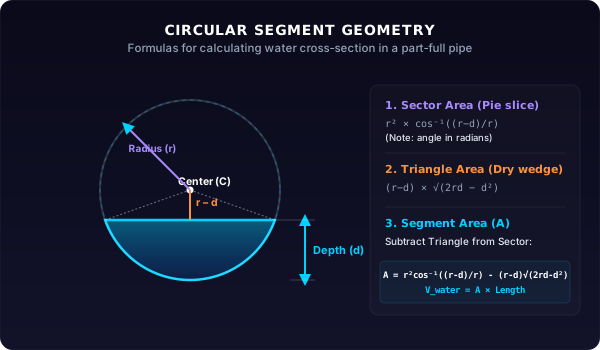
The cross-sectional area of water at depth d in a pipe of radius r is:
A = r² × cos⁻¹((r − d) / r) − (r − d) × √(2rd − d²)Then the volume is simply V = A × L.
Two things to get right:
- Use radians, not degrees, for the cos⁻¹ (inverse cosine) term. This trips up a lot of calculators.
- d is measured from the bottom of the pipe. For a full round pipe, d runs from 0 to 2r (the diameter). For a half pipe, d runs from 0 up to r (the flat top).
For the brim-full and exactly-half cases you can shortcut to the horizontal cylinder calculator values, but anything in between needs the segment formula. If you are creating a calibration chart for tank dipping, check our walkthrough on horizontal tank dip stick chart & calculation.
Worked example 3 (metric): a culvert running part-full
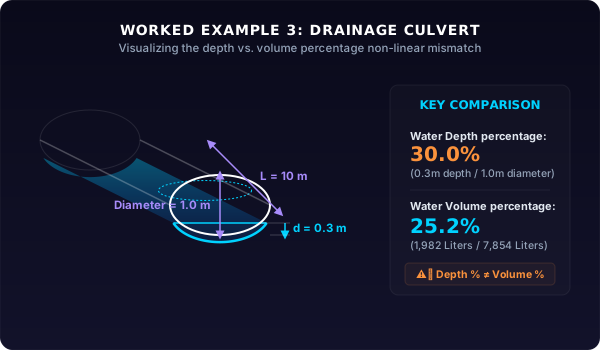
A horizontal drainage pipe is 1 m in diameter (r = 0.5 m) and 10 m long. After a storm, water sits 0.3 m deep. How much water is in it? (If you are installing or backfilling such a pipe, our guide on how to calculate gravel for a culvert pipe explains how to size the gravel surrounding the culvert).
Step 1 — angle term:
(r − d)/r = (0.5 − 0.3)/0.5 = 0.4
cos⁻¹(0.4) = 1.1593 radians

Step 2 — area:
A = r² × 1.1593 − (r − d) × √(2rd − d²)
A = 0.25 × 1.1593 − 0.2 × √(2×0.5×0.3 − 0.3²)
A = 0.28983 − 0.2 × √(0.21)
A = 0.28983 − 0.2 × 0.45826
A = 0.28983 − 0.09165
A = 0.19818 m²

Step 3 — volume:
V = A × L = 0.19818 × 10 = 1.9818 m³  →  ≈ 1,982 liters
Here’s the insight competitors skip: the water is 30% of the way up the pipe by depth, but only about 25% of the pipe by volume (1,982 L out of a full 7,854 L). That’s because a pipe is narrowest at the bottom — shallow water spreads across a thin sliver of cross-section. Depth percentage and volume percentage are not the same thing, and assuming they are is a classic costing error in tank and channel work.
Worked example 4 (imperial, edge case): a gutter in heavy rain
Back to the 6-inch half-round gutter (r = 3 in), 30 ft (360 in) long. In a downpour it fills to 2 inches deep. Because the gutter is a half pipe and 2 in is below the 3-in brim, the water is again a circular segment — so the same segment formula applies.
(r − d)/r = (3 − 2)/3 = 0.3333
cos⁻¹(0.3333) = 1.2310 radians

A = 3² × 1.2310 − (3 − 2) × √(2×3×2 − 2²)
A = 9 × 1.2310 − 1 × √8
A = 11.079 − 2.828
A = 8.250 in²

V = A × L = 8.250 × 360 = 2,970 in³  →  ≈ 12.9 gallons
That’s about 58% of the gutter’s 22-gallon brim capacity — useful for sizing downspouts before water overtops the edge.
A clean shortcut to remember: below the halfway line, a partially filled half pipe holds exactly the same as a full round pipe filled to that same depth d. The bottom of a full pipe is a half pipe. The two only diverge above the centerline, where a round pipe curves back inward but a half pipe’s wall stops at the brim.
The physics: why half pipes are the best shape for drainage
Water moving through a half pipe or a part-full pipe is open channel flow — it has a free surface exposed to the air, unlike a pressurized full pipe. The key quantity in open channel flow is the hydraulic radius:
R = A / Pwhere A is the water’s cross-sectional area and P is the wetted perimeter — only the part of the channel wall actually touching water (the free surface on top doesn’t count). A larger hydraulic radius means less wall friction per unit of water, so the flow moves faster and the channel carries more.
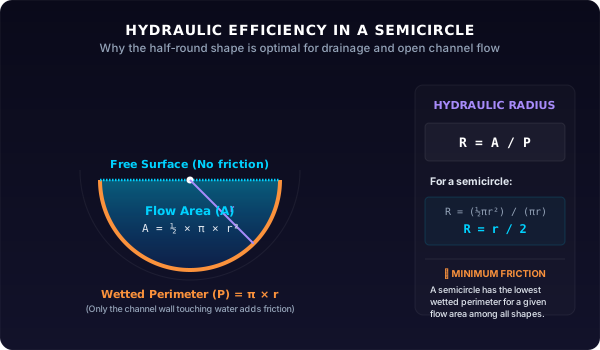
For a half pipe filled to the brim, the area is ½πr² and the wetted perimeter is the curved wall, πr. So:
R = (½πr²) / (πr) = r / 2A clean result — and it’s the maximum you can get for that cross-sectional area. Among all open channel shapes, the semicircle has the smallest wetted perimeter for a given flow area, which is exactly why half-round gutters, sewer inverts, and many concrete drainage channels are curved rather than square. It’s not aesthetics; it’s hydraulics.
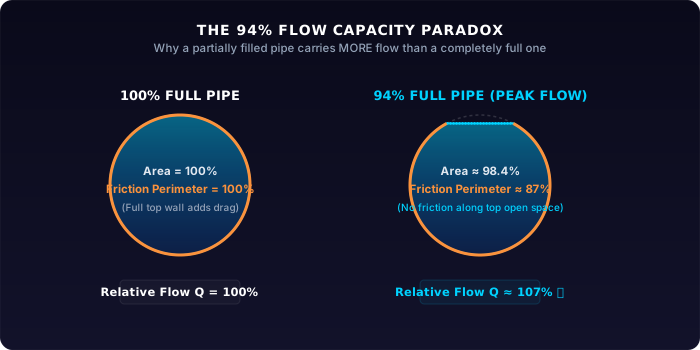
There’s a genuinely counter-intuitive payoff here. Run the segment math across every depth in a round pipe and you find that a circular pipe carries its maximum flow at roughly 94% full, not 100% full, with peak velocity near 81% full. Past those points, the extra wetted perimeter near the top adds more friction than the extra water adds capacity, so a brim-full pipe actually moves less water than one running slightly below full. Drainage engineers design to this.
(One scope note for honesty: hydraulic radius and the related Manning’s equation, Q = (1/n) × A × R^(2/3) × S^(1/2), govern flow rate — how fast water moves given a slope and roughness. The formulas in this article give volume — how much water the channel holds at a given instant. Both rely on the same cross-sectional area, which is why they belong on the same page.)
Common mistakes to avoid
- Treating a part-full pipe as a half pipe. “Half pipe” (½πr²L) only applies when the channel is genuinely semicircular and brim-full. Part-full needs the segment formula.
- Using degrees instead of radians in the cos⁻¹ term. A calculator set to degrees will give an answer that’s off by a factor of about 57.
- Confusing radius with diameter. The half-round gutter “size” usually quotes the diameter (the width across the top); the formula needs r, which is half of that.
- Assuming depth % equals volume %. As example 3 showed, 30% depth ≈ 25% volume. They only coincide at exactly half-full.
- Forgetting wall thickness on real pipe. For the water inside, use the inside radius (e.g., 2.013 in for 4-in Schedule 40, not the 2.25-in nominal).
Unit conversion quick reference
| Convert | Value |
|---|---|
| 1 liter | 1,000 cm³ |
| 1 cubic meter | 1,000 liters |
| 1 US gallon | 231 in³ = 3.785 liters |
| 1 cubic foot | 7.481 US gallons = 28.317 liters |
| 1 cubic inch | 16.387 cm³ |
Need a direct switch between units? Use the volume in liters and volume in gallons tools, or run any shape through the free cylinder volume calculator.
Frequently Asked Questions
What is the formula for the volume of a half pipe?
For a half pipe filled to the brim, V = ½ × π × r² × L, where r is the radius and L is the length. If the pipe is only partly full, use the circular-segment area A = r²·cos⁻¹((r−d)/r) − (r−d)·√(2rd − d²), then multiply by L.
Is a half pipe the same as a half-full pipe?
No. A half pipe is a pipe physically cut in half lengthwise (semicircular cross-section). A half-full pipe is a whole round pipe with water up to its centerline. They happen to give the same volume only when the half pipe is brim-full or the round pipe is exactly half-full — both equal ½πr²L.
How do I calculate water volume in a partially filled pipe?
Find the water depth d, compute the circular-segment area with A = r²·cos⁻¹((r−d)/r) − (r−d)·√(2rd − d²) using radians, then multiply by the pipe length L. For a 1 m-diameter pipe, 10 m long, with water 0.3 m deep, that works out to about 1,982 liters.
How much water does a 6-inch half-round gutter hold?
A 6-inch (radius 3 in) half-round gutter holds about 22 gallons brim-full over a 30 ft run. At a more typical 2-inch depth during rain, it carries roughly 13 gallons — about 58% of capacity — which is why downspout spacing matters.
Why are drainage channels curved instead of square?
Because a semicircle has the smallest wetted perimeter for a given flow area, giving the largest hydraulic radius (R = r/2 when brim-full). Less wall contact means less friction, so a curved half pipe carries more water and self-cleans better than a square channel of the same size.
Does a round pipe carry the most water when completely full?
No — and this surprises people. A circular pipe reaches maximum discharge at about 94% full and maximum velocity at about 81% full. Above those depths the added wall friction outweighs the added area, so a brim-full pipe actually moves slightly less water than one running just below full.
What is the difference between volume and flow rate here?
Volume (the focus of this article) is how much water the channel holds at one moment, in liters or gallons. Flow rate is how much passes a point per second and depends on slope and surface roughness via Manning’s equation. Both use the same cross-sectional area, but they answer different questions.
Sources and verification
Schedule 40 PVC inside-diameter dimensions referenced here follow ASTM D1785 (4-inch nominal = 4.026 in ID). Half-round gutter sizes are industry-standard (150 mm metric and 6-inch US formats). The circular-segment area formula and the hydraulic-radius / Manning’s relationships are standard results in geometry and open-channel hydraulics. All calculations in this article were independently verified.
Further reading from authoritative sources:
- Circular segment geometry — Wolfram MathWorld
- Cylinder fundamentals — Math is Fun
- Partially filled pipe and open-channel flow data — Engineering Toolbox
Author: CylinderVolume-Calculator.com Editorial Team
Published: June 10, 2026
Last reviewed: June 10, 2026
Fact-checked by: CVC Editorial Team
This article was drafted with AI assistance and reviewed for accuracy by the editor before publishing. All calculations independently verified.