Engineering & Industrial · August 27, 2026
Grain Bin Capacity in Bushels and Tonnes by Crop
Calculate grain bin capacity in bushels and metric tonnes across corn, wheat, soybeans, and barley. Includes ASABE compaction pack factors and formulas.

- Grain Bin Capacity in Bushels and Tonnes by Crop
- The Formula: Silo Geometry, Bushels, and Compaction Physics
- Cylindrical Sidewall Volume
- Conical Grain Peak Volume
- Total Gross Geometric Volume
- Converting Cubic Feet to Struck Bushels
- Grain Compaction and Pack Factor (F_pack)
- Crop Tonnage Calculations
- Reference Data: Standard Crop Test Weights, Densities, and Pack Factors
- Worked Examples
- Worked Example 1: Metric Commercial Grain Silo for Shelled Corn
- Worked Example 2: Imperial Farm Grain Bin for Soybeans with Compaction
- Worked Example 3: Edge Case Hopper Bottom Bin with Dual Cones
- Common Mistakes in Grain Bin Capacity Calculations
- Related Agricultural and Industrial Volume Resources
Grain Bin Capacity in Bushels and Tonnes by Crop
Grain bin capacity uses V = (π r² h_cylinder + ⅓ π r² h_cone) × 0.80356. A 24-foot diameter bin with 18-foot eave and 6-foot peak holds 7,271 bushels (198 tonnes of wheat).
Accurate grain inventory estimation is essential for post-harvest logistics, grain marketing contracts, and bin structural safety. Agricultural storage structures combine a cylindrical corrugated steel barrel with a conical top cap and either a flat concrete floor or an inverted conical hopper.
The Formula: Silo Geometry, Bushels, and Compaction Physics
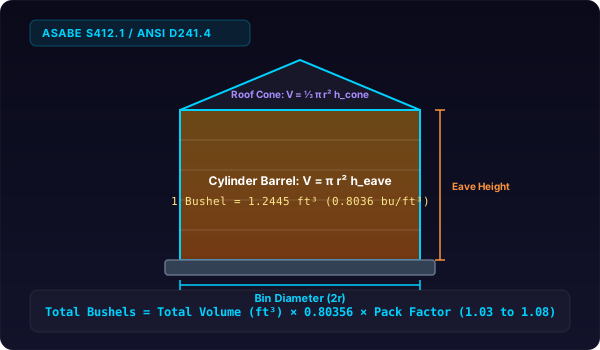
Grain storage capacity combines cylinder and cone geometry, volumetric unit conversions, and ASABE compaction adjustments (ANSI/ASAE D241.4).
Cylindrical Sidewall Volume
For a bin with inside radius r and sidewall height to the eave h_eave:
V_cylinder = π × r^2 × h_eave = \frac(π × D^2 × h_eave)4Conical Grain Peak Volume
When filled to the roof peak, grain forms a cone with height h_cone:
V_cone = (1 / 3) × π × r^2 × h_coneTotal Gross Geometric Volume
V_total = V_cylinder + V_cone = π × r^2 ≤ft(h_eave + \frac(h_cone)3\right)For detailed geometric breakdowns of conical silos and bottoms, review our technical guides on industrial silo volume calculations and cylinders with conical bottoms.
Converting Cubic Feet to Struck Bushels
The standard US Winchester bushel is defined as 2,150.42 cubic inches (1.244456 ft^3). The conversion multiplier is:
Bushels per Cubic Foot = (1 / 1.244456) ≈ 0.803564 bu/ft^3Struck Bushels = V_total, cu ft × 0.803564Grain Compaction and Pack Factor (F_pack)
Grain deep in tall bins compacts under vertical overburden pressure. ASABE Standard S412.1 establishes typical pack factors (F_pack) ranging between 1.02 and 1.08:
Packed Bushels = Struck Bushels × F_packCrop Tonnage Calculations
Crop mass depends on the test weight per bushel or bulk density in kilograms per cubic meter:
- US Customary Tons:
Short Tons (2,000 lbs) = (Packed Bushels × Test Weight (lb/bu) / 2000)- Metric Tonnes (1,000 kg):
Metric Tonnes = \frac(V_total, cu meters × Bulk Density (kg/m^3))1000You can verify structural weights for full grain bins with our cylinder weight calculator.
Reference Data: Standard Crop Test Weights, Densities, and Pack Factors
The following engineering reference table outlines official USDA Federal Grain Inspection Service (FGIS) standard test weights, metric bulk densities, cubic feet per bushel, and typical bin compaction factors.
| Crop Type | Standard Test Weight (lb/bu) | Bulk Density (kg/m³) | Bulk Density (lb/cu ft) | Cu Ft per Bushel (Struck) | Typical Pack Factor (20-30 ft Eave) | Bushels per Metric Tonne |
|---|---|---|---|---|---|---|
| Shelled Corn | 56.0 lb/bu | 720.8 kg/m³ | 45.00 lb/cu ft | 1.2445 cu ft | 1.04 to 1.06 | 39.37 bu/tonne |
| Soybeans | 60.0 lb/bu | 772.3 kg/m³ | 48.21 lb/cu ft | 1.2445 cu ft | 1.03 to 1.05 | 36.74 bu/tonne |
| Hard Red Wheat | 60.0 lb/bu | 772.3 kg/m³ | 48.21 lb/cu ft | 1.2445 cu ft | 1.05 to 1.08 | 36.74 bu/tonne |
| Soft Red Wheat | 58.0 lb/bu | 746.6 kg/m³ | 46.60 lb/cu ft | 1.2445 cu ft | 1.04 to 1.07 | 38.01 bu/tonne |
| Barley | 48.0 lb/bu | 617.8 kg/m³ | 38.57 lb/cu ft | 1.2445 cu ft | 1.03 to 1.05 | 45.93 bu/tonne |
| Oats | 32.0 to 38.0 lb/bu | 411.9 to 489.1 kg/m³ | 25.71 to 30.54 lb/cu ft | 1.2445 cu ft | 1.02 to 1.04 | 58.01 to 68.89 bu/tonne |
| Grain Sorghum (Milo) | 56.0 lb/bu | 720.8 kg/m³ | 45.00 lb/cu ft | 1.2445 cu ft | 1.04 to 1.06 | 39.37 bu/tonne |
| Canola / Rapeseed | 50.0 lb/bu | 643.6 kg/m³ | 40.18 lb/cu ft | 1.2445 cu ft | 1.04 to 1.06 | 44.09 bu/tonne |
| Sunflowers (Oil) | 30.0 lb/bu | 386.2 kg/m³ | 24.11 lb/cu ft | 1.2445 cu ft | 1.02 to 1.04 | 73.49 bu/tonne |
Worked Examples
Worked Example 1: Metric Commercial Grain Silo for Shelled Corn
An agricultural cooperative installs a corrugated steel flat-bottom silo with an inside diameter of 7.32 meters (r = 3.66 m), a sidewall eave height of 6.00 meters, and a conical roof with a height of 1.80 meters. The silo is filled to capacity with standard dry shelled corn with a bulk density of 720.0 kilograms per cubic meter. Calculate the cylinder volume, cone peak volume, total storage volume in cubic meters, and total mass in metric tonnes.
Step 1: Calculate cylindrical sidewall volume.
A_base = π × r^2 = 3.14159265 × 3.66^2 = 3.14159265 × 13.3956 = 42.08381 m^2V_cylinder = 42.08381 m^2 × 6.00 m = 252.5029 m^3Step 2: Calculate conical roof peak volume.
V_cone = (1 / 3) × A_base × h_cone = (1 / 3) × 42.08381 m^2 × 1.80 m = 25.2503 m^3Step 3: Calculate total volume in cubic meters.
V_total = 252.5029 m^3 + 25.2503 m^3 = 277.7532 m^3You can verify these metric dimensions using our cylinder volume in cubic meters tool.
Step 4: Calculate total corn mass in metric tonnes.
Mass (kg) = 277.7532 m^3 × 720.0 kg/m^3 = 199982.3 kgMetric Tonnes = (199982.3 kg / 1000 kg/tonne) = 199.9823 tonnesThe silo holds 199.98 metric tonnes of corn.
Worked Example 2: Imperial Farm Grain Bin for Soybeans with Compaction
A Midwest farm features a 36-foot diameter grain bin (r = 18.0 ft) with an eave height of 24.0 feet and an 8.0-foot conical roof peak. The bin is filled to the peak with soybeans (test weight 60.0 lb/bu). Because of the 24-foot depth, an ASABE compaction pack factor of 1.05 is applied. Calculate total bin cubic footage, struck bushels, packed bushels, and total crop tonnage.
Step 1: Calculate cylindrical volume.
A = π × r^2 = 3.14159265 × 18.0^2 = 3.14159265 × 324.0 = 1017.876 sq ftV_cylinder = 1017.876 sq ft × 24.0 ft = 24429.02 cu ftStep 2: Calculate conical peak volume.
V_cone = (1 / 3) × 1017.876 sq ft × 8.0 ft = 2714.34 cu ftStep 3: Calculate total volume in cubic feet.
V_total = 24429.02 + 2714.34 = 27143.36 cu ftStep 4: Calculate struck bushel capacity.
Struck Bushels = 27143.36 cu ft × 0.803564 bu/cu ft = 21811.43 struck bushelsStep 5: Apply compaction pack factor (1.05).
Packed Bushels = 21811.43 × 1.05 = 22902.00 packed bushelsStep 6: Calculate total crop weight in short tons.
Total Weight (lb) = 22902.00 bu × 60.0 lb/bu = 1374120 lbsShort Tons = (1374120 lbs / 2000 lb/ton) = 687.06 short tonsThe bin stores 22,902 packed bushels of soybeans weighing 687.06 tons.
Worked Example 3: Edge Case Hopper Bottom Bin with Dual Cones
An on-farm seed facility utilizes a steep hopper bottom silo with a 15.0-foot diameter (r = 7.5 ft), a 20.0-foot cylindrical sidewall height, a 4.0-foot conical top roof, and a 45-degree inverted bottom discharge cone with a vertical height of 5.0 feet. Calculate total storage volume in cubic feet, struck bushel capacity, and capacity for wheat at 60 lb/bu.
Step 1: Calculate base circular area.
A = π × 7.5^2 = 3.14159265 × 56.25 = 176.7146 sq ftStep 2: Calculate individual section volumes.
- Cylindrical Center Barrel:
V_cylinder = 176.7146 sq ft × 20.0 ft = 3534.29 cu ft- Top Roof Cone:
V_top cone = (1 / 3) × 176.7146 sq ft × 4.0 ft = 235.62 cu ft- Bottom Hopper Discharge Cone:
V_bottom cone = (1 / 3) × 176.7146 sq ft × 5.0 ft = 294.52 cu ftStep 3: Calculate total geometric volume.
V_total = 3534.29 + 235.62 + 294.52 = 4064.43 cu ftStep 4: Calculate struck bushel capacity.
Struck Bushels = 4064.43 cu ft × 0.803564 = 3266.03 bushelsStep 5: Calculate total wheat weight.
Weight = 3266.03 bu × 60.0 lb/bu = 195961.8 lbs (97.98 short tons)For more on calculating storage volume for liquids or dry materials in vertical tanks, see our vertical cylinder tank calculator.
Common Mistakes in Grain Bin Capacity Calculations
-
Assuming Grain Level Matches the Eave Height Without Peaking Calculating volume strictly to the eave ignores the grain peak created by the filling auger. In a 36-foot diameter bin, an 8-foot grain cone represents 2,714 cubic feet, or over 2,180 bushels. Ignoring the peak underestimates bin capacity by roughly 10%. Conversely, assuming a full peak when grain was leveled flat for temperature coring overestimates inventory.
-
Ignoring Aeration Floor Plenum Deductions Measuring eave height from the outside foundation footing instead of the inside perforated aeration floor creates a major error. If the aeration floor is raised 16 inches (1.33 ft) above the concrete pad, this plenum space represents 1,357 cubic feet in a 36-foot bin (over 1,090 bushels). Always measure height from the top of the aeration floor sheets.
-
Using Nominal Struck Bushels for Deep Bins Without Pack Factors In bins over 30 feet tall, overburden compaction increases storage mass significantly. Failing to apply a 4% to 7% compaction pack factor causes inventory discrepancies where a producer actually has 1,500 more bushels in a 30,000-bushel bin than a basic struck formula indicates.
-
Confusing Legal Volume Bushels with Mass Bushels for Off-Test Grain A legal struck bushel is a unit of volume (
1.2445 ft^3), but commercial elevators purchase grain by weight (e.g., 56 lbs of corn = 1 bushel). If drought-stressed corn tests light at 50 lb/bu, a bin with 10,000 volumetric bushels will only yield 8,928 commercial weight bushels (10,000 × 50 / 56). Always measure actual test weight before financial valuation. -
Neglecting Moisture Shrinkage and Dockage Harvesting corn at 22% moisture fills a bin to the roof, but after drying down to 15% moisture, the grain mass shrinks by roughly 8.5% in total volume. Sizing drying bins requires calculating wet bushels into the dryer versus final dry storage bushels into the main storage bin.
Related Agricultural and Industrial Volume Resources
For related engineering formulas, tank charts, and material volume calculators, check out these guides:
- Industrial silo volume calculator and design guide
- Volume of a cylinder with conical bottom
- Septic tank capacity and sizing by household occupancy
- Concrete cylinder test specimen volume and mix yield
- Well casing volume for chlorination and disinfection dosing
- How to calculate cylinder capacity in gallons and cubic feet
- Cylinder weight calculator
- Cylinder volume in cubic feet calculator
Applying accurate geometric formulas and test weight compaction factors guarantees reliable crop inventory control and structural safety across agricultural operations.