Formulas & Calculations · August 7, 2026
Cylinder Capacity in Gallons and Cubic Feet: Full Guide
Cross-unit decision guide for cylindrical capacity: when to specify in gallons vs cubic feet, industry standards, density differences, and conversion tables.
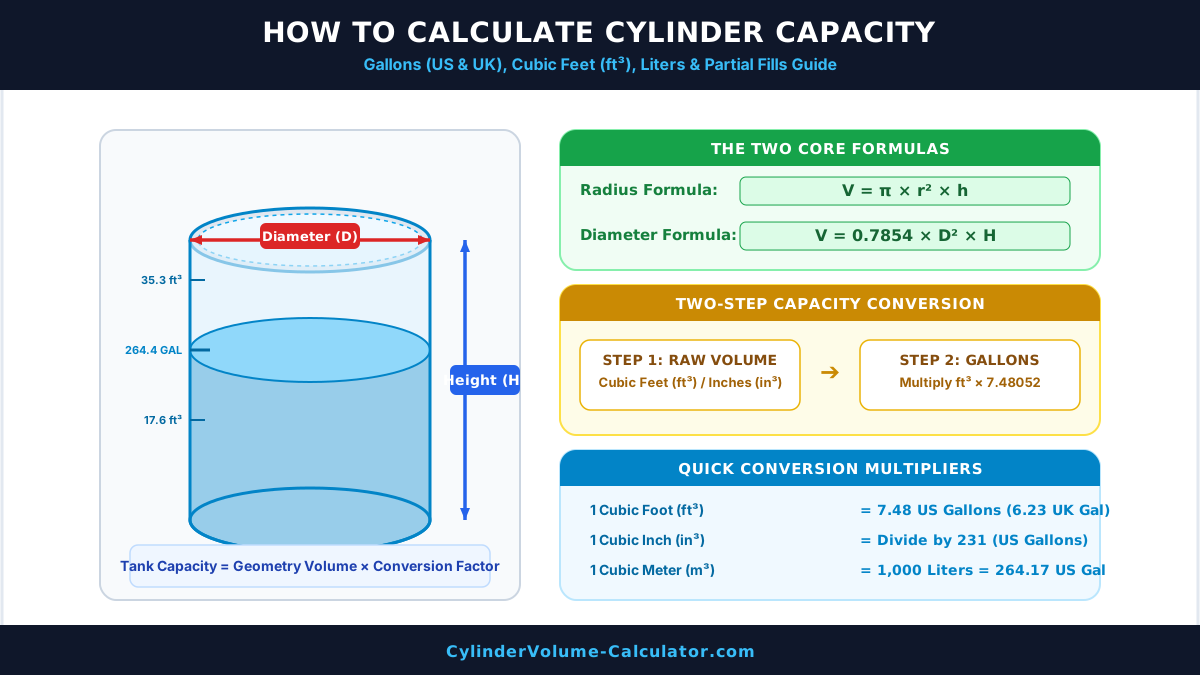

- When to specify in gallons vs cubic feet: the core decision rule
- Industry standards and measurement conventions
- 1. Water supply, wastewater, and brewing
- 2. Concrete, construction, and geotechnical engineering
- 3. Agriculture and grain logistics
- The mathematical conversion relationship
- Large cross-unit capacity reference table
- Material weight comparisons: fluids vs bulk solids
- Four-step framework for choosing your specification unit
- Frequently Asked Questions
- When should I specify a cylinder in gallons versus cubic feet?
- How many US liquid gallons fit inside one cubic foot?
- How do I convert US gallons to cubic feet?
- Why specify concrete columns in cubic feet instead of gallons?
- What is the weight of a cubic foot of water vs concrete?
- Which calculator should I use for direct volume computation?
When specifying or measuring a cylindrical container, choosing the correct unit of volume is essential for purchasing accuracy, engineering calculations, and regulatory compliance.
In English-speaking markets, the two primary units for cylinder capacity are US Liquid Gallons (gal) and Cubic Feet (ft³). While both measure three-dimensional space, they serve completely different industries, materials, and calculation workflows.
This guide provides a comprehensive decision framework, industry breakdown, conversion formulas, and a detailed reference table mapping cubic feet directly to gallons.
For direct automated calculations, use our specialized tools:
- For liquid tanks and water storage: Cylinder Volume in Gallons Calculator
- For concrete columns, excavation, and dry bulk: Cylinder Volume in Cubic Feet Calculator
When to specify in gallons vs cubic feet: the core decision rule
The fundamental dividing line between gallons and cubic feet comes down to physical state of matter:
| Project Context | Standard Specification Unit | Primary Reason | Common Industry Examples |
|---|---|---|---|
| Liquid Fluid Storage | US Gallons (or UK Gallons) | Flow rates, pumps, and metering hardware are rated in gallons per minute (GPM) | Water heaters, fuel tanks, brewing fermenters, chemical totes, cisterns |
| Dry Bulk Materials | Cubic Feet (or Cubic Yards) | Granular solids pack by spatial volume and are sold by weight per cubic foot | Soil excavation, gravel bedding, grain storage, sand hoppers |
| Cast Structural Concrete | Cubic Feet (converted to yd³) | Ready-mix batching plants sell concrete strictly by the cubic yard (27 ft³) | Sonotube piers, bridge columns, auger cast pilings, foundation caissons |
| Compressed Gas / HVAC | Cubic Feet (at standard pressure) | Air flow and pressure tanks are rated in standard cubic feet per minute (SCFM) | Compressed air receiver tanks, ventilation ducts, pneumatic reservoirs |
Industry standards and measurement conventions
Understanding industry conventions prevents costly procurement errors and delays:
1. Water supply, wastewater, and brewing
Water utilities, well drillers, plumbers, and commercial brewers operate entirely in gallons. Pipe flow rates (GPM), chemical disinfection dosing (parts per million per gallon), and residential water heater ratings (40-gal, 50-gal) demand gallon figures. Sizing a municipal or residential holding tank in cubic feet creates confusion during equipment selection.
2. Concrete, construction, and geotechnical engineering
Civil engineers and foundation contractors design structural columns in inches or feet and calculate volume in cubic feet. Ready-mix trucks dispatch concrete in cubic yards (1 yd³ = 27 ft³). Specifying a foundation pour in gallons is non-standard on construction sites and risks ordering errors.
3. Agriculture and grain logistics
Grain silos, corn bins, and feed hoppers are sized in cubic feet and bushels. One standard US bushel occupies approximately 1.244 cubic feet of space (1 ft³ approx 0.8036 bushels). Liquid fertilizers and pesticides, however, are ordered and applied in liquid gallons.
The mathematical conversion relationship
The relationship between cubic feet and liquid gallons is fixed by metrological standards:
1 Cubic Foot (ft³) = 7.480519 US Liquid Gallons
1 US Liquid Gallon = 0.133681 Cubic Feet (or 231 Cubic Inches)

1 Cubic Foot (ft³) = 6.228835 UK Imperial Gallons
1 UK Imperial Gallon = 0.160544 Cubic Feet (or 277.4194 Cubic Inches)
To convert cubic feet to US gallons, multiply by 7.48052.
To convert US gallons to cubic feet, multiply by 0.133681 (or divide by 7.48052).
Large cross-unit capacity reference table
The reference matrix below maps cylinder capacities from 1 to 500 cubic feet directly into US gallons, UK imperial gallons, metric liters, and cubic yards:
| Volume in Cubic Feet (ft³) | US Liquid Gallons | UK Imperial Gallons | Metric Liters (L) | Equivalent Cubic Yards (yd³) |
|---|---|---|---|---|
| 1 ft³ | 7.48 gal | 6.23 gal | 28.32 L | 0.037 yd³ |
| 2 ft³ | 14.96 gal | 12.46 gal | 56.63 L | 0.074 yd³ |
| 5 ft³ | 37.40 gal | 31.14 gal | 141.58 L | 0.185 yd³ |
| 7.35 ft³ (55-gal drum) | 55.00 gal | 45.80 gal | 208.20 L | 0.272 yd³ |
| 10 ft³ | 74.81 gal | 62.29 gal | 283.17 L | 0.370 yd³ |
| 20 ft³ | 149.61 gal | 124.58 gal | 566.34 L | 0.741 yd³ |
| 27 ft³ (1 cubic yard) | 201.97 gal | 168.18 gal | 764.55 L | 1.000 yd³ |
| 36.76 ft³ (275-gal IBC) | 275.00 gal | 228.97 gal | 1,040.99 L | 1.362 yd³ |
| 50 ft³ | 374.03 gal | 311.44 gal | 1,415.84 L | 1.852 yd³ |
| 100 ft³ | 748.05 gal | 622.88 gal | 2,831.68 L | 3.704 yd³ |
| 250 ft³ | 1,870.13 gal | 1,557.21 gal | 7,079.21 L | 9.259 yd³ |
| 500 ft³ | 3,740.26 gal | 3,114.42 gal | 14,158.42 L | 18.519 yd³ |
Material weight comparisons: fluids vs bulk solids
A common mistake in facility design is assuming that two containers of equal cubic footage exert the same structural load. Material density varies dramatically across liquids and solids:
- Pure Fresh Water: Weighs 62.4 lbs per cubic foot (8.34 lbs per gallon).
- Diesel Fuel: Weighs 53.2 lbs per cubic foot (7.10 lbs per gallon).
- Loose Earth / Topsoil: Weighs 75 to 85 lbs per cubic foot.
- Dry Sand: Weighs 100 to 110 lbs per cubic foot.
- Normal Structural Concrete: Weighs 145 to 150 lbs per cubic foot (almost 2.4× the weight of water).
A 100-cubic-foot cylindrical tank holding water weighs 6,240 pounds. If filled with concrete for a bridge pier, that same 100-cubic-foot cylinder weighs 14,500 pounds.
Four-step framework for choosing your specification unit
Before calculating or ordering, use this four-step checklist:
- Identify the Physical Material: Is it a fluid (use gallons) or a granular/cast solid (use cubic feet)?
- Check Supplier Requirements: Does your supplier quote in gallons (plumbing distributors) or cubic yards/feet (ready-mix and aggregate suppliers)?
- Verify Geographical Standard: In North America, use US gallons (231 in³); in the UK or historical Commonwealth countries, verify if UK imperial gallons (277.42 in³) are required.
- Use the Dedicated Calculator: Run your numbers through the Cylinder Volume in Gallons Calculator or the Cylinder Volume in Cubic Feet Calculator to guarantee verified precision.
Frequently Asked Questions
When should I specify a cylinder in gallons versus cubic feet?
Specify in gallons for liquids (water storage, fuel, chemicals, brewing). Specify in cubic feet for dry bulk solids (concrete piers, soil excavation, grain silos) and HVAC gas volumes.
How many US liquid gallons fit inside one cubic foot?
One cubic foot holds exactly 7.48052 US liquid gallons (or 6.22884 UK imperial gallons).
How do I convert US gallons to cubic feet?
Multiply US gallons by 0.133681 (or divide gallons by 7.48052). For example, 100 gallons equals 13.37 cubic feet.
Why specify concrete columns in cubic feet instead of gallons?
Concrete is a solid composite material sold by the cubic yard (27 cubic feet). Structural loading and density calculations are defined in pounds per cubic foot.
What is the weight of a cubic foot of water vs concrete?
A cubic foot of water weighs 62.4 pounds, while a cubic foot of normal concrete weighs approximately 145 pounds (over 2.3 t× heavier).
Which calculator should I use for direct volume computation?
Use our Cylinder Volume in Gallons Calculator for liquid tanks, or the Cylinder Volume in Cubic Feet Calculator for structural and dry bulk estimates.