Engineering & Industrial · August 27, 2026
Concrete Cylinder Test Specimen Volume and Mix Yield
Calculate concrete test cylinder volume, mix sample requirements, and ASTM C138 batch yield. Details ASTM C31, C39, and EN 12390 standards with verified charts.

- Concrete Cylinder Test Specimen Volume and Mix Yield
- The Formula: Test Specimen Geometry and ASTM C138 Yield
- Single Cylinder Specimen Volume
- Total Test Set Sampling Volume
- ASTM C138 Mix Batch Yield and Relative Yield
- Reference Data: Standard Concrete Cylinder Specimen Specifications
- Worked Examples
- Worked Example 1: Metric Commercial Concrete Testing Laboratory Set
- Worked Example 2: Imperial Field Sampling Set of 6x12 Inch Cylinders
- Worked Example 3: Edge Case ASTM C138 Ready-Mix Truck Batch Yield Audit
- Common Mistakes in Concrete Cylinder Testing and Mix Yield
- Related Concrete and Civil Construction Volume Resources
Concrete Cylinder Test Specimen Volume and Mix Yield
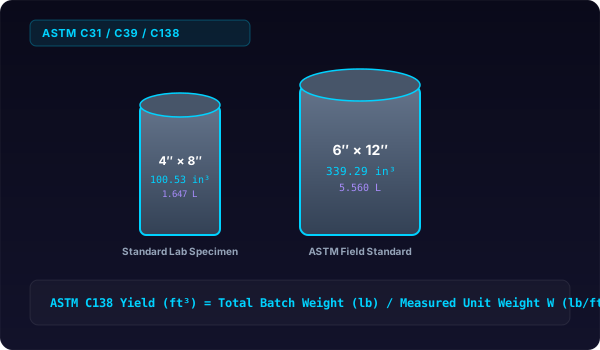
Concrete test cylinder volume uses V = π × r² × h. A standard 4-inch by 8-inch cylinder holds 100.53 in³ (0.0582 ft³ or 1.65 liters), weighing 8.44 pounds at 145 lb/ft³ density.
Quality assurance in civil construction relies on standard cylindrical concrete specimens to verify compliance with specified 28-day compressive strength (f'_c). Whether preparing field samples under ASTM C31 (Making and Curing Concrete Test Specimens in the Field) or auditing ready-mix delivery yield under ASTM C138 (Unit Weight, Yield, and Air Content of Concrete), accurate geometric calculations ensure valid quality control.
The Formula: Test Specimen Geometry and ASTM C138 Yield
A concrete test specimen is a right circular cylinder. Compressive strength testing under ASTM C39 and European standard EN 12390-1 requires strict adherence to standardized dimensions.
Single Cylinder Specimen Volume
For a cylinder of diameter D and height h:
V = π × r^2 × h = (π × D^2 × h / 4)- Standard 4 in × 8 in Cylinder:
V_4x8, cu in = (π × 4.0^2 × 8.0 / 4) = 32π ≈ 100.531 cu inV_4x8, cu ft = (100.531 / 1728) ≈ 0.058178 cu ft (1.6474 liters)- Standard 6 in × 12 in Cylinder:
V_6x12, cu in = (π × 6.0^2 × 12.0 / 4) = 108π ≈ 339.292 cu inV_6x12, cu ft = (339.292 / 1728) ≈ 0.196350 cu ft (5.5600 liters)For structural concrete volume estimation on pillars and footings, check out our cylinder volume in cubic yards tool and our concrete pillar calculation guide.
Total Test Set Sampling Volume
A standard compressive strength test set typically includes 5 cylinders (one tested at 7 days, two at 28 days, and two held as spares):
V_test set = N_cylinders × V_single × 1.15Where 1.15 includes a 15% sample collection waste and slump test allowance.
ASTM C138 Mix Batch Yield and Relative Yield
To verify that a ready-mix concrete producer delivers the full purchased volume:
Actual Batch Yield (cu ft) = (Total Mass of All Batch Materials Loaded (lbs) / W_measured density) (lbs/cu ft)Actual Batch Yield (cu yds) = (Actual Batch Yield (cu ft) / 27)Relative Yield (R_y) = (Actual Batch Yield (cu yds) / Design Batch Volume (cu yds))- If
R_y = 1.00: Exact yield matched. - If
R_y > 1.00: Mix is over-yielding (higher volume produced, often caused by higher air entrainment). - If
R_y < 1.00: Mix is under-yielding (contractor receives less volume than billed).
Reference Data: Standard Concrete Cylinder Specimen Specifications
The following engineering reference table outlines standard ASTM and EN test cylinder mold dimensions, cross-sectional areas, volumes, ASTM C31 consolidation rules, and specimen weights at typical normal-weight concrete density (145.0 lb/cu ft / 2,322.7 kg/m^3).
| Standard Mold Designation | Diameter × Height | Cross-Section Area | Specimen Volume (cu in / L) | Specimen Volume (cu ft / m³) | Rodding Consolidation (ASTM C31) | Specimen Weight at 145 lb/cu ft | Max Aggregate Size (NMAS) |
|---|---|---|---|---|---|---|---|
| 4″ × 8″ (ASTM Standard) | 4.0 in × 8.0 in (101.6 × 203.2 mm) | 12.566 sq in (81.07 cm²) | 100.53 cu in (1.647 L) | 0.0582 cu ft (0.00165 m³) | 2 Layers, 25 strokes/layer (3/8″ rod) | 8.44 lbs (3.83 kg) | 1.0 in (25.0 mm) |
| 6″ × 12″ (ASTM Standard) | 6.0 in × 12.0 in (152.4 × 304.8 mm) | 28.274 sq in (182.41 cm²) | 339.29 cu in (5.560 L) | 0.1964 cu ft (0.00556 m³) | 3 Layers, 25 strokes/layer (5/8″ rod) | 28.47 lbs (12.91 kg) | 2.0 in (50.0 mm) |
| 100 × 200 mm (EN 12390) | 100.0 mm × 200.0 mm (3.94 × 7.87″) | 78.54 cm² (12.17 sq in) | 1.571 Liters (95.86 cu in) | 0.00157 m³ (0.0555 cu ft) | 2 Layers (vibrated or rodded) | 3.65 kg (8.04 lbs) | 22.4 mm |
| 150 × 300 mm (EN 12390) | 150.0 mm × 300.0 mm (5.91 × 11.81″) | 176.71 cm² (27.39 sq in) | 5.301 Liters (323.53 cu in) | 0.00530 m³ (0.1872 cu ft) | 3 Layers (vibrated or rodded) | 12.31 kg (27.14 lbs) | 40.0 mm |
| 2″ × 4″ (Mortar/Grout) | 2.0 in × 4.0 in (50.8 × 101.6 mm) | 3.142 sq in (20.27 cm²) | 12.57 cu in (0.206 L) | 0.0073 cu ft (0.00021 m³) | 2 Layers, 25 strokes/layer (1/4″ rod) | 1.05 lbs (0.48 kg) | 3/8 in (9.5 mm) |
| 3″ × 6″ (Core Testing) | 3.0 in × 6.0 in (76.2 × 152.4 mm) | 7.069 sq in (45.60 cm²) | 42.41 cu in (0.695 L) | 0.0245 cu ft (0.00069 m³) | Laboratory drilled core | 3.56 lbs (1.61 kg) | 3/4 in (19.0 mm) |
Worked Examples
Worked Example 1: Metric Commercial Concrete Testing Laboratory Set
A quality control technician at an infrastructure project in Europe prepares a standard 6-cylinder set of 150.0 mm × 300.0 mm cylindrical specimens under EN 12390-2 to verify 7-day, 28-day, and 56-day compressive strengths. Concrete density is 2,400.0 kg/m³. Calculate single cylinder volume in liters, total net concrete volume for the 6-specimen set, gross sampling volume required (including a 15% allowance for slump and temperature testing), and total mass of sampled concrete.
Step 1: Calculate single cylinder radius and area.
r = (0.150 m / 2) = 0.075 mA = π × r^2 = 3.14159265 × 0.075^2 = 3.14159265 × 0.005625 = 0.01767146 m^2Step 2: Calculate single cylinder volume in cubic meters and liters.
V_single = 0.01767146 m^2 × 0.300 m = 0.00530144 m^3V_single, liters = 0.00530144 × 1000 = 5.30144 litersStep 3: Calculate net volume for 6 cylinders.
V_net = 6 × 5.30144 L = 31.8086 liters (0.031809 m³)Step 4: Add 15% sampling allowance.
V_gross = 31.8086 L × 1.15 = 36.5799 liters (0.036580 m³)Step 5: Calculate sample batch weight in kilograms.
Mass = 0.036580 m^3 × 2400.0 kg/m^3 = 87.792 kgThe technician samples approximately 36.6 liters (87.8 kg) of fresh concrete from the mixer discharge. Check volume metrics with our cylinder volume in liters tool.
Worked Example 2: Imperial Field Sampling Set of 6x12 Inch Cylinders
A testing agency takes a 5-cylinder sample of standard 6.0 in × 12.0 in cylinders from a ready-mix truck delivering structural column concrete (145.0 lb/cu ft unit weight). Calculate single cylinder volume in cubic inches and cubic feet, total volume in cubic feet, and total weight of the 5 test cylinders.
Step 1: Calculate single cylinder volume.
V = π × (3.0 in)^2 × 12.0 in = 3.14159265 × 9.0 × 12.0 = 339.2920 cu inV_cu ft = (339.2920 / 1728) = 0.196350 cu ftStep 2: Calculate total volume for 5 cylinders.
V_total, 5 cyl = 5 × 0.196350 cu ft = 0.98175 cu ftStep 3: Calculate total test cylinder weight.
Weight = 0.98175 cu ft × 145.0 lb/cu ft = 142.3538 lbsThe 5 test cylinders consume 0.982 cubic feet and weigh 142.35 lbs. For structural estimates on full round columns, see our concrete column volume estimation guide.
Worked Example 3: Edge Case ASTM C138 Ready-Mix Truck Batch Yield Audit
A contractor orders a 10.0-cubic-yard (270.0 ft^3) load of 4,000 PSI concrete for a bridge deck pour. The batch delivery ticket lists the following batched batch weights: Cement = 5,640 lbs, Fly Ash = 1,410 lbs, Coarse Aggregate = 18,200 lbs, Fine Aggregate = 11,800 lbs, Mixing Water = 2,370 lbs (Total Batch Weight = 39,420 lbs). The field technician tests the fresh concrete density under ASTM C138 using a 0.500-cu-ft calibrated measure, obtaining a unit weight W = 144.20 lb/cu ft. Calculate actual batch yield in cubic feet and cubic yards, and compute the relative yield (R_y).
Step 1: Calculate actual batch yield in cubic feet.
Actual Yield (cu ft) = (Total Batch Weight / Measured Unit Weight) = (39420.0 lbs / 144.20 lb/cu ft) = 273.3703 cu ftStep 2: Convert actual yield to cubic yards.
Actual Yield (cu yds) = (273.3703 cu ft / 27 cu ft/cu yd) = 10.1248 cu ydsStep 3: Compute Relative Yield (R_y).
R_y = (Actual Yield / Design Volume) = (10.1248 cu yds / 10.0000 cu yds) = 1.01248The relative yield is 1.0125, indicating that the ready-mix load is over-yielding by 1.25% (providing 0.125 extra cubic yards, typically due to 6.0% entrained air). The contractor is receiving full paid volume. You can verify concrete yardage with our cylinder volume in cubic yards calculator.
Common Mistakes in Concrete Cylinder Testing and Mix Yield
-
Using 4x8 Inch Molds with Oversized Aggregate ASTM C31 strictly prohibits using 4-inch by 8-inch cylinder molds when aggregate exceeds 1.0 inch (25 mm) nominal maximum size. Large aggregate bridging against mold walls creates internal honeycombing and artificially lowers measured compressive strength by up to 20%. When aggregate exceeds 1.0 inch, technicians must either use 6x12 inch molds or wet-sieve the sample over a 1-inch screen.
-
Under-Rodding or Omitting Mallet Tapping Failing to tap the outside of plastic cylinder molds with a rubber mallet after rodding leaves vertical voids created by the tamping rod. Trapped air pockets reduce measured 28-day break strength, causing false low-strength test reports that can trigger expensive core drilling investigations.
-
Ignoring Moisture Evaporation During Initial Field Curing Leaving fresh test cylinders exposed to direct sunlight and wind on the job site for the first 24 hours causes rapid moisture loss. ASTM C31 mandates maintaining field specimens in a controlled temperature environment between 60°F and 80°F (16°C to 27°C) with 100% relative humidity before laboratory transport.
-
Confusing Scale Batch Weight with Solid Volume in Yield Audits Attempting to audit ready-mix yield by adding uncorrected dry aggregate weights without measuring fresh unit weight ignores air entrainment and aggregate absorption. A concrete mix containing 6% entrained air produces 6% more volume than a zero-air mix of identical material mass. Always measure fresh unit weight with a calibrated measure under ASTM C138.
-
Testing Cylinders with Irregular, Uncapped End Bearing Surfaces The top finish of a field cylinder is never perfectly flat. Testing an uncapped or un-ground cylinder creates localized point loading, cutting measured compressive strength in half. ASTM C39 requires either sulfur mortar capping under ASTM C617 or bonded elastomeric neoprene pad caps in steel retainer rings under ASTM C1231.
Related Concrete and Civil Construction Volume Resources
For related engineering formulas, yardage estimators, and structural cylinder calculators, explore our technical guides:
- How to calculate concrete for round pillars
- Concrete column volume estimation
- Septic tank capacity and sizing by household occupancy
- Grain bin capacity in bushels and tonnes by crop
- Well casing volume for chlorination and disinfection dosing
- Circular Sonotube concrete calculator
- Cylindrical pile foundation volume guide
- Cylinder volume in cubic yards calculator
Strict adherence to ASTM C31 and C138 standards guarantees reliable compressive strength verification and accurate material yield control across all commercial concrete placements.