Engineering & Industrial · August 27, 2026
Well Casing Volume for Chlorination and Disinfection Dosing
Calculate standing water volume in well casings and shock chlorination bleach dosage. Follows AWWA C654 standards with charts, formulas, and verified examples.

- Well Casing Volume for Chlorination and Disinfection Dosing
- The Formula: Casing Geometry and Chlorine Dosage Calculation
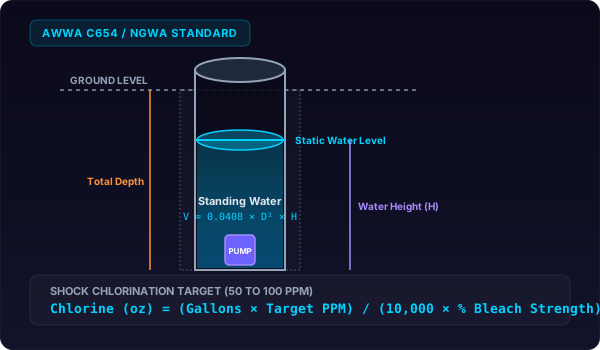
- Standing Water Column Height
- Standing Water Volume Formula
- Chlorine Disinfection Dosage Formula
- Reference Data: Standard Well Casing Dimensions and Chlorine Dosing
- Worked Examples
- Worked Example 1: Metric Potable Water Borehole Disinfection
- Worked Example 2: Imperial Residential 4-Inch Well Shock Chlorination
- Worked Example 3: Edge Case Agricultural Well with Gravel Pack Annular Space
- Common Mistakes in Well Casing Volume and Disinfection
- Related Well and Pipe Volume Engineering Resources
Well Casing Volume for Chlorination and Disinfection Dosing
Well casing water volume uses V = 0.0408 × D² × H. A 6-inch casing with 100 feet of standing water holds 146.9 gallons. Shock chlorination to 100 PPM requires 3.13 cups of 6% household bleach.
Drinking water wells require routine disinfection after initial drilling, pump replacement, casing repairs, or positive bacterial tests for total coliform and E. coli. Calculating standing water volume inside the cylindrical well casing is the critical prerequisite for delivering an accurate chemical shock dose under AWWA Standard C654 (Disinfection of Wells).
The Formula: Casing Geometry and Chlorine Dosage Calculation
A well casing is a vertical cylinder of circular pipe. Calculating total water volume requires knowing the inside diameter of the casing and the vertical height of standing water.
Standing Water Column Height
H_water = Total Well Depth - Static Water DepthFor example, if a well is 250 feet deep and the static water level rests at 70 feet below ground level, the standing water column height is 250 - 70 = 180 feet.
Standing Water Volume Formula
The geometric volume in cubic feet is derived from the standard cylinder equation:
V_cu ft = π × ≤ft(\frac(D_in)(2 × 12)\right)^2 × H_ft = \frac(π × D_in^2 × H_ft)576 ≈ 0.005454 × D_in^2 × H_ftMultiplying by 7.480519 gallons per cubic foot yields the standard well driller formula:
V_gal = 0.005454 × 7.480519 × D_in^2 × H_ft = 0.0408 × D_in^2 × H_ftIn metric units where diameter D is in meters and standing height H is in meters:
V_liters = \frac(π × D_m^2)4 × H_m × 1000 ≈ 785.398 × D_m^2 × H_mTo calculate water volume for custom pipe dimensions, check our cylinder volume from diameter tool and our hollow pipe volume calculator.
Chlorine Disinfection Dosage Formula
To achieve a target free chlorine concentration (expressed in parts per million, PPM, or milligrams per liter, mg/L), the required volume of liquid sodium hypochlorite bleach is:
Bleach Volume (fluid oz) = \frac(V_gal × Target PPM)(10000 × (\% Sodium Hypochlorite))In metric units:
Bleach Volume (liters) = \frac(V_liters × Target mg/L)(10000 × (\% Active Chlorine))Standard household bleach typically contains 6.0% sodium hypochlorite (60,000 mg/L available chlorine), while industrial pool shock or NSF-certified water treatment bleach contains 10.0% to 12.5%.
Reference Data: Standard Well Casing Dimensions and Chlorine Dosing
The following reference table outlines standard well casing sizes, internal water capacity per foot and meter, and the required volume of 6.0% household bleach per 100 feet of standing water across standard disinfection target levels.
| Casing Inside Diameter (in) | Outside Diameter (mm) | Gallons per Foot (gal/ft) | Liters per Meter (L/m) | Bleach (6.0%) for 100 ft at 50 PPM | Bleach (6.0%) for 100 ft at 100 PPM | Bleach (6.0%) for 100 ft at 200 PPM |
|---|---|---|---|---|---|---|
| 4.0 in (Steel/PVC) | 114.3 mm | 0.6528 gal/ft | 8.107 L/m | 5.44 fl oz (0.68 cups) | 10.88 fl oz (1.36 cups) | 21.76 fl oz (2.72 cups) |
| 5.0 in (Steel/PVC) | 141.3 mm | 1.0200 gal/ft | 12.667 L/m | 8.50 fl oz (1.06 cups) | 17.00 fl oz (2.13 cups) | 34.00 fl oz (4.25 cups) |
| 6.0 in (Standard Res) | 168.3 mm | 1.4688 gal/ft | 18.241 L/m | 12.24 fl oz (1.53 cups) | 24.48 fl oz (3.06 cups) | 48.96 fl oz (6.12 cups) |
| 6.25 in (Steel Casing) | 177.8 mm | 1.5938 gal/ft | 19.792 L/m | 13.28 fl oz (1.66 cups) | 26.56 fl oz (3.32 cups) | 53.13 fl oz (6.64 cups) |
| 8.0 in (Commercial) | 219.1 mm | 2.6112 gal/ft | 32.428 L/m | 21.76 fl oz (2.72 cups) | 43.52 fl oz (5.44 cups) | 87.04 fl oz (10.88 cups) |
| 10.0 in (Ag/Municipal) | 273.0 mm | 4.0800 gal/ft | 50.669 L/m | 34.00 fl oz (4.25 cups) | 68.00 fl oz (8.50 cups) | 136.00 fl oz (1.06 gal) |
| 12.0 in (Irrigation) | 323.8 mm | 5.8752 gal/ft | 72.964 L/m | 48.96 fl oz (6.12 cups) | 97.92 fl oz (12.24 cups) | 195.84 fl oz (1.53 gal) |
| 16.0 in (Industrial) | 406.4 mm | 10.4448 gal/ft | 129.713 L/m | 87.04 fl oz (10.88 cups) | 174.08 fl oz (1.36 gal) | 348.16 fl oz (2.72 gal) |
Worked Examples
Worked Example 1: Metric Potable Water Borehole Disinfection
A municipal monitoring well in Europe is lined with a 150 mm inside diameter PVC casing. The total drilled depth is 65.0 meters, and the measured static water level is 20.0 meters below ground surface. The target disinfection concentration under AWWA C654 is 100 mg/L (PPM) free chlorine using technical sodium hypochlorite solution containing 5.0% active chlorine. Calculate standing water volume in liters and the required bleach dosage in liters.
Step 1: Calculate standing water column height.
H_water = 65.0 m - 20.0 m = 45.0 mStep 2: Calculate cross-sectional casing area.
D = 150 mm = 0.150 mr = 0.075 mA = π × r^2 = 3.14159265 × 0.075^2 = 0.0176715 m^2Step 3: Calculate standing water volume in liters.
V = A × H × 1000 = 0.0176715 m^2 × 45.0 m × 1000 = 795.216 litersYou can confirm these metric liquid measurements with our cylinder volume in liters tool.
Step 4: Calculate pure chlorine mass required.
Chlorine Mass (grams) = \frac(V_liters × Target mg/L)1000 = (795.216 × 100 / 1000) = 79.5216 gramsStep 5: Calculate required volume of 5.0% bleach solution.
Bleach (liters) = (Chlorine Mass / \% Active Chlorine × 1000 g/L) = (79.5216 / 0.05 × 1000) = (79.5216 / 50) = 1.5904 litersThe operator adds exactly 1.59 liters of 5.0% sodium hypochlorite to achieve the 100 mg/L target.
Worked Example 2: Imperial Residential 4-Inch Well Shock Chlorination
A homeowner has a 4-inch inside diameter residential well. The drilling report shows total well depth of 180 feet. A water level tape confirms the static water level is at 60 feet. Following a positive total coliform test, the local health department recommends a 200 PPM shock dose using standard 6.0% unscented household bleach. Calculate standing water volume in gallons and bleach volume in fluid ounces and pints.
Step 1: Calculate standing water column height.
H_water = 180 ft - 60 ft = 120 ftStep 2: Calculate standing water volume in gallons.
V_gal = 0.0408 × D^2 × H = 0.0408 × 4^2 × 120 = 0.0408 × 16 × 120 = 78.336 gallonsStep 3: Calculate required 6.0% bleach volume.
Bleach (fl oz) = \frac(V_gal × PPM)(10000 × (\% Bleach)) = (78.336 × 200 / 10000 × 0.06) = (15667.2 / 600) = 26.112 fluid ouncesStep 4: Convert to pints and cups.
Pints = (26.112 / 16 oz/pt) = 1.632 pintsCups = (26.112 / 8 oz/cup) = 3.264 cupsThe homeowner pours 3.26 cups (approx. 1.63 pints) of 6.0% bleach into the casing, mixed with 5 gallons of water.
Worked Example 3: Edge Case Agricultural Well with Gravel Pack Annular Space
A large agricultural irrigation well features a 12-inch inside diameter steel casing installed within an 18-inch diameter drilled borehole. The standing water column is 200 feet deep. The annular space between the 12-inch casing (outside diameter 12.75 inches) and the 18.0-inch borehole wall is backfilled with silica gravel pack possessing an effective porosity of 30% (p = 0.30). Calculate the internal casing water volume, annular gravel pack water volume, total water volume, and 100 PPM chlorine dosage using 12.5% industrial sodium hypochlorite.
Step 1: Calculate internal casing water volume.
V_casing, gal = 0.0408 × 12^2 × 200 = 0.0408 × 144 × 200 = 1175.04 gallonsStep 2: Calculate water volume in annular gravel pack. The annular area is the hollow cylindrical difference between borehole and casing:
A_annular, sq ft = \frac(π × (D_hole^2 - D_casing, OD^2))(4 × 144) = (3.14159265 × (18.0^2 - 12.75^2) / 576) = (3.14159265 × (324 - 162.5625) / 576) = (3.14159265 × 161.4375 / 576) = 0.8805 sq ftAnnular Total Bulk Volume = 0.8805 sq ft × 200 ft = 176.10 cu ftWater Volume in Voids (30% porosity) = 176.10 cu ft × 0.30 × 7.480519 gal/cu ft = 395.20 gallonsStep 3: Calculate total water volume requiring treatment.
V_total = 1175.04 gal (casing) + 395.20 gal (gravel pack) = 1570.24 gallonsStep 4: Calculate 12.5% sodium hypochlorite required for 100 PPM target.
Bleach (gallons) = \frac(V_gal × PPM)(10000 × (\% Bleach) × 128 oz/gal) = (1570.24 × 100 / 10000 × 0.125 × 128) = (157024 / 160000) = 0.9814 gallons (125.6 fl oz)The driller adds approximately 0.98 gallons of 12.5% technical sodium hypochlorite. For estimating total dirt removed while drilling this 18-inch borehole, see our guide on how much dirt comes out of a borehole.
Common Mistakes in Well Casing Volume and Disinfection
-
Calculating Volume from Total Drilled Depth Instead of Standing Water Using total drilled depth rather than standing water height is the most prevalent chlorination mistake. In a 400-foot well with a static water level at 50 feet, standing water is 350 feet. In a well with static water at 320 feet, standing water is only 80 feet. Calculating chemical dosage on 400 feet in the second case overdoses the water five-fold, causing pump corrosion and pipe scale peeling.
-
Pouring Undiluted High-Strength Bleach Directly Down the Casing Concentrated sodium hypochlorite (pH 11 to 13) is extremely corrosive to pump impellers, electrical wiring insulation, and brass check valves. Pouring neat bleach directly down the casing creates high-density chemical stratification at the well bottom. Always pre-mix bleach with 5 to 10 gallons of clean water in a bucket before introducing it into the well head.
-
Failing to Sanitize Household Distribution Lines and Water Heater Sanitizing the casing without drawing chlorinated water through every indoor tap leaves plumbing lines contaminated. Open every cold and hot fixture until a strong chlorine odor is detected, then close the faucets to let the solution sit inside all indoor pipes for 12 to 24 hours.
-
Bypassing Water Treatment Equipment and Carbon Filters Chlorine rapidly degrades and fouls water softener ion exchange resins and oxidizes carbon block filters. Always place water softeners, iron filters, and whole-house filtration cartridges into bypass mode before introducing shock chlorine into household lines.
-
Discharging Chlorinated Wastewater into the Septic System Pumping hundreds of gallons of heavily chlorinated water (100 to 200 PPM) into a residential septic tank kills the beneficial anaerobic bacterial colony responsible for breaking down solids. When flushing the well post-disinfection, route the hose onto an open grassy field or gravel driveway away from lakes, streams, and septic drain fields until the water runs completely clear of chlorine.
Related Well and Pipe Volume Engineering Resources
For related calculations on piping, water storage, and cylindrical tanks, review these technical guides:
- Plumber guide to measuring pipe volume and fluid flow
- How to calculate water tank capacity at home
- Septic tank capacity and sizing by household occupancy
- Rainwater harvesting tank sizing calculation
- How much dirt comes out of a borehole
- Cylinder capacity in gallons and cubic feet guide
- Cylinder volume in gallons calculator
Accurate casing volume calculations guarantee effective biological decontamination while protecting submersible pumping systems and residential water quality.