Engineering & Industrial · August 27, 2026
Rainwater Harvesting Tank Sizing from Roof Area and Rainfall
Calculate rainwater harvesting tank capacity, roof catchment runoff yield, and first-flush diverters using ARCSA/ASABE 63-2020 and BS 8515 standards.
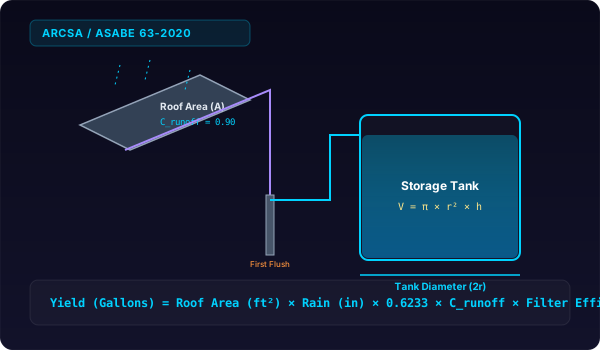

- Rainwater Harvesting Tank Sizing from Roof Area and Rainfall
- The Formula: Roof Catchment Yield and Cistern Sizing
- US Customary Catchment Yield Formula
- Metric Catchment Yield Formula
- First-Flush Diverter Volume Formula
- Cylindrical Cistern Sizing (Dry Buffer Method)
- Reference Data: Roof Material Runoff Factors and Water Quality
- Worked Examples
- Worked Example 1: Metric Eco-Home Monthly Yield and Polyethylene Tank Sizing
- Worked Example 2: Imperial Annual Catchment Yield and 21-Day Buffer Cistern
- Worked Example 3: Edge Case First-Flush Diverter Pipe Sizing for Commercial Building
- Common Mistakes in Rainwater Harvesting Tank Sizing
- Related Water and Tank Volume Resources
Rainwater Harvesting Tank Sizing from Roof Area and Rainfall
Harvested rainwater volume uses V = A_roof × R × C_runoff × η. A 2,000-square-foot roof with 3 inches of rain (C = 0.90, η = 0.95) generates 3,198 gallons, requiring an 8-foot by 9-foot cylindrical tank.
Rainwater harvesting systems collect precipitation from roof surfaces for non-potable applications such as landscape irrigation, toilet flushing, laundry washing, and whole-house potable filtration. Proper cylindrical cistern sizing under ARCSA/ASABE Standard 63-2020 (Rainwater Catchment Systems) and BS 8515:2009 balances monthly rainfall supply with household consumption.
The Formula: Roof Catchment Yield and Cistern Sizing
The volume of harvestable rainwater depends on horizontal roof area, precipitation depth, surface runoff efficiency, and pre-filtration losses.
US Customary Catchment Yield Formula
In US Customary units where roof area A is in square feet and rainfall R is in inches:
V_gallons = A_sq ft × R_inches × 0.6233 × C_runoff × η_filterWhere:
0.6233is the conversion factor from inch-square feet to US liquid gallons (1 inch of rain on 1 sq ft = 0.62333 gallons).C_runoffis the surface runoff coefficient (0.75 to 0.95).η_filteris the hydraulic filter efficiency (0.90 to 0.95, accounting for first-flush rejection and vortex filter bypass).
Metric Catchment Yield Formula
In SI Metric units where roof area A is in square meters and rainfall R is in millimeters:
V_liters = A_sq meters × R_mm × C_runoff × η_filterBecause 1 millimeter of rain on 1 square meter = 1.0 liter, no conversion multiplier is required.
To calculate storage capacity for cylindrical rainwater tanks, use our tank volume calculator and vertical cylinder calculator.
First-Flush Diverter Volume Formula
To remove initial roof dirt, bird droppings, and airborne dust before tank entry under ARCSA 63-2020:
V_first flush, gal = \frac(A_sq ft)100 × (1.0 to 2.0 gallons)In metric units:
V_first flush, liters = A_sq meters × (0.4 to 0.8 liters/m^2)Cylindrical Cistern Sizing (Dry Buffer Method)
For a household with daily non-potable water consumption Q_daily and a design dry-spell buffer of N_days (typically 15 to 21 days between rain events):
V_tank, min = Q_daily × N_daysV_tank = π × r^2 × h = (π × D^2 × h / 4)Reference Data: Roof Material Runoff Factors and Water Quality
The following engineering reference table details catchment runoff coefficients (C_runoff), filter efficiencies, and water quality suitability under ARCSA/ASABE 63-2020 and BS 8515 standards.
| Catchment Surface Material | Runoff Coefficient (C) | Typical Filter Efficiency (η) | Net Harvest Yield per 1″ Rain / 1,000 sq ft | Net Harvest Yield per 25 mm Rain / 100 m² | Water Quality Ranking | Recommended Use |
|---|---|---|---|---|---|---|
| Standing Seam Metal / Coated Steel | 0.95 | 0.95 | 562 gallons | 2,256 liters | Excellent (Low Contaminants) | Potable / Whole House / Irrigation |
| Corrugated Galvanized Iron | 0.90 | 0.95 | 533 gallons | 2,138 liters | Good (Zinc Leaching at Low pH) | Irrigation / Toilet / Laundry |
| Glazed Ceramic / Clay Tile | 0.90 | 0.90 | 505 gallons | 2,025 liters | Very Good (Inert Material) | Potable / Toilet / Irrigation |
| Concrete Tile (Sealed) | 0.85 | 0.90 | 477 gallons | 1,913 liters | Good (Mild Alkalinity) | Irrigation / Toilet / Laundry |
| Asphalt Fiberglass Shingle | 0.80 | 0.90 | 449 gallons | 1,800 liters | Fair (Grit & Particle Loss) | Irrigation / Landscape Only |
| EPDM / TPO Smooth Membrane | 0.90 | 0.95 | 533 gallons | 2,138 liters | Good (Commercial Flat Roofs) | Toilet / Cooling Tower / Irrigation |
| Green Vegetative Roof | 0.30 | 0.85 | 159 gallons | 638 liters | High Organic Content | Stormwater Mitigation Only |
Worked Examples
Worked Example 1: Metric Eco-Home Monthly Yield and Polyethylene Tank Sizing
A residential property in Europe features a coated steel roof with a horizontal projected area of 180.0 square meters (A = 180.0 m^2, C = 0.95). Average monthly rainfall in October is 75.0 mm. The downspout vortex filter operates at 90.0% efficiency (η = 0.90). Calculate total harvestable water yield in liters and cubic meters, and determine the height required for a standard 2.40-meter diameter cylindrical polyethylene cistern.
Step 1: Calculate monthly harvested rainwater yield in liters.
V_liters = A × R × C × η = 180.0 m^2 × 75.0 mm × 0.95 × 0.90 = 13500 × 0.8550 = 11542.50 litersStep 2: Convert to cubic meters.
V_cu meters = (11542.50 liters / 1000 L/m^3) = 11.5425 m^3You can verify metric volume calculations with our cylinder volume in cubic meters tool.
Step 3: Calculate required cylindrical tank height (D = 2.40 m).
r = (2.40 m / 2) = 1.20 mA_tank = π × r^2 = 3.14159265 × 1.20^2 = 3.14159265 × 1.44 = 4.523893 m^2h = (V / A_tank) = (11.5425 m^3 / 4.523893 m^2) = 2.55145 metersThe homeowner specifies a standard 2.40-meter diameter by 2.60-meter tall cylindrical storage tank holding 11,760 liters. Check dimensions using our cylinder volume in liters tool.
Worked Example 2: Imperial Annual Catchment Yield and 21-Day Buffer Cistern
A suburban home in Atlanta has an asphalt shingle roof with a horizontal footprint of 2,500 square feet (A = 2,500 sq ft, C = 0.80). Annual rainfall is 38.0 inches. Pre-tank leaf screens operate at 95.0% efficiency (η = 0.95). The household uses 80.0 gallons per day of harvested water for toilet flushing and laundry. Calculate total annual harvestable yield in gallons, and size a cylindrical cistern providing a 21-day dry-spell buffer.
Step 1: Calculate annual harvestable yield.
V_annual = 2500 sq ft × 38.0 in × 0.6233 × 0.80 × 0.95 = 95000 × 0.6233 × 0.76 = 59213.5 × 0.76 = 45002.26 gallonsStep 2: Calculate minimum 21-day dry buffer capacity.
V_buffer = 80.0 gal/day × 21 days = 1680.00 gallonsStep 3: Convert buffer capacity to cubic feet.
V_cu ft = (1680.00 gal / 7.480519 gal/cu ft) = 224.5833 cu ftStep 4: Determine cylindrical cistern dimensions with 6.0-foot diameter.
r = 3.0 ftA_base = π × 3.0^2 = 3.14159265 × 9.0 = 28.27433 sq fth = (224.5833 cu ft / 28.27433 sq ft) = 7.9430 feetA 6-foot diameter by 8-foot tall cylindrical cistern holds 1,692 gallons, comfortably satisfying the 21-day buffer requirement. Sizing calculations can be checked with our cylinder volume in gallons tool.
Worked Example 3: Edge Case First-Flush Diverter Pipe Sizing for Commercial Building
A commercial warehouse has a 3,000-square-foot standing seam metal roof (A = 3,000 sq ft). Under ARCSA 63-2020 guidelines, the engineer specifies a first-flush diversion volume of 1.50 gallons per 100 square feet of roof area. The first-flush diverter is constructed using a vertical 6-inch Schedule 40 PVC pipe. Calculate the required first-flush diversion volume in gallons and cubic feet, and determine the necessary vertical pipe length.
Step 1: Calculate total first-flush diversion volume.
V_diverter, gal = (3000 sq ft / 100) × 1.50 gallons = 30.0 × 1.50 = 45.00 gallonsStep 2: Convert to cubic feet.
V_diverter, cu ft = (45.00 gal / 7.480519 gal/cu ft) = 6.0156 cu ftStep 3: Determine 6-inch PVC pipe internal dimensions.
Standard 6-inch Schedule 40 PVC has an inside diameter of 6.065 inches (r = 3.0325 in = 0.252708 ft).
A_pipe = π × (0.252708 ft)^2 = 3.14159265 × 0.063861 = 0.200627 sq ftStep 4: Calculate required vertical pipe length.
L_pipe = \frac(V_diverter, cu ft)(A_pipe) = (6.0156 cu ft / 0.200627 sq ft) = 29.984 feetBecause a single 30-foot vertical pipe is impractical, the engineer specifies three parallel 10-foot 6-inch PVC diverter columns at separate downspout locations. For gutter flow calculations, see our water volume in a half pipe channel guide.
Common Mistakes in Rainwater Harvesting Tank Sizing
-
Using Sloped Roof Surface Area Instead of Horizontal Footprint Measuring along the slope of a steep roof overestimates collection area by 15% to 40%. Because rain falls vertically, a 2,000-square-foot horizontal floor plan intercepts the exact same precipitation volume whether the roof is flat or pitched at 45 degrees. Always use the horizontal projected building footprint.
-
Omitting the Catchment Runoff Coefficient (
C) Assuming 100% of rain entering the roof ends up in the tank is a major planning mistake. Porous tiles, rough shingles, evaporation on hot summer roofs, and gutter splash-out consume 10% to 25% of gross rainfall. Failing to multiply by the runoff coefficient leads to under-sized backup storage and system run-out. -
Neglecting First-Flush Diverter Volume Rejection Failing to deduct the water discarded by first-flush diverters from monthly yield calculations overestimates usable cistern inflow, especially during short, frequent summer showers where the entire rainfall volume is consumed by the diverter chamber.
-
Sizing Cisterns for Peak Annual Rain Rather Than Dry Spell Buffers Buying a massive 20,000-gallon tank to capture every drop of spring rainfall when household demand is only 2,000 gallons per month results in wasted capital. The tank sits 90% full with stagnant water, while spending that budget on multi-stage pre-filtration produces higher quality water. Size tanks to balance dry-season consumption with historical rainfall intervals.
-
Inadequate Overflow Sizing Causing Tank Wall Hydrostatic Failure Connecting four 4-inch downspouts into a tank with a single 3-inch overflow pipe causes the tank to pressurize internally during torrential downpours. Above-ground poly tanks are gravity structures not rated for hydrostatic head pressure. When the overflow restricts flow, water backs up into vents, rupturing top inspection covers and flooding basements. Always ensure overflow pipe cross-sectional area equals or exceeds total combined inlet area.
Related Water and Tank Volume Resources
For related engineering formulas, piping guides, and cylinder capacity calculators, explore our technical library:
- How to calculate water tank capacity at home
- Water volume in a half pipe channel
- Septic tank capacity and sizing by household occupancy
- Well casing volume for chlorination and disinfection dosing
- HVAC round duct volume and air changes per hour
- Plumber guide to measuring pipe volume and fluid flow
- Vertical cylinder tank calculator
- Cylinder volume in gallons calculator
Applying ARCSA 63-2020 standards ensures optimal rainwater storage sizing, protecting residential water security and sustainable stormwater management.