Guides · June 11, 2026
Industrial Silo Volume Calculator: Bushels, m3 and Tons
Calculate farm and industrial silo storage capacity. Combines cylinder body and cone hopper volume to get cubic feet, cubic metres, bushels and tons.

- The Silo Volume Formula
- Why a Silo Is Not Just a Cylinder
- Step-by-Step: Calculating Industrial Silo Volume
- Worked Example 1 — Imperial, Flat-Bottom Grain Bin (Bushels)
- Worked Example 2 — Metric, Cylinder + Hopper Cone (Liters)
- Worked Example 3 — The Heaped-Cone Edge Case (Information Gain)
- Grain Bulk Density: Bushels and Tonnes
- Common Mistakes to Avoid
- Frequently Asked Questions
- How do you calculate the volume of a silo?
- How many bushels does a grain silo hold?
- What is the formula for a silo with a hemispherical top?
- Why does my silo hold less grain than its rated volume?
- Does the peak of grain at the top really matter?
- How do I convert silo volume from cubic meters to bushels?
- What’s the difference between a grain bin and a silo?
- Are US and UK bushels the same?
- Sources & Verification
The volume of an industrial silo equals the cylinder body plus its cone sections: V = π × r² × h + ⅓ × π × r² × hₒₒₙₑ. Quick check: a 27 ft diameter farm bin filled to 20 ft of level grain holds π × 13.5² × 20 = 11,451 ft³, which is 9,201 bushels (11,451 ÷ 1.2445) — about 258 tons of corn. An industrial silo volume calculator just runs that geometry for you, but understanding the parts is what keeps your capacity numbers honest.
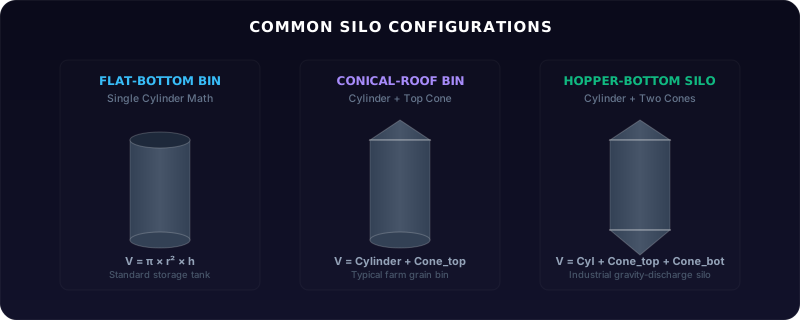
The mistake nearly everyone makes is treating a silo as one plain cylinder. Real agricultural silo dimensions almost always include a cone — a hopper at the bottom, a peaked roof on top, or both — and grain itself stacks into a cone when you fill or empty a bin. Skip those, and your estimate can be off by 10% or more.
The Silo Volume Formula
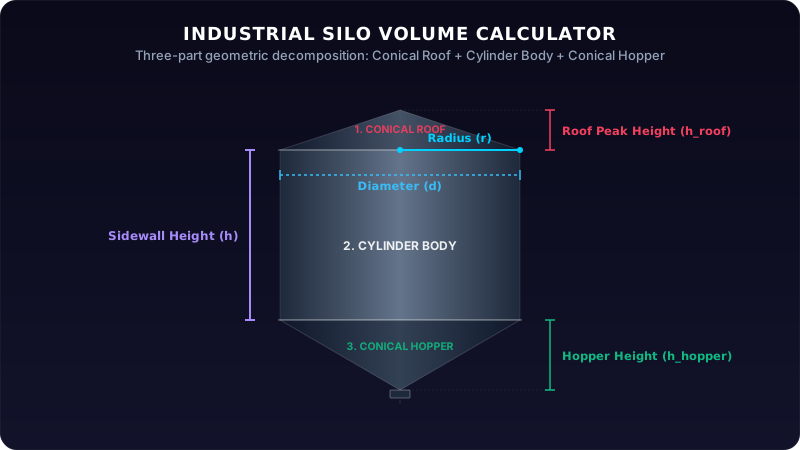
A silo is a stack of simple shapes. You find the volume of each and add them.
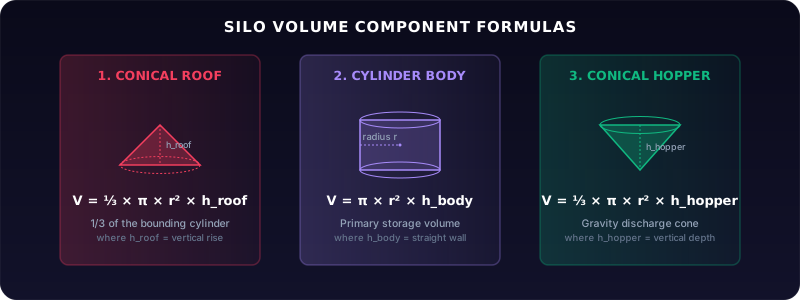
Cylinder body:
V_cylinder = π × r² × hCone (roof or hopper bottom):
V_cone = ⅓ × π × r² × h_coneHemispherical dome (some liquid/cement silos):
V_dome = ⅔ × π × r³So a typical conical-roof, hopper-bottom silo is:
V_total = (π × r² × h) + (⅓ × π × r² × h_top) + (⅓ × π × r² × h_bottom)Here r is the radius (diameter ÷ 2), h is the straight sidewall height, and each h_cone is the vertical height of that cone — not its slanted side. For the geometry behind these formulas, Wolfram MathWorld’s cylinder reference is a solid primer.
If your silo is a plain flat-bottom, flat-top bin, you only need the cylinder term — the same math our free cylinder volume calculator runs.
Why a Silo Is Not Just a Cylinder
Three real-world features separate a true cylindrical bin volume from the textbook cylinder:
- The hopper bottom. Many feed and seed silos sit on a steep cone so grain self-discharges. That cone is dead-simple to forget and removes (or adds) real capacity.
- The roof. Conical and domed roofs add usable headspace. Manufacturers like GSI quote peak heights for “30 degree slope roofs,” which is extra volume above the sidewall.
- The grain itself cones. When you fill a bin through a center spout, grain piles into a peak. When you draw it down, it funnels into an inverted cone. This is the angle of repose, and it’s the single biggest source of estimating error.
That last point is the one competitor calculators quietly skip — and it’s worth its own section below.
(If you are dealing with tanks that are tilted during transport or installed on a slope, you can refer to our guide on how to calculate the volume of a partially filled tilted cylinder.)
Step-by-Step: Calculating Industrial Silo Volume
- Measure or look up the diameter, then halve it for the radius. If you only have the circumference, radius = circumference ÷ (2π).
- Measure the straight sidewall height (the cylinder section only).
- Measure each cone height — the vertical rise of the roof peak and/or hopper bottom.
- Calculate each shape’s volume with the formulas above, keeping units consistent.
- Add them together for total volume.
- Convert to your target unit — liters, cubic feet, bushels, or tonnes.
A quick sanity check: for any cone, the volume is exactly one-third of the cylinder with the same base and height. If your cone term ever comes out larger than that, you’ve made an error.
Worked Example 1 — Imperial, Flat-Bottom Grain Bin (Bushels)
Farm grain bins commonly run 15–48 ft in diameter (the standard Sukup and Sioux Steel farm range). Take a 27 ft diameter bin filled to 20 ft of level grain:
- Radius = 27 ÷ 2 = 13.5 ft
- V = π × 13.5² × 20 = 3.14159 × 182.25 × 20 = 11,451 ft³
- Bushels = 11,451 ÷ 1.2445 = 9,201 bushels
- As corn (56 lb/bushel): 9,201 × 56 = 515,256 lb ÷ 2,000 = 258 tons
That’s how a grain silo capacity in bushels is built from raw volume — calculate cubic feet first, then divide by the USDA constant.
Worked Example 2 — Metric, Cylinder + Hopper Cone (Liters)
A feed silo with a 3 m diameter, 6 m sidewall, and a 1.5 m conical hopper bottom:
- Radius = 1.5 m
- Cylinder: π × 1.5² × 6 = 42.41 m³
- Hopper cone: ⅓ × π × 1.5² × 1.5 = 3.53 m³
- Total = 42.41 + 3.53 = 45.94 m³ = 45,940 liters
- In US bushels: 45.94 × 28.378 = 1,304 bushels
Notice the hopper adds only ~8% here because its cone is short relative to the body. On a steep 45° hopper, that share climbs fast.
(For other cylindrical storage configurations, like cooling systems or mineral oil reserves, check out our guide on transformer cylindrical tank oil capacity.)
Worked Example 3 — The Heaped-Cone Edge Case (Information Gain)
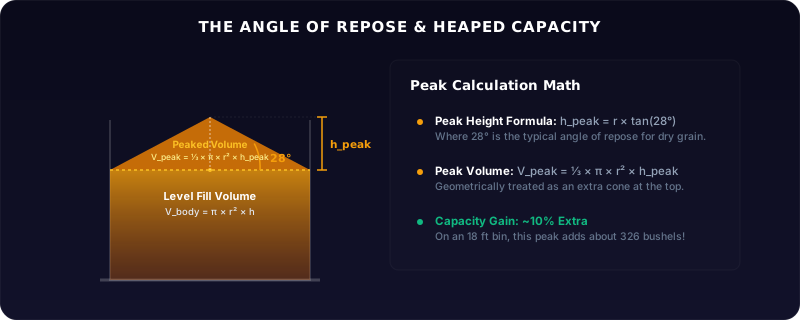
Here’s what most calculators miss. Take an 18 ft diameter bin filled level to 16 ft, then filled to a natural peak. Grain’s angle of repose is roughly 28° (Engineering Toolbox lists bulk-solid repose angles, and GSI rates its bins on a 28° basis):
- Level fill: π × 9² × 16 = 4,072 ft³ = 3,272 bushels
- Peak height: r × tan(28°) = 9 × 0.532 = 4.79 ft
- Peaked cone: ⅓ × π × 9² × 4.79 = 406 ft³ = 326 bushels
- Total heaped: 3,272 + 326 = 3,598 bushels
That peak adds 10% more capacity — 326 bushels you’d lose if you stopped at the cylinder. The reverse happens on discharge: a center-unloading bin cones down, so a bin that looks “half full” by height may hold far less than half its rated grain. This is exactly the “material coned down” toggle you’ll see on professional silo tools, and it’s the difference between a textbook number and a real one.
(Additionally, if you need to calculate the capacity of open-channel flows or drainage channels on site, see our guide on water volume in a half pipe.)
Grain Bulk Density: Bushels and Tonnes
Volume is one number; weight is another. A bushel is a fixed volume (1.2445 ft³ / 35.24 L), but each grain weighs differently. These are the USDA standard test weights used across US grain trade:
| Grain | lb / bushel | Bulk density (kg/m³) | Standard moisture |
|---|---|---|---|
| Wheat | 60 | ~772 | 13.5% |
| Soybeans | 60 | ~772 | 13.0% |
| Corn (shelled) | 56 | ~721 | 15.5% |
| Sorghum | 56 | ~721 | 13.0% |
| Barley | 48 | ~618 | 14.5% |
| Oats | 32 | ~412 | 14.0% |
To get weight: bushels × lb-per-bushel ÷ 2,000 = US tons. For metric, multiply silo volume in m³ by the bulk density (kg/m³) and divide by 1,000 for tonnes. Grain stored wetter than standard moisture weighs more per bushel; over-dried grain weighs less. You can cross-check any volume-to-weight step with our cylinder weight calculator.

Common Mistakes to Avoid
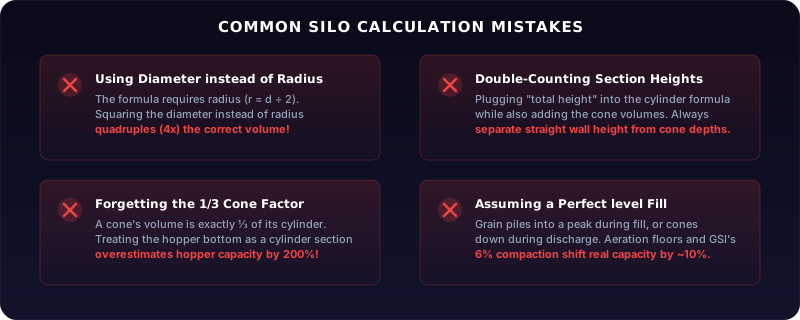
- Using diameter as radius. The most frequent error in any cylinder volume calculation. Always halve the diameter first.
- Counting the full cone as a cylinder. A cone is one-third the volume of its bounding cylinder — never the same.
- Forgetting the hopper or roof. Real agricultural silo dimensions include cones; a pure cylinder estimate undercounts a coned roof and overcounts a hopper-bottom’s usable storage.
- Ignoring usable vs. theoretical capacity. Operators typically plan for ~90–95% of theoretical volume to allow for aeration floors, unloading gear, and a safety margin. GSI even bakes a ~6% grain compaction factor into its rated capacities.
- Mixing units. Keep everything in feet or meters before converting. Convert at the end, not mid-calculation.
For a deeper look at how a cone differs from its cylinder, see our cylinder vs cone volume explainer, or convert a finished figure with the volume in liters tool.
Frequently Asked Questions
How do you calculate the volume of a silo?
Add the cylinder body (π × r² × h) to any cone sections (⅓ × π × r² × h_cone). For a plain flat bin, the cylinder term alone is enough.
How many bushels does a grain silo hold?
Calculate the volume in cubic feet, then divide by 1.2445 (the USDA bushel constant). A 27 ft bin filled to 20 ft holds about 9,201 bushels.
What is the formula for a silo with a hemispherical top?
V = π × r² × h + ⅔ × π × r³. The cylinder body plus a half-sphere. Common on some liquid and cement silos rather than grain bins.
Why does my silo hold less grain than its rated volume?
Two reasons: usable capacity is normally only 90–95% of theoretical volume, and when grain unloads from the center it cones downward, leaving the bin emptier than its fill height suggests. Compaction (around 6%) also reduces effective volume slightly over time.
Does the peak of grain at the top really matter?
Yes. Grain piles to its angle of repose (about 28°), forming a cone on top. On an 18 ft bin that peak alone can add roughly 10% more capacity — several hundred bushels you’d miss with a level-fill estimate.
How do I convert silo volume from cubic meters to bushels?
Multiply cubic meters by 28.378. So 45.94 m³ equals about 1,304 US bushels. One cubic meter equals 1,000 liters or 35.31 cubic feet.
What’s the difference between a grain bin and a silo?
Loosely, “bin” usually means a wider, flatter steel grain store and “silo” a taller tower, but the volume math is identical — cylinder plus any cones. Both use the same cylindrical bin volume formula.
Are US and UK bushels the same?
No. A US dry bushel is 35.24 liters (1.2445 ft³); the UK Imperial bushel is about 36.37 liters — roughly 3% larger. Always confirm which standard a contract uses.
Sources & Verification
Bushel conversion (1 bushel = 1.2445 ft³ = 2,150.42 in³ = 35.24 L) and grain test weights are USDA standards (USDA Weights, Measures, and Conversion Factors for Agricultural Commodities). Standard farm bin diameters (15–48 ft) and the 28° angle-of-repose / 6% compaction design basis are published by grain-bin manufacturers GSI and Sukup. Geometry formulas follow standard references including Wolfram MathWorld. All calculations in this article were independently verified.
Author: CylinderVolume-Calculator.com Editorial Team
Published: 11 June 2026 · Last reviewed: 11 June 2026
Fact-checked by: CVC Editorial Team. This article was drafted with AI assistance and reviewed for accuracy by the site editor; all calculations independently verified.