Guides · October 26, 2026
55 Gallon Drum Volume: Dimensions, Formula, and Worked Examples
55 gallon drum volume explained with verified math: a standard drum measures about 22.5 inches across and 33.5 inches tall, and its nominal capacity is 55 US gallons (208 liters).

- The short answer
- Standard dimensions
- The formula
- Worked example
- Why the cylinder result differs from 55 gallons
- Partial fill chart
- Drum size comparison: 15, 30, and 55 gallons
- The 42 gallon oil barrel vs the 55 gallon drum
- Common mistakes and traps
- Sizing guidance and measuring your own drum
- Frequently asked questions
- How many gallons does a 55 gallon drum actually hold?
- How tall and wide is a 55 gallon drum?
- How many liters are in a 55 gallon drum?
- Is a 55 gallon drum the same as a barrel of oil?
- How much does a full 55 gallon drum of water weigh?
- How do I calculate a partly full drum?
- Conclusion
55 gallon drum volume means a nominal capacity of 55 US gallons (208 liters) for a standard drum. A standard drum measures about 22.5 inches (57.2 centimeters) in diameter and 33.5 to 34.5 inches (85.1 to 87.6 centimeters) tall, depending on the maker and drum style. Use the nominal figure when you buy, label, or compare drums. Use a calculated figure for a partial fill or a nonstandard drum.
The short answer
A standard 55 gallon drum holds 55 US gallons (208 liters) at its rated fill level. Its brim-full geometric volume runs higher: a perfect cylinder with a 22.5 inch diameter and a 33.5 inch height holds about 57.7 US gallons (218 liters). The rating leaves headspace for safe handling and expansion, and the drum ends, wall thickness, and side bulge trim usable volume below the textbook result.
Standard dimensions
Open head drums have a removable lid for solids, while closed head drums have a fixed top with two small bung openings for pumping liquid. A standard drum gives a radius of 11.25 inches (28.6 centimeters) and about 7.35 cubic feet of nominal capacity. The same 208 liter drum reads as about 45.8 imperial gallons in the United Kingdom, because an imperial gallon (about 277.4 cubic inches) is larger than a US gallon (231 cubic inches). Measure your own drum before you rely on a tight doorway fit.
The formula
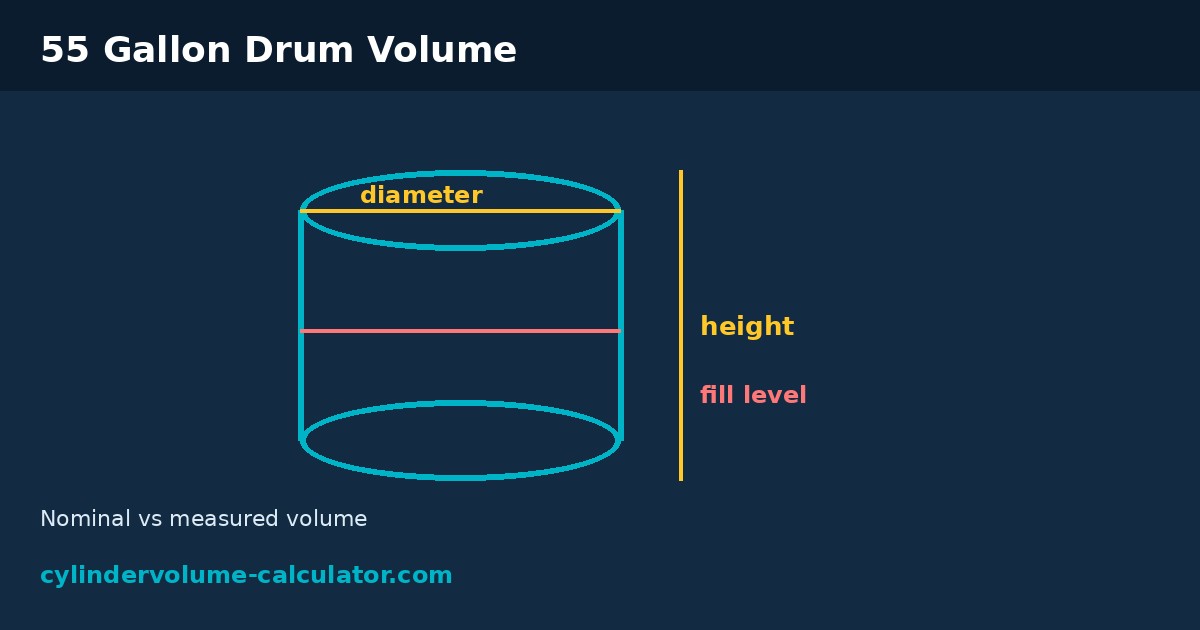
Hover a dimension to see what it means. The rated 55 gallons sits below the rim, with headspace above it.
A drum sits close enough to a cylinder for a useful calculation, so you use the cylinder volume formula:
Volume = pi x radius squared x height
Measure radius and height in inches for a result in cubic inches. Then convert:
US gallons = cubic inches / 231
One US gallon equals exactly 231 cubic inches. Convert to liters by multiplying by 3.78541: 55 x 3.78541 = 208.2 liters.
Worked example
Take a standard drum with a 22.5 inch diameter and a 33.5 inch height.
Step 1: Radius = 22.5 / 2 = 11.25 inches.
Step 2: 11.25 squared = 11.25 x 11.25 = 126.56 square inches.
Step 3: Volume = 3.1416 x 126.56 x 33.5 = 13,319.9 cubic inches.
Step 4: US gallons = 13,319.9 / 231 = 57.66 US gallons.
Step 5: Liters = 57.66 x 3.78541 = 218.3 liters.
So the pure cylinder result is 57.66 US gallons (218.3 liters) at 33.5 inches tall. At 34.5 inches, the height many drums reach once you include the top and bottom rims (called chimes), the result rises: 3.1416 x 126.56 x 34.5 = 13,717.5 cubic inches, or 13,717.5 / 231 = 59.38 US gallons (224.8 liters). The extra inch adds about 1.72 gallons, because each inch of depth holds 3.1416 x 126.56 / 231 = 1.72 gallons.
Why the cylinder result differs from 55 gallons
Neither number is wrong. They measure different things. First, 55 gallons is a rated capacity, not a brim-full measurement. A liquid depth of about 32 inches in this drum gives almost exactly the rated figure: 3.1416 x 126.56 x 32 / 231 = 55.08 US gallons (208.5 liters). So the rating corresponds to roughly 32 inches of liquid in a 33.5 inch drum, with about 1.5 inches of headspace at the top.
Second, a real drum is not a perfect cylinder. The heads dish inward, the walls carry ribs and a slight bulge, and the chime rings add height without adding usable volume. The wall also takes up space, so inside diameter runs slightly smaller than outside diameter. Third, safe filling leaves headspace on purpose, because liquids expand when they warm up.
Partial fill chart
Most drums in daily use are only partly full. This table uses the standard radius of 11.25 inches, at 1.72 gallons per inch of depth. Measure depth from the inside bottom to the liquid surface, not from the outside floor to the top rim.
| Liquid depth | Volume |
|---|---|
| 6 inches (15.2 centimeters) | 10.33 US gallons (39.1 liters) |
| 12 inches (30.5 centimeters) | 20.65 US gallons (78.2 liters) |
| 18 inches (45.7 centimeters) | 30.98 US gallons (117.3 liters) |
| 24 inches (61.0 centimeters) | 41.31 US gallons (156.4 liters) |
| 30 inches (76.2 centimeters) | 51.64 US gallons (195.5 liters) |
| 32 inches (81.3 centimeters) | 55.08 US gallons (208.5 liters) |
| 33.5 inches (85.1 centimeters) | 57.66 US gallons (218.3 liters, brim-full cylinder) |
Estimate any other depth by multiplying depth in inches by 1.72: a 20 inch depth gives about 34.4 gallons. Treat the chart as a planning estimate, not a certified measurement for trade or billing.
Drum size comparison: 15, 30, and 55 gallons
Smaller drums follow the same rule: the rating sits below the brim-full cylinder result, and exact dimensions vary by maker and material. Treat the 15 gallon and 30 gallon dimensions below as approximate, because steel, plastic, open head, and closed head versions of the same size measure differently. Check your drum label and measure the drum when an exact fit matters.
| Nominal size | Typical diameter (approximate) | Typical height (approximate) | Nominal capacity |
|---|---|---|---|
| 15 gallons | About 14 to 14.5 inches (35.6 to 36.8 centimeters) | About 25 to 26.5 inches (63.5 to 67.3 centimeters) | 15 US gallons (56.8 liters) |
| 30 gallons | About 18.25 to 19 inches (46.4 to 48.3 centimeters) | About 27.5 to 30 inches (69.9 to 76.2 centimeters) | 30 US gallons (113.6 liters) |
| 55 gallons | About 22.5 inches (57.2 centimeters) | 33.5 to 34.5 inches (85.1 to 87.6 centimeters) | 55 US gallons (208 liters) |
A check confirms the pattern. A 15 gallon steel drum with an inside diameter of about 13.94 inches and an inside height of about 24.06 inches gives about 15.89 gallons, close to its rating once you allow for dished ends and headspace. A 30 gallon drum with an inside diameter near 18 inches and an inside height near 27.5 inches gives about 30.29 gallons. For scale, one drum holds 11 times the volume of a 5 gallon bucket volume container, and a smaller pressurized container follows its own rating rules in the beer keg sizes and volume guide.
The 42 gallon oil barrel vs the 55 gallon drum
People often confuse a 42 gallon oil barrel with a 55 gallon drum, but they are not the same. A barrel of oil equals 42 US gallons (159 liters). Traders, refineries, and news reports use this 42 gallon barrel as a standard unit of account. It is a unit of measurement, not a physical container that you fill with exactly 42 gallons. A physical 55 gallon drum, by contrast, is a real container with a 55 US gallon (208 liter) rated capacity.
One drum therefore holds 55 / 42 = 1.31 barrels by volume. A shipment of 100 barrels means 4,200 US gallons, which fills about 76 rated drums (4,200 / 55 = 76.4). If you mistakenly treat a barrel as 55 gallons, you overstate the shipment by 31 percent. Early oil barrels varied in size, and 42 gallons became the standard trading unit even though the shipping drum later settled at 55 gallons. Divide a price per barrel by 42 for the price per gallon, and trust the 55 gallon rating on a drum label.
Common mistakes and traps
Using the diameter as the radius. If you plug 22.5 inches in as the radius, you get about 230 gallons, four times the correct result. Always halve the diameter first.
Mixing US and imperial gallons. A UK supplier may quote a 44 imperial gallon drum for the same 208 liter container that a US supplier calls 55 gallons. Convert through liters: 208 liters equals 55 US gallons and about 45.8 imperial gallons.
Measuring outside height as fill depth. Outside height includes the chimes and lid, while liquid depth stops at the liquid surface. Measure inside the drum with a dipstick or clean rod.
Treating the cylinder result as a billing measurement. Dished ends, wall thickness, and bulge shift true volume by a few percent. For regulated transfers, use a calibrated meter or the drum label.
Forgetting content weight. Water weighs about 8.34 pounds per gallon, so 55 gallons of water weighs about 459 pounds (208 kilograms). Add an empty drum, often around 40 pounds for steel and around 20 pounds for plastic, and a full drum of water weighs roughly 480 to 500 pounds. Heavier liquids weigh more, so plan lifting and floor loading with the real product density.
Filling to the brim. Heat expands liquid, so a brim-full drum leaves no room for expansion. Fill to the rated level and follow the product label for headspace and storage temperature.
Sizing guidance and measuring your own drum
Choose a 55 gallon drum for bulk storage in a single, movable container: rainwater, bulk liquid, waste oil, and feed or grain all suit this size, as long as local rules allow the use and the material suits the contents. Steel suits many industrial liquids outdoors, while food grade plastic suits water and food products. Never store drinking water, food, or animal feed in a drum that previously held chemicals, even after washing, unless the drum carries a food grade rating and you verify its history.
Choose a smaller drum when you move contents by hand or when floor space is tight: a 30 gallon drum cuts full water weight to about 250 pounds plus the drum, and a 15 gallon drum cuts it to about 125 pounds plus the drum. Choose a tank instead of drums for a large fixed volume in one place, which you can check with the tank volume calculator. A propane tank likewise never fills to 100 percent by design, as the propane tank fill percentage rule explains.
To measure your own drum, measure diameter across the widest point, then measure inside height from the inside bottom to the inside top, with the lid off. Halve the diameter, square it, multiply by pi and by the height, then divide by 231. For a partly full drum, use liquid depth in place of full height. If you can only measure the outside, expect the result to run slightly high. For a hollow center or double wall, use the hollow cylinder calculator instead. The guide on how to calculate water tank capacity at home uses the same steps, and the how to measure pipe volume guide applies the same radius discipline to a smaller cylinder.
Frequently asked questions
How many gallons does a 55 gallon drum actually hold?
It holds 55 US gallons (208 liters) at its rated fill level. Its brim-full geometric volume is about 57.66 US gallons (218.3 liters) for a 22.5 inch diameter and 33.5 inch height, because the rating leaves headspace and allows for dished ends and wall thickness.
How tall and wide is a 55 gallon drum?
It stands about 33.5 to 34.5 inches tall and measures about 22.5 inches in diameter, giving a radius of 11.25 inches. Outside diameter can run closer to 23 inches with reinforcing ribs.
How many liters are in a 55 gallon drum?
About 208 liters (55 x 3.78541 = 208.2 liters). The same drum holds about 45.8 imperial gallons, so confirm which gallon a label uses.
Is a 55 gallon drum the same as a barrel of oil?
No. A barrel of oil equals 42 US gallons (159 liters) as a trading unit, while a drum holds 55 US gallons (208 liters) at its rated capacity. One drum holds about 1.31 barrels by volume.
How much does a full 55 gallon drum of water weigh?
About 459 pounds (208 kilograms) for the water alone, plus roughly 40 pounds for an empty steel drum or 20 pounds for plastic, giving roughly 480 to 500 pounds in total.
How do I calculate a partly full drum?
Measure liquid depth in inches, then multiply pi x 11.25 squared x depth and divide by 231. Each inch holds about 1.72 gallons, so 20 inches holds about 34.4 gallons. Check the result with the volume in gallons calculator or the volume in liters calculator.
Conclusion
55 gallon drum volume comes down to two numbers you should never confuse. The rated capacity is 55 US gallons (208 liters), for buying, labeling, and storage planning. The brim-full cylinder calculation for a 22.5 inch diameter and 33.5 inch height is 57.66 US gallons (218.3 liters), and you use it when you calculate from dimensions or measure a partial fill. The gap is honest: headspace, dished ends, wall thickness, and bulge trim usable volume below the textbook result.
Measure your own drum, use the radius (not the diameter), divide by 231 for US gallons, and leave the rated headspace when you fill. For a fast check, run your radius and height through the volume in gallons calculator and compare the result with the drum label.