Guides · October 26, 2026
5 Gallon Bucket Volume: Exact Capacity, Frustum Math, and Hauling Charts
5 gallon bucket volume equals 5 US gallons (18.9 liters, 0.67 cubic feet). Learn why the tapered shape changes the math, how to measure your bucket, and how many buckets fill a cubic yard.

- What 5 Gallons Means in Other Units
- Why a Bucket Is Not a Straight Cylinder
- Worked Example: A Typical 5 Gallon Bucket
- Straight cylinder calculation (using the top radius)
- Frustum calculation (using both radii)
- Cylinder vs frustum comparison
- Why the Frustum Result Still Exceeds 5 Gallons
- How to Measure Your Own Bucket
- Buckets per Cubic Yard Chart
- Common Mistakes and Traps
- Using only the top diameter
- Filling to the brim in your plan
- Confusing US and Imperial gallons
- Assuming every bucket matches
- Counting a heaped bucket as a level bucket
- Forgetting wall thickness
- Sizing Guidance: Pick the Right Container for the Job
- Frequently Asked Questions
- How many gallons does a 5 gallon bucket actually hold?
- What are the dimensions of a typical 5 gallon bucket?
- How many cubic feet are in a 5 gallon bucket?
- How many 5 gallon buckets fill a cubic yard?
- Why does the cylinder formula give the wrong answer for a bucket?
- How much does a full 5 gallon bucket of water weigh?
- Can I use a 5 gallon bucket to measure concrete or soil accurately?
- Conclusion
5 gallon bucket volume equals 5 US gallons when you fill the bucket to its rated fill line, not to the brim. That rated volume converts to 18.9 liters (L) and 0.67 cubic feet (ft3). You can use that conversion for most jobs, from mixing paint to hauling soil. You need different math when you measure the bucket itself, because a bucket tapers from a wide top to a narrower base. This guide gives you the rated volume, the honest geometry behind it, and practical charts you can use on the job.
What 5 Gallons Means in Other Units
One US gallon holds 231 cubic inches (in3), 3.785 liters, and 0.133681 cubic feet. Multiply each factor by 5 and you get the standard conversions below.
| Unit | 5 gallon bucket volume |
|---|---|
| US gallons | 5 gal |
| Liters | 18.9 L |
| Cubic inches | 1,155 in3 |
| Cubic feet | 0.67 ft3 (5 x 0.133681 = 0.668 ft3, rounded to 0.67 ft3) |
| Imperial gallons | 4.12 Imperial gallons (18.9 L / 4.546 L per Imperial gallon) |
| Weight of water | About 41.7 pounds (5 x 8.34 pounds per gallon) |
Use US gallons first in the United States. The Imperial gallon matters only for a label or guide from the United Kingdom or Canada, because an Imperial gallon holds more liquid than a US gallon. A bucket rated at 5 Imperial gallons would hold about 6.0 US gallons, so check which gallon your source uses first.
Why a Bucket Is Not a Straight Cylinder
Hover a dimension to see what it means. The frustum formula uses both radii, so it gives less than the straight-cylinder result.
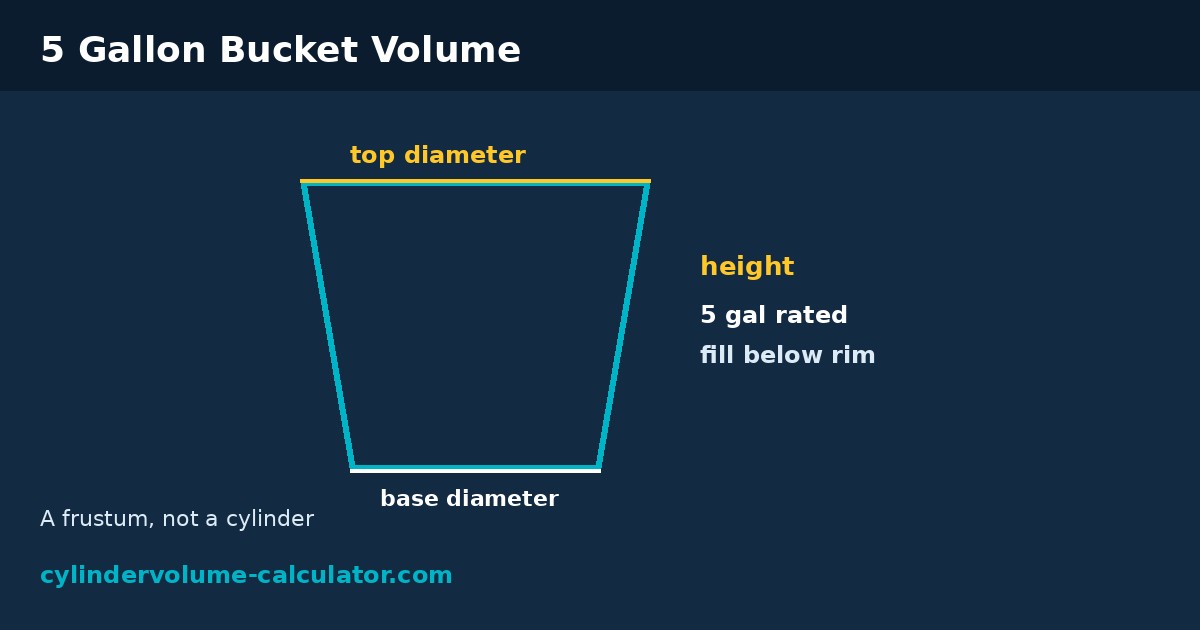
A straight cylinder keeps the same diameter from bottom to top. A bucket does not. Its top measures wider than its base, and its side slopes inward as it drops. Mathematicians call that tapered shape a frustum, which is a cone with its tip cut off. If you treat a bucket like a straight cylinder and use only the top diameter, you overstate its volume every time.
You calculate a straight cylinder with this cylinder volume formula: V = pi x r^2 x h. You calculate a frustum with this formula: V = (1/3) x pi x h x (R^2 + R x r + r^2). In the frustum formula, R stands for the top radius, r stands for the base radius, and h stands for the height. You need both radii because the shape changes as you move down the side.
Worked Example: A Typical 5 Gallon Bucket
Take a common bucket profile: top diameter 12 inches (in), base diameter 10.25 in, and height 14.5 in. Halve each diameter to get top radius R = 6 in and base radius r = 5.125 in. Run both formulas with the same height so you can compare them fairly.
Straight cylinder calculation (using the top radius)
V = pi x 6^2 x 14.5 V = pi x 36 x 14.5 V = 1,639.9 in3 V = 1,639.9 / 231 = 7.10 gallons V = 1,639.9 / 1,728 = 0.949 ft3
Frustum calculation (using both radii)
V = (1/3) x pi x 14.5 x (6^2 + 6 x 5.125 + 5.125^2) V = (1/3) x pi x 14.5 x (36 + 30.75 + 26.27) V = (1/3) x pi x 14.5 x 93.02 V = 1,412.4 in3 V = 1,412.4 / 231 = 6.11 gallons V = 1,412.4 / 1,728 = 0.817 ft3
The straight cylinder calculation overstates the frustum volume by 227.5 in3, or 0.99 gallons. That gap equals 16.1 percent. If you use only the top diameter for a tapered bucket, you plan for almost an extra gallon that the bucket does not actually hold at that height.
Cylinder vs frustum comparison
| Method | Volume (in3) | Volume (gallons) | Volume (ft3) |
|---|---|---|---|
| Straight cylinder, top radius only | 1,639.9 | 7.10 | 0.949 |
| Frustum, top and base radii | 1,412.4 | 6.11 | 0.817 |
| Difference (straight cylinder minus frustum) | 227.5 | 0.99 | 0.132 |
Why the Frustum Result Still Exceeds 5 Gallons
You may spot a second gap here, and it deserves an honest answer. The frustum math gives 6.11 gallons to the brim, while the bucket carries a 5 gallon rating. Both numbers can stand, because they measure different things.
First, manufacturers rate the usable volume at a fill line below the rim, not at the brim. You need that headspace so you can carry liquid without spilling it and mix material without splashing it over the edge. Second, wall thickness and the exact interior profile reduce the inside volume below the outside dimensions. Third, brands vary, so one maker’s bucket can measure slightly taller, wider, or more tapered than another’s.
For this profile, 5 gallons reaches about 12.2 inches up from the base, which leaves about 2.3 inches of headspace below the 14.5 inch rim. Treat that fill height as approximate for this profile, not as a rule for every bucket.
How to Measure Your Own Bucket
You need only a tape measure. Follow these steps in order.
- Measure the inside top diameter across the widest point, just below the rim.
- Measure the inside base diameter across the bottom.
- Measure the inside height from the bottom to the rim.
- Halve each diameter to get the top radius and the base radius.
- Plug both radii and the height into the frustum formula above.
- Divide cubic inches by 231 for gallons and by 1,728 for cubic feet.
Check your result with a fill test when you can. Pour in one measured gallon at a time and mark each level on the outside with tape. The marks show exactly where 1, 2, 3, 4, and 5 gallons sit in your bucket, and they remove all guesswork about headspace. For a quick check, you can also run the numbers through the volume in gallons calculator or the volume in liters calculator.
Buckets per Cubic Yard Chart
Landscapers and gardeners often order loose material by the cubic yard, then haul it in buckets. One cubic yard equals 27 ft3. Divide 27 ft3 by the rated bucket volume of 0.67 ft3 and you get about 40 buckets per cubic yard (27 / 0.67 = 40.3, rounded down in practice because you lose material to spillage and uneven fills).
Use the chart below for planning, and treat every count as approximate before compaction and losses. Soil settles, mulch fluffs up, and a heaped bucket holds more than a level bucket.
| Material to move | Buckets at 5 gallons (0.67 ft3) each |
|---|---|
| 0.25 cubic yard | 10 buckets |
| 0.5 cubic yard | 20 buckets |
| 1 cubic yard | 40 buckets |
| 2 cubic yards | 81 buckets |
| 3 cubic yards | 121 buckets |
| 5 cubic yards | 202 buckets |
Do not mix the two bucket volumes in one estimate. If you count the brim frustum volume of 0.817 ft3 from the worked example, one cubic yard needs only about 33 buckets (27 / 0.817 = 33.0). That lower count assumes you fill every bucket to the brim, which you should not do with a load you must carry. Use 40 buckets per cubic yard for rated 5 gallon fills, then add extra trips for spillage and settling.
For larger storage, one 55 gallon drum volume equals 11 five gallon buckets (55 / 5 = 11).
Common Mistakes and Traps
Using only the top diameter
This mistake causes the largest error. The top diameter describes only the widest ring of the bucket. The narrower base pulls the true volume down, so a top-only calculation overstates the example bucket by 16.1 percent. Always use both diameters for a tapered container.
Filling to the brim in your plan
A brim-full bucket spills and leaves no room to stir. Five gallons of water already weighs about 41.7 pounds, and wet soil or concrete weighs far more per bucket. Plan around the rated fill line, and make two lighter trips when a full bucket feels unsafe.
Confusing US and Imperial gallons
A US gallon holds 3.785 liters. An Imperial gallon holds 4.546 liters. If you read a 5 gallon figure from a UK source and treat it as US gallons, you understate the volume by about 1 gallon (22.7 L versus 18.9 L). Confirm the gallon standard on the label first.
Assuming every bucket matches
Brands change molds, lids add height, and older buckets warp. Two buckets that both say 5 gallons can hold slightly different amounts at the same fill height. Measure the bucket you actually use when accuracy matters.
Counting a heaped bucket as a level bucket
A heaped load of mulch or soil can hold noticeably more than a level 5 gallon fill, while a settled load can hold less. Use level fills for repeatable counts. For concrete work, pair your bucket count with the bag math in the guide on how many bags of concrete for a post hole rather than guessing from bucket loads alone.
Forgetting wall thickness
Outside dimensions overstate inside capacity. Treat the 6.11 gallon brim result as a profile calculation, not as a claim about the inside of every bucket. Inside measurements give you the volume you can actually use.
Sizing Guidance: Pick the Right Container for the Job
Use a 5 gallon bucket when you need a load one person can carry, mix, or pour in stages. It suits paint, cleaning solution, animal feed, garden soil, and small concrete mixes. It also suits measuring liquids, because you can mark gallon levels and pour with control.
Move up to a larger container when the job needs bulk storage or fewer trips. A drum holds 11 times the rated volume of one bucket, but you cannot lift it when full, and you need a pump, spigot, or dolly to use it safely. A fixed tank suits rainwater or well water storage, and you should size it from total household demand, not from bucket counts. Size for weight as well as volume: water sets a baseline at 41.7 pounds per full bucket, but soil, gravel, and wet concrete run much heavier, so split the load when the bucket gets hard to control.
Frequently Asked Questions
How many gallons does a 5 gallon bucket actually hold?
A bucket rated at 5 gallons holds 5 US gallons at its fill line. Its brim volume runs higher, and the worked example above reaches 6.11 gallons at the brim for its stated profile. Use the rated 5 gallons for planning, and leave headspace for carrying and mixing.
What are the dimensions of a typical 5 gallon bucket?
A common profile measures 12 inches across the top, 10.25 inches across the base, and 14.5 inches tall. Brands vary, so measure your bucket when you need an exact result. Always record all three numbers, because you need both diameters for the frustum formula.
How many cubic feet are in a 5 gallon bucket?
A 5 gallon bucket holds 0.67 cubic feet. You get that result from 5 x 0.133681 = 0.668 cubic feet, rounded to 0.67 cubic feet.
How many 5 gallon buckets fill a cubic yard?
About 40 rated 5 gallon buckets fill one cubic yard before compaction and losses (27 ft3 / 0.67 ft3 = 40.3). Add extra buckets for spillage and uneven fills.
Why does the cylinder formula give the wrong answer for a bucket?
The cylinder formula assumes one constant radius for the full height. A bucket narrows toward its base, so the lower part holds less than a top-sized cylinder would hold. The frustum formula corrects that error by using both radii.
How much does a full 5 gallon bucket of water weigh?
A full 5 gallon bucket of water weighs about 41.7 pounds, plus the weight of the bucket itself. Soil, gravel, and concrete weigh more per bucket, so judge the load by material as well as volume.
Can I use a 5 gallon bucket to measure concrete or soil accurately?
You can use it for rough hauling counts, but you should not treat it as a precision measure for ratio-sensitive mixes. Level each load the same way, measure your bucket, and follow the product label for mix ratios.
Conclusion
5 gallon bucket volume gives you a simple planning number, 5 US gallons, 18.9 liters, and 0.67 cubic feet, plus one warning: the tapered shape means a top-only cylinder calculation overstates the bucket. Use the frustum formula when you measure a bucket, use the rated volume when you plan hauling, and leave headspace when you fill it. To check your own measurements fast, run your diameters and height through the volume in gallons calculator and compare the result with the gallon marks on your bucket.