Guides · October 26, 2026
How Many Bags of Concrete for a Post Hole: Fence and Deck Post Chart
How many bags of concrete for a post hole? A 12 inch wide, 36 inch deep hole with a 4x4 post needs 4 bags of 80 lb concrete after waste and post displacement. Use the chart and formula to size your job.

- The Short Answer by Common Hole Size
- The Formula: Hole Volume Minus Post Displacement, Plus Waste
- Worked Example: 12 Inch Hole, 36 Inches Deep, 4x4 Post
- Bag Chart: 8, 10, and 12 Inch Holes
- How to Total a Whole Fence Line
- Sizing Guidance: How Wide and How Deep Should the Hole Be?
- 40 lb vs 60 lb vs 80 lb Bags: Which Size Should You Buy?
- Common Mistakes and Traps
- Frequently Asked Questions
- How many bags of concrete do I need for a 4x4 fence post?
- How many 80 lb bags of concrete per post hole?
- How many bags of concrete for a deck post hole?
- Does the post itself reduce the concrete I need?
- Should I add extra concrete for waste?
- Can I use fast-setting concrete for post holes?
- Conclusion
- Article Notes: Verification and Assumptions
How many bags of concrete for a post hole? A 12 inch (30.5 cm) wide, 36 inch (91.4 cm) deep hole with a standard 4x4 fence post needs 4 bags of 80 lb (36.3 kg) concrete, or 6 bags of 60 lb (27.2 kg) concrete, or 8 bags of 40 lb (18.1 kg) concrete. Those counts already include 10 percent waste and subtract the space the post itself occupies. Size each job from its actual hole diameter and depth instead of guessing one bag per post, because smaller holes need far less and larger or deeper holes need far more.
This guide covers fence and deck posts in round, augered holes, not square footings, piers with rebar cages, or full round pillars. For larger footings, see how to calculate concrete for round pillars.
The Short Answer by Common Hole Size
- An 8 inch (20.3 cm) wide, 24 inch (61.0 cm) deep hole with a 4x4 post needs 1 bag of 80 lb concrete. Buy a spare, because this count leaves almost no margin.
- A 10 inch (25.4 cm) wide, 30 inch (76.2 cm) deep hole with a 4x4 post needs 3 bags of 80 lb concrete.
- A 12 inch (30.5 cm) wide, 36 inch (91.4 cm) deep hole with a 4x4 post needs 4 bags of 80 lb concrete.
The Formula: Hole Volume Minus Post Displacement, Plus Waste
Hover a dimension to see what it means. Subtract the post, then add 10 percent waste.
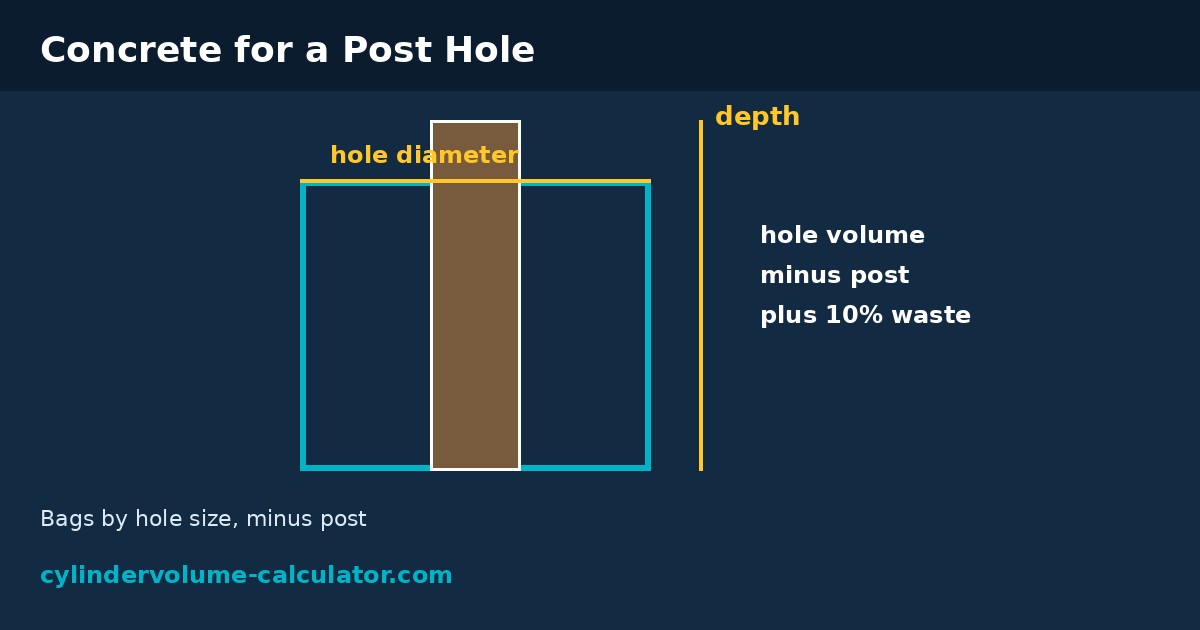
You calculate a post hole as a cylinder, then you adjust twice: subtract the volume the post displaces, then add 10 percent waste for spillage, uneven walls, and crowning the top.
Hole volume = pi x (hole diameter / 2)^2 x hole depth
Work in feet, so divide inches by 12 first. Then apply the adjustments:
Concrete you need = (hole volume minus post displacement) x 1.10
Post displacement equals post cross-section area times depth in concrete. A standard 4x4 post actually measures 3.5 inches by 3.5 inches, not a full 4 inches, and that detail matters on deeper holes.
Use these bag yields throughout this guide:
- 80 lb bag: about 0.60 cubic feet (17.0 liters)
- 60 lb bag: about 0.45 cubic feet (12.7 liters)
- 40 lb bag: about 0.30 cubic feet (8.5 liters)
Always round bag counts UP. You cannot buy part of a bag, and rounding down guarantees a short pour. For the cylinder step, see the cylinder volume formula.
Worked Example: 12 Inch Hole, 36 Inches Deep, 4x4 Post
Step 1: Convert to feet. The hole diameter measures 12 inches, so the radius measures 6 inches, or 0.5 feet. The depth measures 36 inches, or 3 feet.
Step 2: Calculate the full hole volume. Multiply pi x 0.5^2 x 3. That gives 2.3562 cubic feet.
Step 3: Subtract post displacement. A 4x4 post measures 3.5 inches by 3.5 inches, which gives 12.25 square inches. Divide by 144 to convert to square feet, which gives 0.0851 square feet. Multiply by the 3 foot depth, which gives 0.2552 cubic feet. Subtract that from the hole volume: 2.3562 minus 0.2552 equals 2.1010 cubic feet of concrete space.
Step 4: Add 10 percent waste. Multiply 2.1010 by 1.10, which gives 2.3111 cubic feet to buy for.
Step 5: Divide by bag yield and round up.
- 80 lb bags: 2.3111 / 0.60 equals 3.85, so you buy 4 bags.
- 60 lb bags: 2.3111 / 0.45 equals 5.14, so you buy 6 bags.
- 40 lb bags: 2.3111 / 0.30 equals 7.70, so you buy 8 bags.
Skipping displacement and waste can mislead you by a full bag on some sizes.
Bag Chart: 8, 10, and 12 Inch Holes
This chart assumes a 4x4 post (3.5 inches by 3.5 inches actual), the yields above, 10 percent waste, and rounding up. Measure at the widest point, because an auger often cuts wider than its nominal size.
| Hole diameter | Hole depth | Concrete needed (after displacement and 10% waste) | 80 lb bags | 60 lb bags | 40 lb bags |
|---|---|---|---|---|---|
| 8 in (20.3 cm) | 24 in (61.0 cm) | 0.58 ft3 | 1 | 2 | 2 |
| 8 in (20.3 cm) | 30 in (76.2 cm) | 0.73 ft3 | 2 | 2 | 3 |
| 8 in (20.3 cm) | 36 in (91.4 cm) | 0.87 ft3 | 2 | 2 | 3 |
| 10 in (25.4 cm) | 24 in (61.0 cm) | 1.01 ft3 | 2 | 3 | 4 |
| 10 in (25.4 cm) | 30 in (76.2 cm) | 1.27 ft3 | 3 | 3 | 5 |
| 10 in (25.4 cm) | 36 in (91.4 cm) | 1.52 ft3 | 3 | 4 | 6 |
| 12 in (30.5 cm) | 24 in (61.0 cm) | 1.54 ft3 | 3 | 4 | 6 |
| 12 in (30.5 cm) | 30 in (76.2 cm) | 1.93 ft3 | 4 | 5 | 7 |
| 12 in (30.5 cm) | 36 in (91.4 cm) | 2.31 ft3 | 4 | 6 | 8 |
Treat the first row with caution: you need 0.58 cubic feet and one 80 lb bag yields about 0.60 cubic feet, so buy 2 bags for that size and keep the spare for the next post.
How to Total a Whole Fence Line
Multiply the per-hole count by the number of holes, then add one or two spares. Do not multiply the exact decimal volume and round only at the end, because you pour each hole separately. For the headline size (12 inch wide, 36 inch deep, 4x4 post, 80 lb bags), 10 holes need 40 bags and 20 holes need 80 bags. Total gate posts separately, because they often run wider and deeper than line posts.
Sizing Guidance: How Wide and How Deep Should the Hole Be?
A common rule of thumb calls for a hole about three times as wide as the post, so a 4x4 post (3.5 inches actual) fits a hole around 10 to 12 inches wide. Treat that rule as a starting point, not a building code: local codes, soil, wind load, and gate weight all change the right size, so check local requirements before you dig deck or gate posts.
Post size changes displacement fast. A 6x6 post (5.5 inches actual) in the same 12 inch wide, 36 inch deep hole displaces 0.63 cubic feet, compared with 0.26 cubic feet for a 4x4 post. After waste, that hole still needs 4 bags of 80 lb concrete, but the margin shrinks, so run the displacement step for your actual post size instead of borrowing the 4x4 chart.
Depth matters just as much. Volume grows in direct proportion to depth, so a 36 inch hole needs 50 percent more concrete than a 24 inch hole of the same diameter. Depth also controls stability, and frost depth varies by region, so confirm the required depth for your area first, then calculate bags.
This chart covers round, augered holes only. Square holes hold more because the corners add volume, and bell-shaped holes hold more than the chart shows, so measure the widest diameter and buy spare bags for those holes.
40 lb vs 60 lb vs 80 lb Bags: Which Size Should You Buy?
Bag size changes handling and count, not the concrete itself. 80 lb bags suit most fence and deck jobs, because you handle, open, and mix fewer bags per hole. The tradeoff is weight, so lift with help or use a wheelbarrow and a ramp.
60 lb bags suit solo work and smaller holes. You carry less per trip and waste less on small holes. The headline hole needs 6 bags of 60 lb concrete instead of 4 bags of 80 lb.
40 lb bags suit very small jobs and tight access. You move each bag easily, but the headline hole needs 8 bags, which means more opening and mixing on a long fence line.
Fast-setting mixes follow the same volume math, but follow the bag instructions: some allow a dry pour you then soak, while standard mixes need full mixing first. For mix water on small batches, check the 5-gallon bucket volume guide.
Common Mistakes and Traps
You measure the hole at the top only. Augered holes taper, cave in, or bell out, so measure at the top, middle, and bottom if you can reach, and use the widest measurement.
You forget post displacement or waste. Dividing the full hole volume by bag yield overstates the buy, while ignoring spillage understates it. Apply both adjustments.
You round down. A calculation of 3.85 bags means 4 bags, not 3 bags plus hope. A short pour leaves a weak collar, and a later top-off creates a cold joint.
You set the post before you check plumb and height. Brace the post, check plumb on two faces, set the height, and then pour. Re-check plumb halfway through, because the mix can push a loose post off line.
You finish the concrete flat or dished at grade. Shape the top into a slight dome that slopes away from the post, because a flat top ponds water against the wood and shortens post life.
You count line posts and forget gate posts. Gate posts carry hinges and a swinging load, so they usually need wider, deeper holes. Price them separately.
Frequently Asked Questions
How many bags of concrete do I need for a 4x4 fence post?
A 4x4 post in a 10 inch wide, 30 inch deep hole needs 3 bags of 80 lb concrete after displacement and waste. In a 12 inch wide, 36 inch deep hole, it needs 4 bags.
How many 80 lb bags of concrete per post hole?
Most backyard post holes need 1 to 4 bags of 80 lb concrete. Small 8 inch by 24 inch holes need 1 bag (buy a spare), 10 inch by 30 inch holes need 3 bags, and 12 inch by 36 inch holes need 4 bags.
How many bags of concrete for a deck post hole?
Deck post holes often run wider and deeper than fence holes because they carry structural loads, so start from your local code depth and footing size, then use the formula here. A 12 inch by 36 inch hole with a 4x4 post needs 4 bags of 80 lb concrete, but a deck footing may require a wider pier. Confirm the requirement before you dig.
Does the post itself reduce the concrete I need?
Yes. A 4x4 post (3.5 inches actual) in a 36 inch deep hole displaces 0.26 cubic feet, nearly half an 80 lb bag. A 6x6 post displaces more than twice that amount, so always use your actual post size.
Should I add extra concrete for waste?
Yes, add 10 percent for normal jobs to cover spillage, mix left in the wheelbarrow, and uneven walls. Rough or caving soil needs more, so carry spares. The chart already includes the 10 percent allowance.
Can I use fast-setting concrete for post holes?
Yes, when you follow the bag instructions. The volume math stays the same: hole volume minus displacement, plus waste, divided by bag yield. Products differ, so read the label on the product you buy.
Conclusion
How many bags of concrete for a post hole comes down to three numbers: hole diameter, hole depth, and post size. Measure all three, subtract post displacement, add 10 percent waste, and round up. That gives 4 bags of 80 lb concrete for the classic 12 inch by 36 inch hole with a 4x4 post, and 3 bags for a 10 inch by 30 inch hole.
Before you buy, double-check your hole size against the cylinder volume formula page, and compare larger footings in how to calculate concrete for round pillars. Measure twice, buy the spare bag, and set each post plumb the first time.
Article Notes: Verification and Assumptions
The author calculated every figure from the cylinder formula in the text, using pi, the stated diameters and depths, a 4x4 post at 3.5 inches by 3.5 inches, yields of 0.60, 0.45, and 0.30 cubic feet, 10 percent waste, and rounding up. Recalculation of all nine chart rows matched the published counts. No earlier published figure existed, so no correction to a prior figure was required. One caution survives recalculation: the 8 inch by 24 inch row needs 0.58 cubic feet against a single 80 lb bag yield of about 0.60 cubic feet, so the article recommends a spare bag. Yields vary slightly by product, so confirm the yield on the bags you buy.