Guides · October 26, 2026
Beer Keg Sizes Volume: How Many Gallons, Ounces, and Servings Each Keg Holds
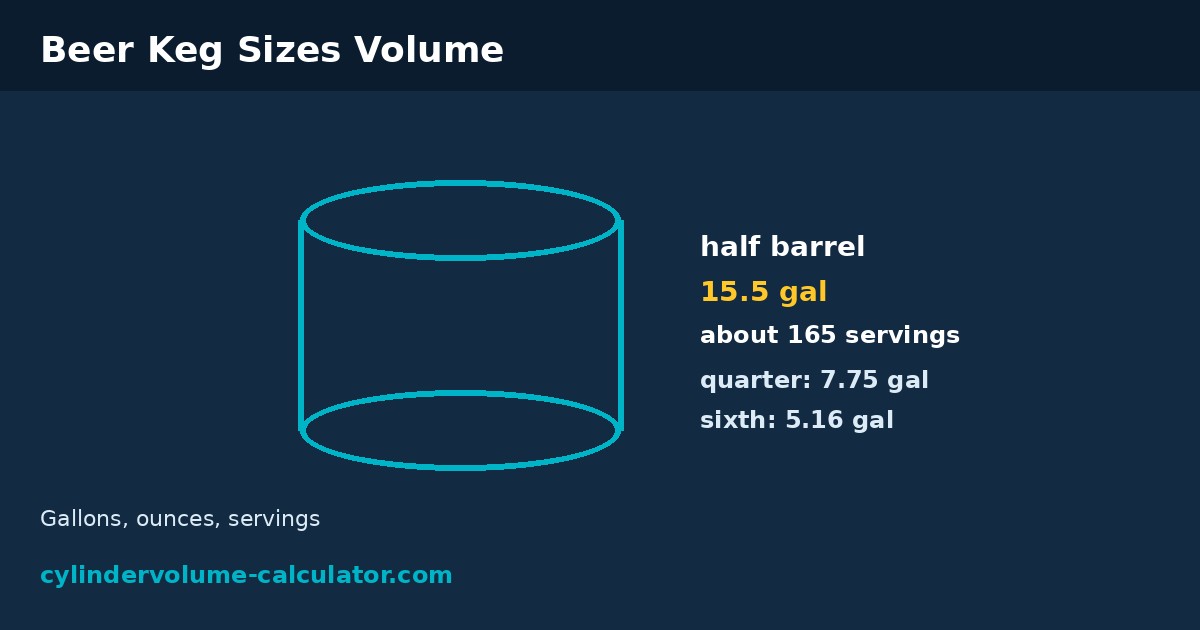
Beer keg sizes volume explained in plain numbers: a half barrel holds 15.5 US gallons, a quarter barrel holds 7.75 US gallons, a sixth barrel holds 5.16 US gallons, and a Cornelius keg holds 5 US gallons, with servings for each size.

- The Formula Behind Keg Volume
- Verified Worked Example: Half Barrel Servings and Cylinder Check
- Step 1: Convert gallons to fluid ounces
- Step 2: Convert fluid ounces to 12 ounce servings
- Step 3: Check the half barrel against the cylinder formula
- Beer Keg Sizes Chart: Gallons, Ounces, and Servings
- Why the Cylinder Check Gives More Than 15.5 Gallons
- Common Mistakes and Traps
- A beer barrel is not a 55-gallon drum
- Counting foam as beer
- Using outside dimensions as inside volume
- Forgetting the pour size
- Assuming every keg of the same name holds the same volume
- Planning with zero margin
- Sizing Guidance: Pick the Right Keg
- Frequently Asked Questions
- How many gallons are in a half barrel keg?
- How many beers does a quarter barrel keg hold?
- What is a sixth barrel keg, and how many servings does it hold?
- How many gallons does a Cornelius keg hold?
- Why does a beer barrel hold 31 gallons instead of 55 gallons?
- Does the cylinder formula give the exact keg volume?
- How do I convert keg gallons to servings for a different pour size?
- Conclusion
- Article Notes: Verification and Corrections
Beer keg sizes volume starts with four standard US sizes. A half barrel holds 15.5 US gallons (58.67 liters). A quarter barrel holds 7.75 US gallons (29.34 liters). A sixth barrel holds 5.16 US gallons (19.53 liters). A Cornelius keg, which many brewers call a Corny keg, holds 5 US gallons (18.93 liters). To plan servings, convert gallons to fluid ounces, then divide by your serving size. This article shows that math, checks a half barrel against the cylinder formula, and flags keg math traps.
US brewers base the three commercial sizes on a US beer barrel of 31 US gallons: a half barrel equals half of 31, a quarter barrel equals one quarter of 31, and a sixth barrel equals one sixth of 31. The Cornelius keg breaks that pattern because homebrewers adopted it as a practical 5 gallon vessel, not as a barrel fraction. This article uses 12 fluid ounces (355 milliliters) as the standard serving. A 16 ounce pint cuts the serving count by one quarter, so check your pour size before you order.
The Formula Behind Keg Volume
Hover a dimension to see what it means. Outside dimensions give more than the rated beer volume.
A keg approximates a cylinder, so the cylinder volume formula gives you a useful check:
V = π × r² × h
Here V means volume, π equals about 3.1416, r means the radius (half the diameter), and h means the height. Measure r and h in the same unit. For US gallons, use these conversions:
1 US gallon = 231 cubic inches Fluid ounces = gallons × 128 Servings = fluid ounces ÷ serving size in fluid ounces
For a 12 ounce serving, the shortcut reads: servings = gallons × 128 ÷ 12.
Verified Worked Example: Half Barrel Servings and Cylinder Check
Step 1: Convert gallons to fluid ounces
A half barrel holds 15.5 US gallons. Multiply by 128 fluid ounces per gallon:
15.5 × 128 = 1,984 fluid ounces
Step 2: Convert fluid ounces to 12 ounce servings
Divide 1,984 fluid ounces by 12 fluid ounces per serving:
1,984 ÷ 12 = 165.3 servings
A half barrel therefore yields about 165 twelve ounce servings in theory, and 165 full servings in practice once you drop the 0.3 partial serving. Foam and line loss can reduce the practical count a little further, so treat 165 as your ceiling, not as a guarantee.
Step 3: Check the half barrel against the cylinder formula
Now test the same keg with outside dimensions of about 16.1 inches (40.9 centimeters) in diameter and about 23.3 inches (59.2 centimeters) tall. First halve the diameter to find the radius:
16.1 ÷ 2 = 8.05 inches
Next, apply the cylinder formula:
V = π × 8.05² × 23.3 V = 3.1416 × 64.8025 × 23.3 V = 4,743.5 cubic inches
Then divide by 231 cubic inches per US gallon:
4,743.5 ÷ 231 = 20.5 US gallons (77.73 liters)
The pure cylinder calculation gives about 20.5 US gallons, while the nominal half barrel capacity equals 15.5 US gallons. That gap does not mean the nominal figure is wrong. It means a keg is not a perfect cylinder, and outside dimensions do not equal usable beer volume. For a faster check, run your own numbers through the cylinder volume calculator in gallons and compare the result with the nominal keg size.
Beer Keg Sizes Chart: Gallons, Ounces, and Servings
Every serving count below assumes 12 fluid ounce servings and the nominal gallon figure for that size.
| Keg size | Volume (US gallons) | Volume (liters) | Fluid ounces | 12 oz servings |
|---|---|---|---|---|
| Half barrel | 15.5 | 58.67 | 1,984 | About 165 |
| Quarter barrel (pony keg) | 7.75 | 29.34 | 992 | About 83 (82 full servings, plus a partial serving) |
| Sixth barrel (sixtel) | 5.16 | 19.53 | 660.48 | About 55 |
| Cornelius (Corny) keg | 5.0 | 18.93 | 640 | About 53 |
The same shortcut, gallons × 128 ÷ 12, gives 165.3 for the half barrel, 82.7 for the quarter barrel, 55.0 for the sixth barrel, and 53.3 for the Cornelius keg.
Retailers commonly quote 82 servings for a quarter barrel because they count only full 12 ounce pours. The arithmetic gives 82.7, so both figures describe the same keg.
Why the Cylinder Check Gives More Than 15.5 Gallons
Five honest reasons explain the gap between the 20.5 gallon cylinder result and the 15.5 gallon nominal capacity. First, the 16.1 inch diameter measures the widest point, including the bulge and chime, while the main body runs narrower. Second, the domed top and bottom cut volume away from a perfect cylinder. Third, steel walls take up space, so inside dimensions run smaller than outside dimensions. Fourth, brewers leave headspace, gas space above the beer that holds no beer. Fifth, nominal capacity means usable beer, not total geometry. Treat the 15.5 gallon rating and the 20.5 gallon cylinder estimate as different measurements, not as rivals. The same lesson applies to other round containers; see the 55-gallon drum volume guide, which separates nominal drum capacity from cylinder math in the same way.
Common Mistakes and Traps
A beer barrel is not a 55-gallon drum
A US beer barrel equals 31 US gallons, while a standard industrial drum holds 55 US gallons. A half barrel therefore holds 15.5 US gallons, not 27.5 US gallons. If someone quotes a keg as a fraction of a 55 gallon drum, correct the base: divide 31 gallons, not 55 gallons, by the fraction. This single confusion causes the largest keg volume errors.
Counting foam as beer
Foam fills a glass, but it does not count as a full serving. Warm lines, high pressure, or a dirty faucet waste beer on foam and purged lines. Keep lines cold and clean, and set pressure to the system recommendation.
Using outside dimensions as inside volume
Outside dimensions inflate a half barrel by about 5 gallons, or about one third above nominal capacity. Trust the nominal gallon rating over an outside-dimension estimate.
Forgetting the pour size
A 16 ounce pint changes every number in the chart. A half barrel gives 1,984 ÷ 16 = 124 pints, not 165 servings, and a sixth barrel gives 660.48 ÷ 16 = 41.3, so about 41 pints. Always state your pour size next to your serving count.
Assuming every keg of the same name holds the same volume
Imported kegs and older vessels can follow different standards, so a European keg, a slim quarter keg, and a US quarter barrel can share a nickname while holding different volumes. Read the gallon rating on the keg or supplier listing, and run the calculation for that exact rating.
Planning with zero margin
Hold back a margin of about 10 percent for foam, spillage, and uneven pours, or keep a small backup such as a sixth barrel. For a gathering that needs 150 twelve ounce servings, one half barrel at 165 theoretical servings leaves only a thin margin, so a backup plan protects the event.
Sizing Guidance: Pick the Right Keg
Start with servings, not with keg romance. Estimate how many servings you need, choose your pour size, and then match the total to the chart.
Small gathering or homebrew batch: A Cornelius keg at 5 gallons and about 53 twelve ounce servings suits a home kegerator and a small group. A sixth barrel at 5.16 gallons and about 55 servings plays a similar role for commercial beer. Compare shape and coupler type before you buy, because the two vessels serve different draft systems.
Medium party: A quarter barrel at 7.75 gallons and about 82 full twelve ounce servings covers a medium group without the weight and height of a half barrel. Beer weighs about 8.34 pounds per US gallon (about 1 kilogram per liter), so a full quarter barrel holds about 64.6 pounds (29.3 kilograms) of beer alone, before the steel keg adds weight. Plan lifting help and cold storage before delivery day.
Large event: A half barrel at 15.5 gallons and about 165 twelve ounce servings gives you the best servings per keg and the fewest changeovers. Beer alone weighs about 129.3 pounds (58.7 kilograms) in a full half barrel, so confirm that your venue, vehicle, and kegerator can handle it. Two sixth barrels can beat one half barrel when you want two different beers on tap, even though two sixth barrels hold only about 110 servings combined versus 165 in one half barrel.
Worked sizing example: For about 100 twelve ounce servings, one quarter barrel (about 82 full servings) falls short, two sixth barrels (about 110 servings) cover the need, and one half barrel (about 165 servings) covers it with margin. Choose the half barrel for simplicity, or two sixth barrels for variety.
A Cornelius keg and a 5 gallon bucket share a nominal 5 gallon figure, but they differ completely in shape, pressure rating, and use. For the bucket side of that comparison, see the 5-gallon bucket volume guide. Serve responsibly, offer nonalcoholic options, and arrange safe rides home for guests.
Frequently Asked Questions
How many gallons are in a half barrel keg?
A half barrel keg holds 15.5 US gallons (58.67 liters), or 1,984 fluid ounces. Divide by 12 to get about 165 twelve ounce servings.
How many beers does a quarter barrel keg hold?
A quarter barrel, also called a pony keg, holds 7.75 US gallons (29.34 liters), or 992 fluid ounces. That volume yields 82.7 twelve ounce servings in theory, so count on 82 full servings in practice. For 16 ounce pints, 992 ÷ 16 = 62 pints.
What is a sixth barrel keg, and how many servings does it hold?
Brewers call a sixth barrel a sixtel. It holds 5.16 US gallons (19.53 liters), or 660.48 fluid ounces. Divide by 12 to get 55.0 twelve ounce servings, so plan on about 55 servings. Bars favor sixtels for rotating tap beers because the smaller size turns over faster.
How many gallons does a Cornelius keg hold?
A standard Cornelius keg holds 5 US gallons (18.93 liters), or 640 fluid ounces. That volume yields 53.3 twelve ounce servings, so plan on about 53 servings. Homebrewers favor Cornelius kegs because the size suits a home kegerator and a typical 5 gallon brew batch.
Why does a beer barrel hold 31 gallons instead of 55 gallons?
The United States defines a beer barrel as 31 US gallons, while the 55 gallon drum belongs to a separate industrial standard. Always check which barrel a source means before you convert. A half beer barrel equals 15.5 gallons, while half of a 55 gallon drum would equal 27.5 gallons, and only the first figure describes a keg.
Does the cylinder formula give the exact keg volume?
No. The cylinder formula gives an estimate from the dimensions you feed it, and outside dimensions overstate usable beer volume for the reasons this article lists: maximum diameter, domed ends, wall thickness, headspace, and the nominal rating itself. Use the formula as a sanity check and the nominal gallon rating for ordering. For other round vessels, the tank volume calculator helps you run the same check with your own dimensions.
How do I convert keg gallons to servings for a different pour size?
Multiply gallons by 128 to get fluid ounces, then divide by your pour size in fluid ounces. A half barrel at 15.5 gallons gives 1,984 fluid ounces, and 1,984 ÷ 16 = 124 sixteen ounce pints. Change only the final divisor, and keep the gallon figure and pour size visible so anyone can audit your count.
Conclusion
Beer keg sizes volume comes down to four numbers: 15.5 gallons for a half barrel, 7.75 gallons for a quarter barrel, 5.16 gallons for a sixth barrel, and 5 gallons for a Cornelius keg. Convert gallons to fluid ounces, divide by your pour size, hold a margin for foam and loss, and check any outside-dimension estimate against the nominal rating. Before you order, run your exact keg rating and pour size through the cylinder volume calculator in gallons.
Article Notes: Verification and Corrections
The author recalculated every serving figure from gallons × 128 ÷ 12, and every gallon rating passed with no change. One clarification: the quarter barrel arithmetic gives 82.7 servings, so the common quote of 82 counts full servings only, while 83 rounds the theoretical total. The article labels both uses clearly. The cylinder check also passed arithmetic but corrected a possible misreading: π × 8.05² × 23.3 = 4,743.5 cubic inches, and 4,743.5 ÷ 231 = 20.5 US gallons, not 15.5 US gallons. The article explains that 5 gallon gap through maximum diameter, domed ends, wall thickness, headspace, and nominal usable capacity. No other figure required correction.