Guides — July 8, 2026
Steel Coil Volume Calculation: Formula, Examples & Weight
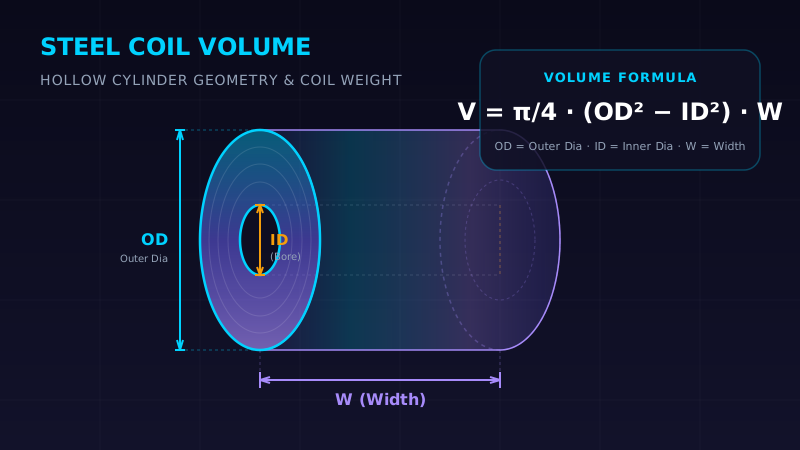

The volume of a steel coil equals π/4 × (OD² − ID²) × W, where OD is the outer diameter, ID is the inner diameter (the bore), and W is the coil width. A coil is just a hollow cylinder, so you subtract the empty core. Quick check: a coil measuring 1.5 m OD, 0.508 m ID, and 1.25 m wide holds about 1.96 m³ of steel — roughly 15.35 tonnes at standard steel density. The same relationship also gives you the coil's weight and the length of strip wound inside it, and this guide walks through all three.
This article was drafted with AI assistance and reviewed for accuracy by the CVC Editorial Team. All calculations were independently verified.
Why a steel coil is a hollow cylinder
Strip steel is wound around a mandrel, which leaves a hole through the middle — the "eye" or bore. Geometrically, that makes a coil a hollow cylinder (an annular cylinder), not a solid one. If you picture the flat end of the coil, you see a ring: a large outer circle with a smaller circle removed from the centre.
The cross-section you actually need is that ring, called an annulus. Its area is the big circle minus the small circle:
Annulus area = π/4 × (OD² − ID²)
Multiply that ring area by the coil's width and you have the volume of steel. This is the same principle used by any hollow cylinder calculator or when estimating pipe insulation volume — a coil is simply a wide, tightly-wound example of one.
Diagram 1: The Hollow Cylinder Coil Geometry
A steel coil is a hollow cylinder. Estimating its volume requires calculating the outer cylinder volume (from OD) and subtracting the inner empty bore volume (from ID).
The steel coil volume formula
V = π/4 × (OD² − ID²) × W
Equivalently, using radii instead of diameters:
V = π × (R_outer² − R_inner²) × W
Both give the identical result — use whichever measurement you have on hand.
Diagram 2: Annulus Area (Radii vs. Diameters)
Be careful not to mix radius and diameter. Radius (R/r) is measured from the center, while diameter (OD/ID) goes all the way across. Using diameter in a radius formula causes a 4x calculation error.
What each variable means
- OD — outer diameter of the finished coil (the full width across the outside).
- ID — inner diameter, i.e. the bore left by the mandrel. Common industry mandrel sizes are 508 mm (20 in) and 610 mm (24 in).
- W — coil width, which is the strip width. This is the "height" of the cylinder.
- π/4 — approximately 0.7854. This factor converts a squared diameter into a circle's area (since area = π/4 × d²).
One point students and new estimators often confuse: radius versus diameter. If you plug a diameter into a formula written for radius, your answer will be off by a factor of four. Decide which version you're using and stay consistent.
How to calculate it, step by step
- Measure or look up OD, ID, and W in the same unit (all millimetres, all inches, etc.).
- Square OD and ID, then subtract:
OD² − ID². - Multiply by π/4 (0.7854) to get the annulus area.
- Multiply by the width W to get the volume.
- Convert units if needed (see the volume in cubic metres and cubic-feet references below).
- Sanity check: the result should be smaller than a solid cylinder of the same OD. If it isn't, you forgot to subtract the bore.
Worked example 1 — metric coil
A hot-rolled coil measures OD = 1,500 mm, ID = 508 mm, W = 1,250 mm. Convert to metres first: 1.5 m, 0.508 m, 1.25 m.
ID² = 0.508² = 0.258064 m²
OD² − ID² = 1.991936 m²
Annulus area = π/4 × 1.991936
= 0.785398 × 1.991936
= 1.5645 m²
Volume = 1.5645 × 1.25 (width)
= 1.9556 m³ (rounded to 4 decimals)
Result: about 1.96 m³ of steel. We'll convert this to weight below.
Worked example 2 — imperial coil
A coil measures OD = 60 in, ID = 20 in, W = 48 in.
Annulus = 0.785398 × 3,200 = 2,513.27 in²
Volume = 2,513.27 × 48 = 120,637 in³
Convert to cubic feet (1 ft³ = 1,728 in³):
Result: about 69.81 ft³, or roughly 120,637 in³. If you prefer this in cubic feet, that conversion is already done.
From volume to weight (using steel density)
Weight is simply volume × density. The standard nominal density for carbon steel is 7,850 kg/m³ (≈ 490 lb/ft³, or 0.284 lb/in³), a widely used engineering constant.
Metric coil from Example 1 (1.9556 m³):
= 15,351 kg
≈ 15.35 tonnes
Imperial coil from Example 2 (69.81 ft³):
= 34,208 lb
≈ 17.1 US tons
For repeated jobs, a dedicated cylinder weight calculator saves the density lookup. Note that stainless and alloy grades differ slightly (roughly 7,700–8,000 kg/m³), so use your specific grade's figure for precision work.
Diagram 3: Material Presets & Densities
Material density determines how volume translates to weight. Aluminum is roughly 1/3 the density of steel, while stainless alloys weigh slightly more than standard carbon steel.
Bonus: how to find the strip length inside a coil
Estimators often want the length of strip wound in the coil — how many metres would unspool if you rolled it out. This falls straight out of the same volume relationship, using the strip thickness t:
The steel volume can be written two ways. As a hollow cylinder:
V = π/4 × (OD² − ID²) × W
And as an unrolled flat strip:
V = Length × W × t
Set them equal, and the width W cancels from both sides:
Length = π × (OD² − ID²) ÷ (4 × t)
This is the genuinely useful insight most guides miss: strip length does not depend on coil width. A narrow slit coil and a full-width coil with the same OD, ID, and thickness contain the same length of strip — the wide one is just heavier.
Diagram 4: Unrolling a Coil (Width Cancels Out)
Since the volume is identical whether coiled or flat (V = Length × W × t), and width (W) is identical on both sides, the width cancels out. The length of a steel coil depends purely on OD, ID, and strip thickness.
Example: OD = 1,200 mm, ID = 610 mm, thickness t = 2.0 mm.
Length = π × 1,067,900 ÷ (4 × 2.0)
= 3,354,904 ÷ 8
= 419,363 mm
≈ 419.4 m
Result: about 419 metres of strip.
The mistake that overstates coil weight by ~13%
The single most common error is treating a coil as a solid cylinder — using π/4 × OD² × W and forgetting to subtract the bore. Because the mandrel hole is genuinely empty, this always overestimates.
Using the Example 1 coil (OD 1.5 m, ID 0.508 m, W 1.25 m):
Hollow (right): π/4 × (1.5² − 0.508²) × 1.25 = 1.9556 m³
Difference = 0.2534 m³
= 0.2534 × 7,850 = 1,989 kg ≈ 2 tonnes too heavy
That's a 13% overstatement on a typical coil — enough to throw off freight quotes, crane load limits, and material costing. The bigger the bore relative to the coil, the bigger the error. Always subtract the ID.
Diagram 5: Solid Cylinder vs. Hollow Coil (13% Error)
Forgetting to subtract the empty mandrel hole adds an artificial 2 tonnes (1,989 kg) of weight in this example, which risks overloaded freight or structural failures.
Steel coil unit conversion reference
For more details on converting between cubic units and liquid measures, check our volume unit conversion guide.
| From | To | Multiply by |
|---|---|---|
| in³ | cm³ | 16.387 |
| in³ | ft³ | ÷ 1,728 |
| ft³ | m³ | 0.02832 |
| m³ | litres | 1,000 |
| m³ | kg (steel) | 7,850 |
| ft³ | lb (steel) | 490 |
| in³ | lb (steel) | 0.284 |
| mm | m | ÷ 1,000 |
Diagram 6: Industry Standard Mandrel Sizes
In sheet steel fabrication, mandrels are designed to standard dimensions. The two most common steel mill mandrel configurations are 20-inch (508 mm) and 24-inch (610 mm) diameters.
You can also run these through the free cylinder volume calculator if you'd rather skip the manual conversion, or review the underlying cylinder volume formula in more depth.
Frequently asked questions
How do you calculate the volume of a steel coil?
Use V = π/4 × (OD² − ID²) × W. Square the outer and inner diameters, subtract, multiply by 0.7854, then multiply by the coil width.
Is a steel coil a hollow cylinder?
Yes. The mandrel leaves a hole through the centre, so the cross-section is a ring (an annulus), making the coil a hollow cylinder rather than a solid one.
What is the formula for steel coil weight?
Weight = volume × density, with steel density at 7,850 kg/m³. For a 1.96 m³ coil, that's 1.96 × 7,850 ≈ 15,350 kg, or about 15.35 tonnes.
How do you find the length of steel in a coil?
Divide the annulus cross-section by the strip thickness: Length = π × (OD² − ID²) ÷ (4 × t). A coil with OD 1,200 mm, ID 610 mm, and t 2.0 mm holds roughly 419 m of strip.
Why do you subtract the inner diameter?
Because the bore is empty. Subtracting ID² removes the missing core; skipping it treats the hole as solid steel and overstates both volume and weight.
What density should I use for steel coils?
7,850 kg/m³ (490 lb/ft³) is the standard value for carbon steel. Stainless and alloy grades run slightly higher or lower, roughly 7,700–8,000 kg/m³, so use your specific grade when precision matters.
Does coil width affect the strip length?
No — and this surprises people. When you set the hollow-cylinder volume equal to the unrolled-strip volume, the width cancels algebraically. Two coils with identical OD, ID, and thickness contain the same strip length regardless of width. The wider coil simply weighs more because it has more strip across, not more strip end-to-end.
How much does a standard steel coil weigh?
It depends entirely on dimensions, but a mid-sized coil (OD 1.5 m, ID 0.508 m, W 1.25 m) works out to about 1.96 m³ × 7,850 kg/m³ ≈ 15.35 tonnes. Large master coils can exceed 25 tonnes, and slit coils are much lighter.
Sources & verification
Steel density (7,850 kg/m³ / 490 lb/ft³) is the standard nominal figure for carbon steel, as tabulated by Engineering Toolbox. The hollow-cylinder and annulus geometry follows the standard definitions given by Wolfram MathWorld and Math is Fun. Common mandrel inner-diameter sizes (508 mm and 610 mm) are industry-standard coil specifications. All calculations in this article were computed and independently re-checked; unit conversions use exact factors (1 ft³ = 1,728 in³; 1 in³ = 16.387 cm³).
Need the fast answer? Use our online cylinder volume calculator, then convert the result with the unit you actually need.