Engineering & Industrial · October 26, 2026
Pipe Volume Per Foot Chart: Gallons Per Foot for PVC Schedule 40 Pipe
Pipe volume per foot chart for PVC Schedule 40 pipe, with true inner diameters, gallons per foot, litres per metre, and gallons per 100 feet for sizes from 1/2 inch to 4 inches.

- The Formula Behind the Chart
- Worked Example: A 50 Foot Run of 2 Inch Pipe
- The Complete Chart: PVC Schedule 40
- The Nominal vs. True Inner Diameter Trap
- A Short Note on Copper and Steel Pipe
- How to Use the Chart for Sizing and Planning
- Common Mistakes to Avoid
- Frequently Asked Questions
- How many gallons per foot does a 2 inch PVC pipe hold?
- How do I calculate pipe volume per foot myself?
- Why does the chart use inner diameter instead of nominal size?
- How much water does 100 feet of 1 inch pipe hold?
- Does Schedule 80 pipe hold the same volume per foot as Schedule 40?
- How do I convert gallons per foot to litres per metre?
- Can I use this chart for copper pipe?
- Conclusion
- Article Notes
Pipe volume per foot chart values tell you exactly how much water a pipe holds for every foot of its length, so you can size a run, plan a flush, or dose a treatment without guessing. A 2 inch PVC Schedule 40 pipe holds 0.174 US gallons per foot (0.66 litres per foot), a 1 inch pipe holds 0.045 US gallons per foot (0.17 litres per foot), and a 4 inch pipe holds 0.661 US gallons per foot (2.50 litres per foot). Use the chart below, match the row to the true inner diameter of your pipe, and multiply gallons per foot by your total run length.
The Formula Behind the Chart
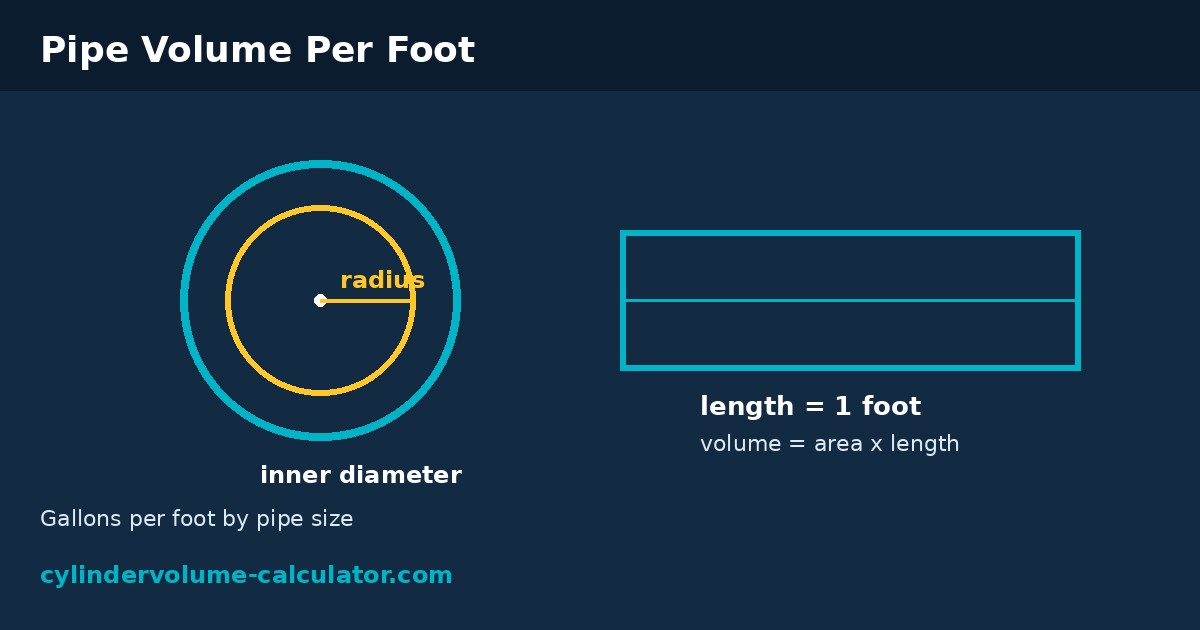
Hover a dimension to see what it means. Radius runs from the centre to the inside edge, never across the full diameter.
Every row in this chart comes from one short formula:
Gallons per foot = inner diameter in inches squared x 0.0408
A pipe is a long cylinder. You find its cross sectional area from the inner diameter, extend that area over one foot, and convert cubic inches to US gallons. One US gallon equals 231 cubic inches. The constant 0.0408 bundles the circle factor (pi divided by 4), the 12 inches in a foot, and that conversion into one number: 0.7854 x 12 divided by 231 equals 0.0408.
That shortcut only gives the right answer with the true inner diameter, not the nominal size printed on the pipe. Nominal size is a trade name, not a measurement: a 2 inch pipe has a Schedule 40 inner diameter of 2.067 inches. This article uses true inner diameters throughout, and the chart states each one so you can verify every row.
For odd lengths, bends, and fittings, read the guide on how to measure pipe volume.
Worked Example: A 50 Foot Run of 2 Inch Pipe
Suppose you need the water volume in a straight 50 foot run of 2 inch PVC Schedule 40 pipe, before you add fittings or branches. Follow the arithmetic exactly as the chart does it.
Step 1: Take the true inner diameter. For 2 inch Schedule 40 PVC, the inner diameter is 2.067 inches.
Step 2: Square it. 2.067 x 2.067 = 4.272489 square inches.
Step 3: Multiply by the constant. 4.272489 x 0.0408 = 0.1743 US gallons per foot. The chart rounds this to 0.174 gallons per foot.
Step 4: Multiply by the run length. 0.1743 x 50 feet = 8.72 US gallons (33.0 litres).
So a 50 foot run of 2 inch pipe holds about 8.72 US gallons, and a 100 foot run holds 17.43 US gallons, which matches the chart. If your run includes elbows, tees, or valves, measure each straight section separately, add the lengths together first, and then multiply once.
Second check: a 1 inch pipe has a true inner diameter of 1.049 inches. Square it (1.049 x 1.049 = 1.100401), multiply by 0.0408, and you get 0.0449 US gallons per foot, rounded to 0.045. Over 100 feet, that run holds 4.49 US gallons (17.0 litres). If your calculation lands far from these numbers, you probably used the nominal size instead of the true inner diameter.
The Complete Chart: PVC Schedule 40
The table covers the sizes homeowners and plumbers reach for most often, from a 1/2 inch supply line to a 4 inch drain or main. Gallons per foot uses US gallons. Litres per metre converts each figure at 12.4193 (1 US gallon equals 3.78541 litres and 1 foot equals 0.3048 metres). Gallons per 100 feet multiplies gallons per foot by 100.
| Nominal size | True inner diameter (inches) | Gallons per foot (US gal/ft) | Litres per metre (L/m) | Gallons per 100 feet (US gal) |
|---|---|---|---|---|
| 1/2 inch | 0.622 | 0.016 | 0.20 | 1.58 |
| 3/4 inch | 0.824 | 0.028 | 0.34 | 2.77 |
| 1 inch | 1.049 | 0.045 | 0.56 | 4.49 |
| 1-1/2 inch | 1.610 | 0.106 | 1.31 | 10.58 |
| 2 inch | 2.067 | 0.174 | 2.16 | 17.43 |
| 3 inch | 3.068 | 0.384 | 4.77 | 38.40 |
| 4 inch | 4.026 | 0.661 | 8.21 | 66.13 |
Read the table from left to right: confirm the nominal size, check the true inner diameter column, then read gallons per foot for a short run or gallons per 100 feet for a long run. For any other length, multiply gallons per foot by your exact length in feet. For example, a 75 foot run of 3 inch pipe holds 0.3840 x 75 = 28.80 US gallons (109.0 litres).
Notice how fast volume grows with diameter. A 4 inch pipe holds almost 15 times as much water per foot as a 1 inch pipe (0.661 divided by 0.045 equals about 14.7), even though its diameter is only about four times larger. Volume follows the square of the diameter, not the diameter itself.
The Nominal vs. True Inner Diameter Trap
The single biggest error in pipe volume work is plugging the nominal size into the formula as if it were the inner diameter. It always understates the volume, because the true inner diameter is larger than the nominal size for these Schedule 40 sizes. The size of the mistake varies by pipe size, so you cannot correct it with one flat percentage.
Take the 1/2 inch size. The nominal calculation gives 0.500 squared x 0.0408 = 0.0102 gallons per foot, while the true calculation gives 0.622 squared x 0.0408 = 0.0158 gallons per foot. The shortcut understates the real volume by about 35 percent, enough to throw off a flush volume or a chemical dose by more than a third.
Take the 2 inch size. The nominal calculation gives 2.000 squared x 0.0408 = 0.1632 gallons per foot, against a true 0.1743 gallons per foot, an understatement of about 6 percent. That gap grows to about 1.1 gallons on a 100 foot run (17.43 minus 16.32).
A second trap is measuring the outside diameter and using it as the inner diameter. The outside diameter exceeds the inner diameter by twice the wall thickness, so that shortcut overstates the volume. If you can only measure the outside, subtract twice the wall thickness, or check the pipe specification sheet. For a purchase, permit, or safety calculation, verify the inner diameter with calipers or the manufacturer specification.
A Short Note on Copper and Steel Pipe
Do not apply this PVC chart directly to copper or steel pipe. Copper tube and steel pipe use different sizing systems and different wall thicknesses, so their true inner diameters differ from PVC Schedule 40 at the same nominal size. A copper line and a PVC line that both carry a 1 inch label can hold different volumes per foot.
The formula itself still works for any round pipe. Measure the actual inner diameter in inches, square it, and multiply by 0.0408. The cylinder volume formula page shows the same method in general form, and the hollow cylinder calculator derives the bore when you know the outer diameter and wall thickness. For steel pipe, confirm the schedule first, since Schedule 40, Schedule 80, and other schedules change the wall thickness and inner diameter at the same nominal size.
How to Use the Chart for Sizing and Planning
Estimate drain down and flush volumes. Multiply gallons per foot by the total length you plan to drain or flush, and add a small stated margin for fittings, valves, and low spots.
Compare pipe sizes before you buy. A 3 inch line holds 0.384 gallons per foot against 0.174 for a 2 inch line, more than double the stored volume per foot. That extra water can help a system ride through a short demand spike, but it also doubles the water you must flush, heat, or treat.
Size storage against the pipe run. A single 100 foot run of 4 inch pipe holds 66.13 US gallons, which already exceeds the capacity described in the guide to 55 gallon drum volume. If your plan calls for one drum and your run holds 66 gallons, you need a second container before you open the valve, not after. Apply the same check to tanks using the guidance on water tank capacity.
Dose chemicals by total volume, not by length alone. A dose that works for 100 feet of 1 inch pipe (4.49 gallons total) will underdose 100 feet of 2 inch pipe (17.43 gallons total) by nearly four times if you copy it by length. Convert length to volume first, then apply the dose rate per gallon.
Convert units cleanly for metric jobs. For total litres, multiply litres per metre by length in metres. For total US gallons from a metric length, convert metres to feet first (multiply by 3.28084), then multiply by gallons per foot. The cylinder volume in liters and cylinder volume in gallons calculators accept direct inputs for a size outside this chart.
Common Mistakes to Avoid
Using nominal size as inner diameter. This understates volume at every size in the chart, by about 35 percent at 1/2 inch and about 6 percent at 2 inch. Always use the true inner diameter column.
Using outside diameter as inner diameter. This overstates volume, because the wall thickness sits inside the outside measurement. Subtract twice the wall thickness, or look up the stated inner diameter.
Scaling volume linearly with diameter. Doubling the diameter quadruples the volume per foot. A 2 inch pipe holds about 3.9 times as much per foot as a 1 inch pipe, not twice as much. Check any estimate that doubles when the diameter doubles.
Mixing US gallons and imperial gallons. This chart uses US gallons throughout, which is the standard unit for US plumbing work. One imperial gallon equals about 1.201 US gallons, so a figure quoted in imperial gallons will look about 20 percent larger for the same pipe. Confirm which gallon a supplier or treatment label uses before you compare numbers.
Forgetting fittings and branches. The chart covers straight pipe only. Measure branch lengths, add them to the total length before you multiply, and add a stated margin for fittings on critical estimates.
Rounding too early. Round only the final answer. The worked example keeps four decimals through the multiplication and rounds at the end; rounding to two decimals first compounds the error across a long run.
Frequently Asked Questions
How many gallons per foot does a 2 inch PVC pipe hold?
A 2 inch PVC Schedule 40 pipe holds 0.174 US gallons per foot (2.16 litres per metre). The calculation runs 2.067 squared x 0.0408 = 0.1743 gallons per foot, so 100 feet holds 17.43 US gallons.
How do I calculate pipe volume per foot myself?
Square the true inner diameter in inches and multiply by 0.0408 to get US gallons per foot, then multiply by the run length in feet. For 3 inch pipe, 3.068 squared x 0.0408 = 0.3840 gallons per foot, and a 50 foot run holds 19.20 US gallons.
Why does the chart use inner diameter instead of nominal size?
Nominal size is a trade label, not a measurement of the hole inside the pipe. Volume depends on the actual bore that water flows through, so only the inner diameter gives the correct cross sectional area.
How much water does 100 feet of 1 inch pipe hold?
One hundred feet of 1 inch PVC Schedule 40 pipe holds 4.49 US gallons (17.0 litres), since 0.0449 x 100 equals 4.49. Compare that with 100 feet of 4 inch pipe, which holds 66.13 US gallons.
Does Schedule 80 pipe hold the same volume per foot as Schedule 40?
No. Schedule 80 pipe has thicker walls at the same nominal size, so its inner diameter is smaller and it holds less per foot. Measure the Schedule 80 inner diameter and apply the same formula to get the correct gallons per foot.
How do I convert gallons per foot to litres per metre?
Multiply gallons per foot by 12.4193 to get litres per metre. For 2 inch pipe, 0.174 x 12.4193 = 2.16 litres per metre. The chart already lists the metric figure for each size.
Can I use this chart for copper pipe?
Use the formula, but do not copy the PVC rows. Copper tube has different wall thicknesses and true inner diameters from PVC Schedule 40. Measure the copper inner diameter in inches, square it, and multiply by 0.0408.
Conclusion
A pipe volume per foot chart only helps when every row traces back to a true inner diameter and a formula you can check. Start with the true inner diameter, square it, multiply by 0.0408, and multiply by your run length. Check the nominal size trap before you trust any number, keep US gallons and imperial gallons apart, and add a stated margin for fittings.
For a size outside this chart, or for a pipe where you know the outer diameter and wall thickness rather than the bore, use the hollow cylinder calculator and enter your measured dimensions directly.
Article Notes
All chart figures in this article were recalculated from the stated Schedule 40 PVC true inner diameters using gallons per foot = inner diameter squared x 0.0408, gallons per 100 feet = gallons per foot x 100, and litres per metre = gallons per foot x 12.4193. No supplied figure failed recalculation, so no correction to a supplied figure was required. One conversion detail deserves a plain statement: an early draft calculation used a litres per metre factor of 12.345, which understates the metric column. The article corrects that factor to 12.4193, derived from 3.78541 litres per US gallon divided by 0.3048 metres per foot, and every litres per metre value in the chart uses the corrected factor. Rounded chart values: gallons per foot to three decimals, litres per metre to two decimals, gallons per 100 feet to two decimals. Unrounded values used for the headline example: 2 inch pipe, 2.067 squared = 4.272489, x 0.0408 = 0.1743 gallons per foot, x 50 feet = 8.72 US gallons. Schedule 40 PVC inner diameters used: 1/2 inch 0.622, 3/4 inch 0.824, 1 inch 1.049, 1-1/2 inch 1.610, 2 inch 2.067, 3 inch 3.068, 4 inch 4.026. Verify critical dimensions against the manufacturer specification for your exact pipe before you use a figure for a regulated, safety related, or high value decision, and treat straight pipe figures as the baseline before you add fittings and branches.