Guides — July 8, 2026
How To Find The Volume Of A Wire Spool (Formula + Worked Examples)
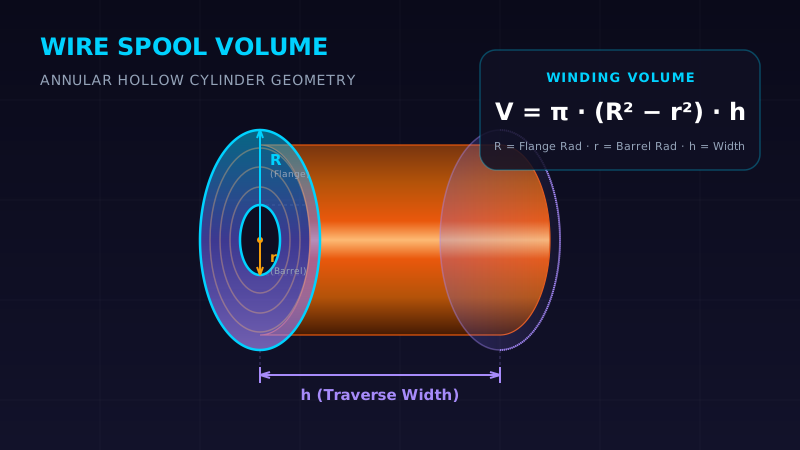

To find the volume of a wire spool, treat the winding space as a hollow cylinder and use V = π × (R² − r²) × h, where R is the outer (flange) radius, r is the barrel/core radius, and h is the traverse — the inside width between the two flanges. Quick check: a drum with a 50 cm flange radius, a 25 cm barrel radius and a 56 cm traverse gives V = π × (50² − 25²) × 56 ≈ 329,867 cm³, or about 330 litres of winding space. That single formula answers most "wire spool volume" questions — and once you have it, working out how much wire actually fits is one more short step.
What "volume of a wire spool" actually means
A wire spool (also called a cable drum or reel) isn't a solid cylinder. It has three parts that matter for volume: a central barrel (the core the wire wraps around), two flanges (the discs on each end), and the traverse — the gap between the flanges where the wire lives. Depending on what you're doing, "volume" can mean one of three things:
- The winding space — the empty annular region between the barrel and the flange edge. This is what tells you how much wire the spool can hold, and it's the answer people usually want.
- The volume of wire on the spool — the copper (or aluminium) itself, which is the winding-space volume multiplied by a fill factor.
- The solid material of the spool — the wood, plywood or plastic of the flanges and barrel wall. This only matters for shipping weight or manufacturing, and it's a separate calculation.
This guide focuses on the first two, because that's what "how to find the volume of a wire spool" almost always means in practice.
The winding space is a hollow cylinder
Picture the spool end-on. The wire fills the ring between the barrel and the flange rim — a doughnut shape (an annulus) that runs the full width of the traverse. That's the exact definition of a hollow cylinder, so the winding volume uses the standard hollow-cylinder formula. If you want to check any figure below, our hollow cylinder calculator does it in one step (similar to how you calculate pipe insulation volume or perform a steel coil volume calculation).
Diagram 1: Wire Spool Anatomy & Winding Space
A wire spool consists of two end flanges of radius R and a core barrel of radius r. The winding space between them forms a hollow cylinder running the traverse width h.
The formula, part by part
V = π × (R² − r²) × h
| Symbol | Meaning | Where to measure |
|---|---|---|
| R | Outer winding radius | Half the flange diameter (or slightly less — see clearance below) |
| r | Barrel/core radius | Half the barrel diameter |
| h | Traverse | Inside distance between the two flanges |
| π | Pi | 3.14159 (we round to five figures) |
Two things trip people up. First, drums are almost always specified by diameter, not radius — so halve them before you start, or use our cylinder volume using diameter approach. Second, it's (R² − r²), not (R − r)². You square each radius first, then subtract. Getting that order wrong is the single most common mistake in spool flange math.
If you prefer to work straight from diameters, the identical formula is V = (π ⁄ 4) × (D² − d²) × h, where D and d are the flange and barrel diameters. The (π ⁄ 4) is the same 0.785 coefficient we'll unpack later — remember it.
Diagram 2: Annulus Area (Difference of Squares vs. Squared Difference)
Always square each radius before subtracting: V ∝ (R² - r²). Doing (R - r)² would calculate the area of a circle of radius 6 (area ~113 cm²), while the actual annulus area is 84π (~264 cm²), causing a 2.3x math error.
Worked Example 1 — a metric cable drum
Take a mid-size timber cable drum. Typical medium drums run roughly 600–1000 mm on the flange (Eland Cables, per BS 8512). We'll use:
- Flange diameter = 1000 mm → R = 50 cm
- Barrel diameter = 500 mm → r = 25 cm
- Traverse (inside width) = 560 mm → h = 56 cm
Plug in, keeping units consistent in centimetres:
V = π × (50² − 25²) × 56
V = π × (2500 − 625) × 56
V = π × 1875 × 56
V = π × 105,000
V ≈ 329,867 cm³ (rounded to the nearest cm³)
Convert to something readable: 329,867 cm³ ÷ 1000 = 329.87 litres, or about 0.33 m³. Sanity check — a drum a metre across holding roughly a third of a cubic metre of wire feels right for a medium drum. Want the litre figure automatically? Run it through volume in litres.
Worked Example 2 — an imperial cable drum
Now the same method in inches. Medium drums in imperial sizing sit around 24–48 in flanges and 10–24 in barrels (per published cable-drum dimension tables). We'll use:
- Flange diameter = 36 in → R = 18 in
- Barrel diameter = 18 in → r = 9 in
- Traverse = 24 in → h = 24 in
V = π × (324 − 81) × 24
V = π × 243 × 24
V = π × 5832
V ≈ 18,321.6 in³
Convert using standard factors (1 US gallon = 231 in³; 1 ft³ = 1728 in³):
- 18,321.6 ÷ 231 = 79.31 US gallons
- 18,321.6 ÷ 1728 = 10.60 ft³
If you'd rather skip the arithmetic, volume in gallons handles the conversion for you.
From winding space to wire capacity (copper winding volume)
Knowing the winding space is only half the job. Wire is round, and round things never fill a space completely — there are always tiny air gaps between adjacent turns. To go from "empty winding space" to "length of wire that fits", you need two more numbers: the wire's cross-sectional area and a fill factor (also called packing factor) that accounts for those gaps.
The chain of logic is simple:
- Winding space volume = π × (R² − r²) × h
- Volume of wire it holds = winding space × fill factor (k)
- Length of wire = wire volume ÷ cross-sectional area of one strand
Combine them and the whole thing collapses to one tidy equation:
L = k × h × (D² − d²) ⁄ d_w²
where D and d are flange and barrel diameters, h is the traverse, d_w is the wire diameter, and k is the fill factor. (Cable-drum capacity calculation is exactly this formula in disguise.)
Diagram 3: Close-up of Wire Windings & Interstitial Air Gaps
Round wires wound on a spool leave empty interstitial spaces. The fill factor (k) represents the fraction of winding volume actually occupied by copper material vs. air pockets.
Worked Example 3 — how much copper wire fits
Consider a copper magnet-wire spool:
- Barrel diameter = 40 mm → r = 20 mm
- Flange diameter = 100 mm → R = 50 mm
- Traverse = 60 mm → h = 60 mm
- Wire diameter = 1.0 mm
Step 1 — winding space:
V = π × (2500 − 400) × 60
V = π × 2100 × 60
V = π × 126,000 ≈ 395,841 mm³ (≈ 395.84 cm³)
Step 2 — apply a realistic fill factor. For randomly wound round wire, a practical fill factor of about 0.75 is a sound working assumption (more on the exact value next). Wire volume = 395,841 × 0.75 ≈ 296,881 mm³.
Step 3 — divide by the wire's cross-section. A 1.0 mm wire has area (π ⁄ 4) × 1.0² = 0.7854 mm².
So roughly 378 m of 1 mm copper wire fits on that spool at 75% fill. A quick bonus: that 296.88 cm³ of copper (density 8.96 g/cm³) weighs about 2.66 kg — the kind of figure our cylinder weight calculator returns directly.
The fill factor: why 0.785 keeps appearing
Here's the part most guides leave out. Open almost any cable-reel capacity formula and you'll find a coefficient of 0.785 sitting in it, usually unexplained. That number isn't arbitrary — it's π ⁄ 4 = 0.7854, the fraction of a square that a circle inscribed inside it occupies. In other words, the standard formula quietly assumes each wire sits in its own little square cell (a neat parallel "square packing"), touching its neighbours but leaving the corner gaps empty.
That's one packing pattern, but not the only one. How tightly round wires can theoretically nest depends on the geometry:
| Packing pattern | Fill factor | Where you see it |
|---|---|---|
| Random / "jumble" winding | ~0.60–0.73 | Fast machine winding, thick insulated cable |
| Square (parallel-layer) packing | π ⁄ 4 ≈ 0.785 | The classic 0.785 in reel formulas |
| Ordered round-wire winding | ~0.73–0.80 | Careful layer winding of magnet wire |
| Hexagonal close packing (theoretical max) | π ⁄ (2√3) ≈ 0.907 | The absolute ceiling for round wire |
The hexagonal maximum comes from nesting each upper row of wires into the grooves of the row below — the "orthocyclic" pattern used in precision coil winding, which can approach a ~90% fill factor in ideal conditions (per MWS Wire; Wikipedia, Coil winding technology). In everyday practice, round-wire windings land around 73–80%.
Diagram 4: Wire Packing Geometries & Theoretical Fill Factors
Square packing assumes circles align in columns, leaving 21.5% air gaps. Hexagonal close packing nests circles in row grooves to achieve the highest density, leaving only 9.3% gaps.
What does that mean for our Example 3 spool? The choice of fill factor changes the answer more than any measurement error would:
- At k = 0.75 (typical practical): 378 m
- At k = 0.785 (square packing): ≈ 396 m
- At k = 0.907 (hexagonal maximum): ≈ 457 m
That's a 21% spread from the same physical spool — which is exactly why you should treat any single capacity number as an estimate, and why understanding the fill factor matters more than memorising a formula.
The real-world adjustment competitors skip (flange clearance)
Wire is never wound right up to the flange edge — you leave clearance so the outer layers don't spill over the rim. Suppose we take the Example 1 drum but wind only to a 45 cm radius instead of the full 50 cm (a 5 cm clearance):
V = π × (2025 − 625) × 56
V = π × 1400 × 56
V = π × 78,400 ≈ 246,301 cm³ ≈ 246.3 litres
A 5 cm clearance drops usable volume from ~330 L to ~246 L — roughly a 25% reduction from what the flange-edge number suggested. Manufacturers go further and often quote a recommended capacity of about 80% of the theoretical maximum to keep the wind neat and protect the cable. Apply that on top and the genuinely usable space here is closer to 197 L. Always separate "geometric volume" from "usable volume" — they're rarely the same.
Diagram 5: Usable Capacity Loss from Safety Flange Clearance
Because winding layers increase in radius, the outermost rings represent the largest portion of total volume. Even a small safety clearance zone results in a disproportionate loss of capacity.
Common mistakes
- Squaring the difference instead of the difference of squares. It's (R² − r²), not (R − r)². These give wildly different answers.
- Mixing radius and diameter. Drums are labelled by diameter; the formula needs radius. Halve first, then compute. Our cylinder volume using radius page walks through this if you want a refresher.
- Forgetting the fill factor. Winding space is not wire capacity. Skipping the fill factor overstates how much wire fits by 20–40%.
- Winding to the flange edge on paper. Real spools need clearance; the theoretical volume is an upper bound, not a target.
- Unit drift. Keep everything in one unit system through the whole calculation, then convert at the very end.
Quick conversion reference
| From | To | Multiply by |
|---|---|---|
| cm³ | litres | ÷ 1000 |
| m³ | litres | × 1000 |
| in³ | US gallons | ÷ 231 |
| in³ | ft³ | ÷ 1728 |
| ft³ | US gallons | × 7.481 |
| ft³ | litres | × 28.317 |
| in³ | cm³ | × 16.387 |
Frequently asked questions
What is the formula for the volume of a wire spool?
Use the hollow-cylinder formula: V = π × (R² − r²) × h, where R is the flange (outer) radius, r is the barrel radius, and h is the traverse between the flanges.
Is a wire spool a hollow cylinder?
The winding space is, yes. The ring of wire between the barrel and the flange rim forms an annulus running the width of the drum, which is exactly a hollow cylinder — so the hollow-cylinder formula applies directly.
How do I calculate how much wire fits on a spool?
Find the winding volume, multiply by a fill factor (about 0.75 for typical round wire), then divide by the wire's cross-sectional area, (π ⁄ 4) × d². For a spool holding ~396 cm³ of space wound with 1 mm wire, that works out to roughly 378 m.
What is a good fill factor for winding wire?
For randomly wound round wire, plan on about 0.60–0.73; careful layer winding reaches roughly 0.75–0.80. The theoretical ceiling for round wire is π ⁄ (2√3) ≈ 0.907, achieved only with precision "orthocyclic" winding.
Why does the cable reel formula use 0.785?
Because 0.785 is π ⁄ 4 — the fraction of a square occupied by a circle inside it. The formula assumes each wire sits in its own square cell, which is a reasonable square-packing model for cable that doesn't nest into grooves.
How do I find the volume of the whole spool versus the winding space?
The winding space uses V = π(R² − r²)h. The solid spool material (flanges plus barrel wall) is a separate calculation you'd only need for shipping weight — add the two flange discs and the barrel wall as their own cylinders. For most purposes, the winding space is the figure you want.
How much wire can a large cable drum hold?
It depends entirely on flange size, barrel size and wire diameter, so there's no single answer — but the method is fixed. Compute the winding volume with V = π(R² − r²)h, apply a fill factor near 0.75 and an ~80% usable allowance for clearance, then divide by the wire's cross-section. A large drum with a 1.5 m flange can hold several kilometres of thin wire or a few hundred metres of thick armoured cable using the same steps.
How do I convert spool volume to litres or gallons?
Divide cm³ by 1000 for litres, or divide in³ by 231 for US gallons. Keep your whole calculation in one unit system and convert only at the end.
Sources & verification
Cable-drum dimension ranges (flange, barrel and traverse for small, medium and large drums) reflect published industry tables and the British Standard BS 8512 for cables on wooden drums (Eland Cables). Fill-factor and packing-density figures for round wire — the ~73–80% practical range and the ~90% orthocyclic ceiling — are drawn from MWS Wire and the Wikipedia entry on Coil winding technology. The hollow-cylinder volume formula follows the standard geometric definition (Wolfram MathWorld). Standard conversions used: 1 L = 1000 cm³; 1 US gallon = 231 in³; 1 ft³ = 1728 in³ = 28.317 L. Copper density taken as 8.96 g/cm³. All calculations in this article were worked step by step and independently checked.
Need the fast answer? Use our online cylinder volume calculator, then convert the result with the unit you actually need.