Timber & Wood Calculation · August 7, 2026
Volume of Round Timber Logs: Smalian and Huber Formulas
Calculate log volume using forestry formulas: Huber, Smalian and Doyle methods. Enter small-end diameter, large-end diameter and length for board feet.

- The quick method: treat the log as a cylinder
- Worked example 1: metric log
- Worked example 2: imperial log
- Why logs are not perfect cylinders
- Formulas for tapered logs: Smalian, Huber, and Newton
- Smalian’s formula
- Huber’s formula
- Newton’s formula
- Worked example 3: the same tapered log, three ways
- The Hoppus formula: how the timber trade measures logs
- Worked example 4: a hardwood log measured the Hoppus way
- Which method should you use?
- Unit conversions for log volume
- Common mistakes when measuring log volume
- Frequently Asked Questions
- What is the formula for the volume of a round log?
- How do I find the radius if I only measured the diameter?
- Which log volume formula is the most accurate?
- What is the difference between Smalian and Huber?
- How do I convert hoppus feet to cubic metres?
- Why is the Hoppus volume smaller than the true volume?
- Can I use a cylinder calculator for firewood?
- Do I measure the log with or without bark?
- Sources and verification note
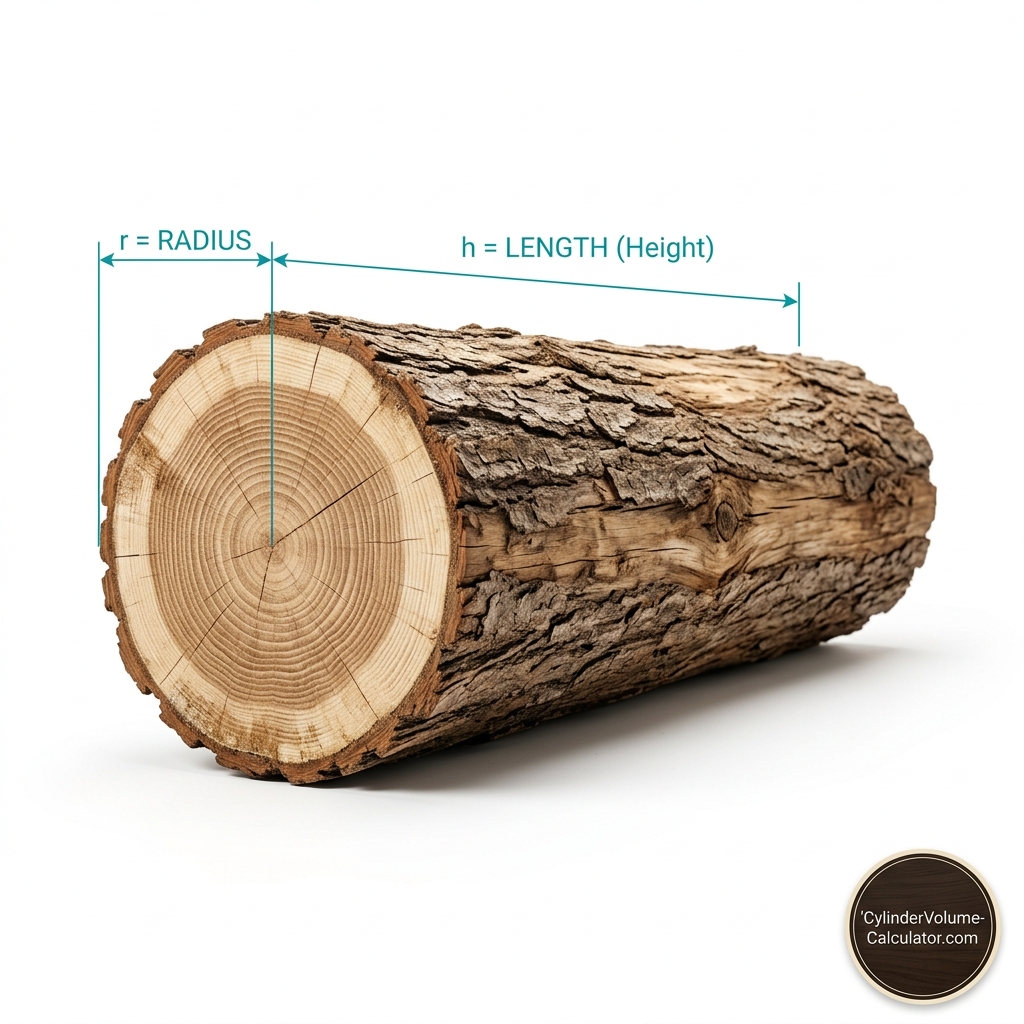
To calculate the volume of a round timber log, treat it as a cylinder and use V = π × r² × h, where r is the log’s radius and h is its length. A log 30 cm across (0.15 m radius) and 4 m long holds about 0.28 m³ of wood. That formula works well for straight, even logs. Real logs taper, so foresters also use the Smalian, Huber, and Newton formulas, while the timber trade often measures logs with the older Hoppus rule. This guide covers all of them, with worked examples in metric and imperial units.
The quick method: treat the log as a cylinder
A round log is close to a cylinder, so the fastest estimate uses the standard cylinder volume formula:
V = π × r² × hHere r is the radius (half the diameter) and h is the length of the log. You usually measure the diameter across the cut face, then halve it to get the radius. If you prefer to work straight from the diameter, you can follow our detailed guide on how to find the volume of a cylinder using diameter or use our with diameter calculator.
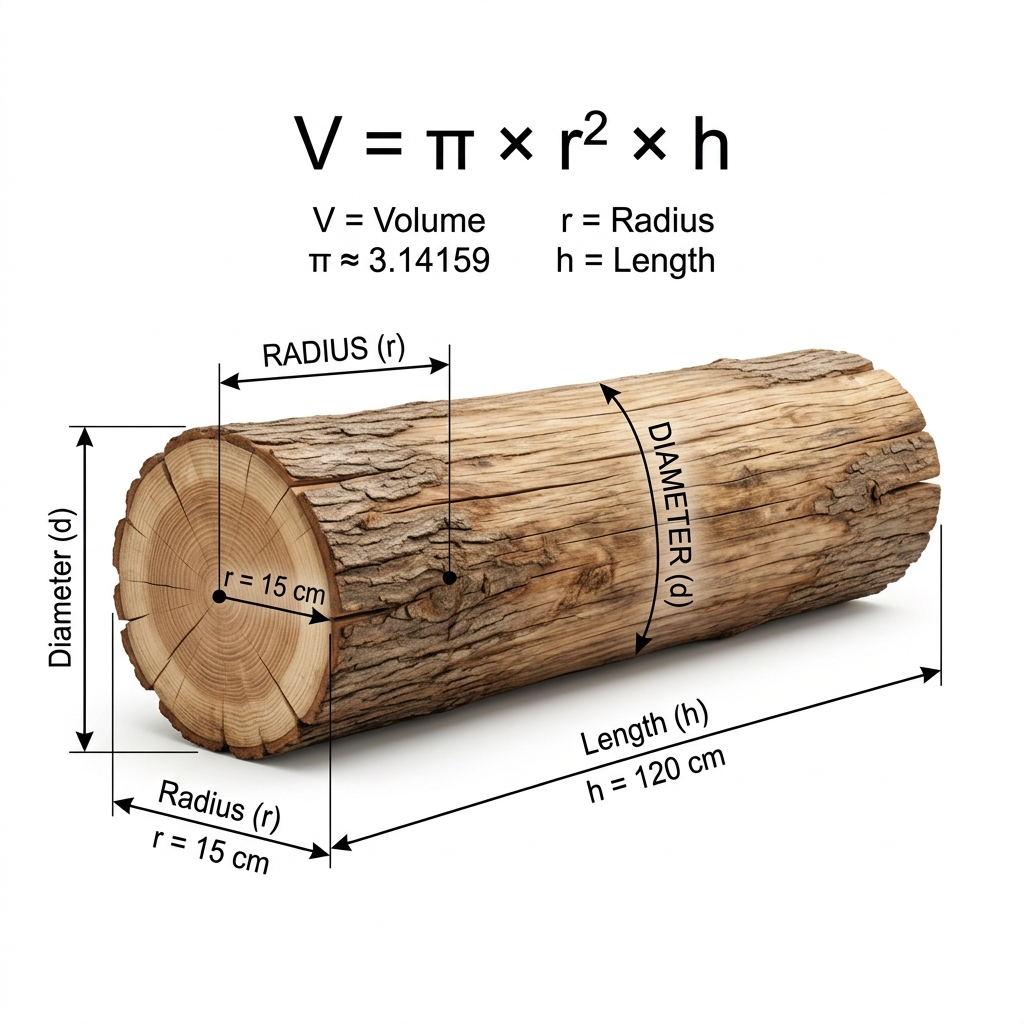
Use π = 3.14159 and round the final answer, not the steps.
Worked example 1: metric log
A log measures 30 cm in diameter and 4 m in length.
Radius r = 30 cm ÷ 2 = 15 cm = 0.15 m
V = π × r² × h
V = 3.14159 × (0.15)² × 4
V = 3.14159 × 0.0225 × 4
V = 3.14159 × 0.09
V = 0.2827 m³  (rounded to 0.28 m³)
Sanity check: a log about a foot across and 4 m long should be a small fraction of a cubic metre. 0.28 m³ fits.
Worked example 2: imperial log
A log measures 16 inches in diameter and 8 feet in length. Convert the diameter to feet first so the units match.
Diameter = 16 in ÷ 12 = 1.3333 ft
Radius r = 1.3333 ÷ 2 = 0.6667 ft
V = π × r² × h
V = 3.14159 × (0.6667)² × 8
V = 3.14159 × 0.4444 × 8
V = 11.17 ft³  (rounded to 2 decimal places)
To convert that to metric, multiply by 0.0283168:
11.17 ft³ × 0.0283168 = 0.316 m³Working the radius by hand each time gets tedious, so a cylinder volume using radius tool speeds this up when you have a batch of logs to measure.
Why logs are not perfect cylinders
The cylinder method assumes the log is the same thickness from end to end. Most logs are not. A tree trunk is wider at the base (the butt) and narrower at the top. This narrowing is called taper.
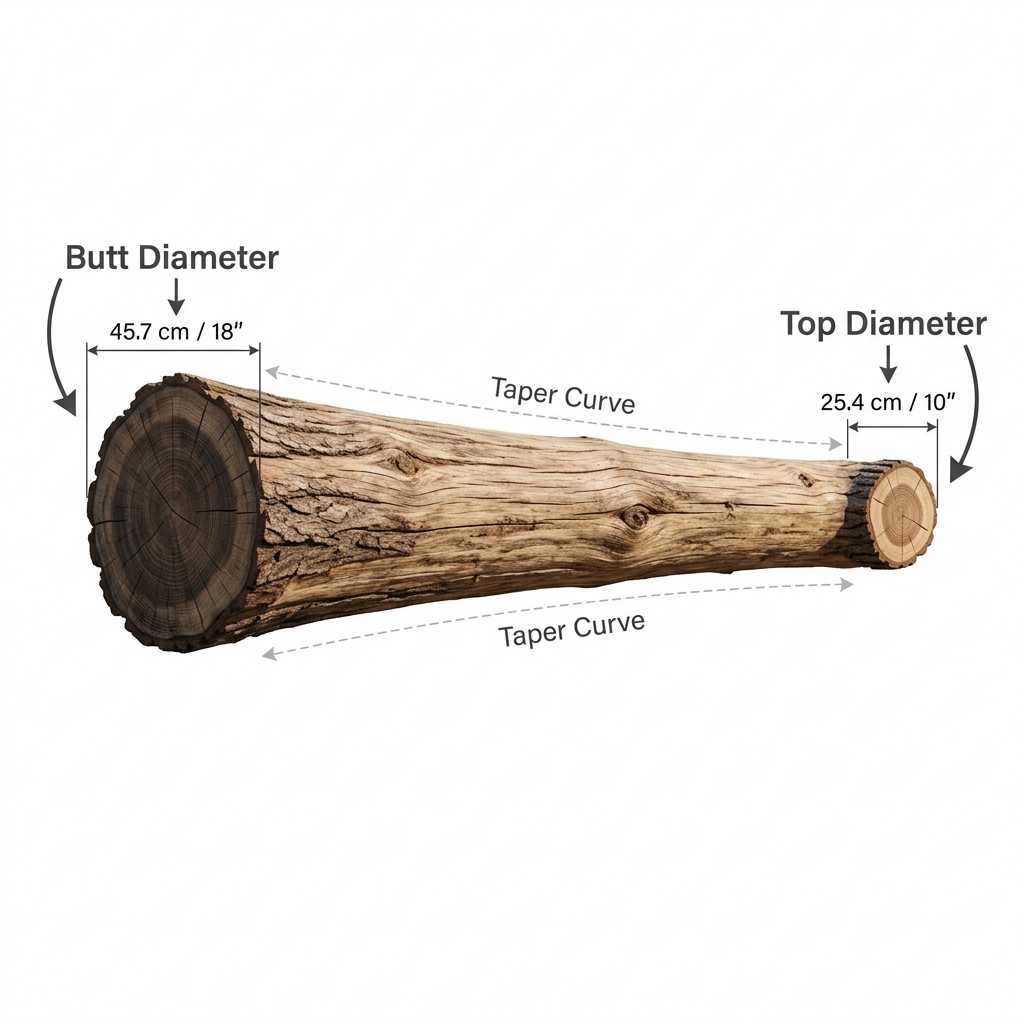
If you plug only the butt diameter into the cylinder formula, you overestimate the volume. If you use only the top diameter, you underestimate it. For a short, fairly even log the error is small. For a long, strongly tapered log it can be large. That is why forestry uses formulas built for taper.
Formulas for tapered logs: Smalian, Huber, and Newton
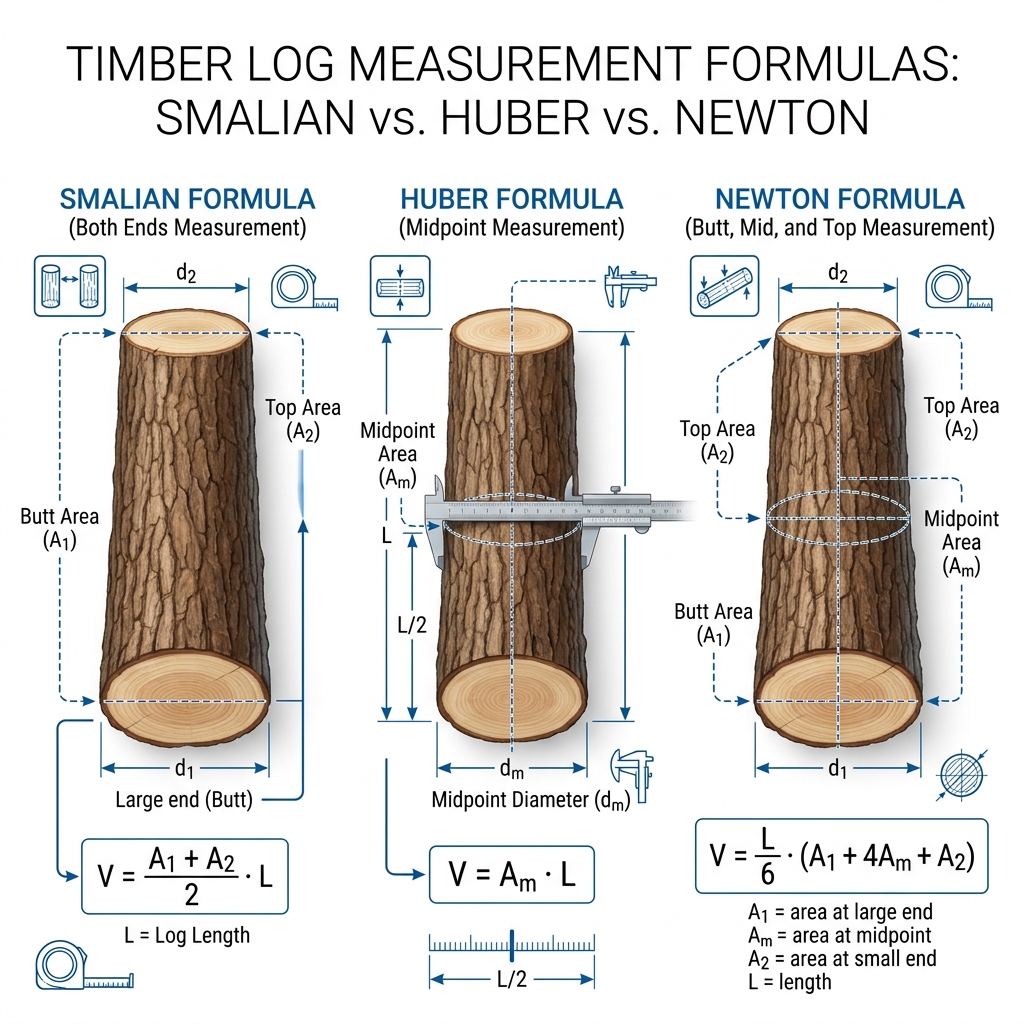
These three formulas all work in the same basic way. You find the cross-sectional area of the log at one or more points, then multiply by the length. The cross-sectional area of a circle is A = π × r². The difference between the formulas is which points you measure.
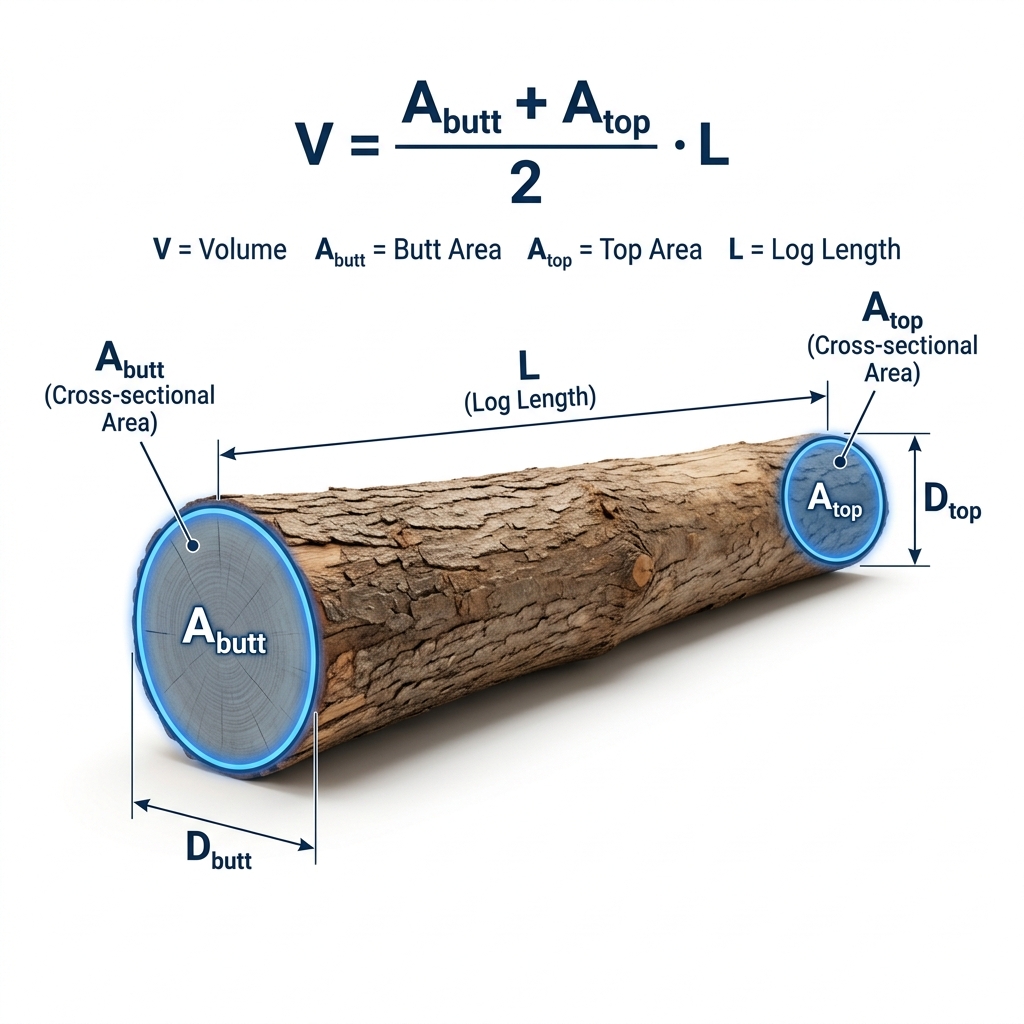
Smalian’s formula
Smalian uses the area at both ends and averages them:
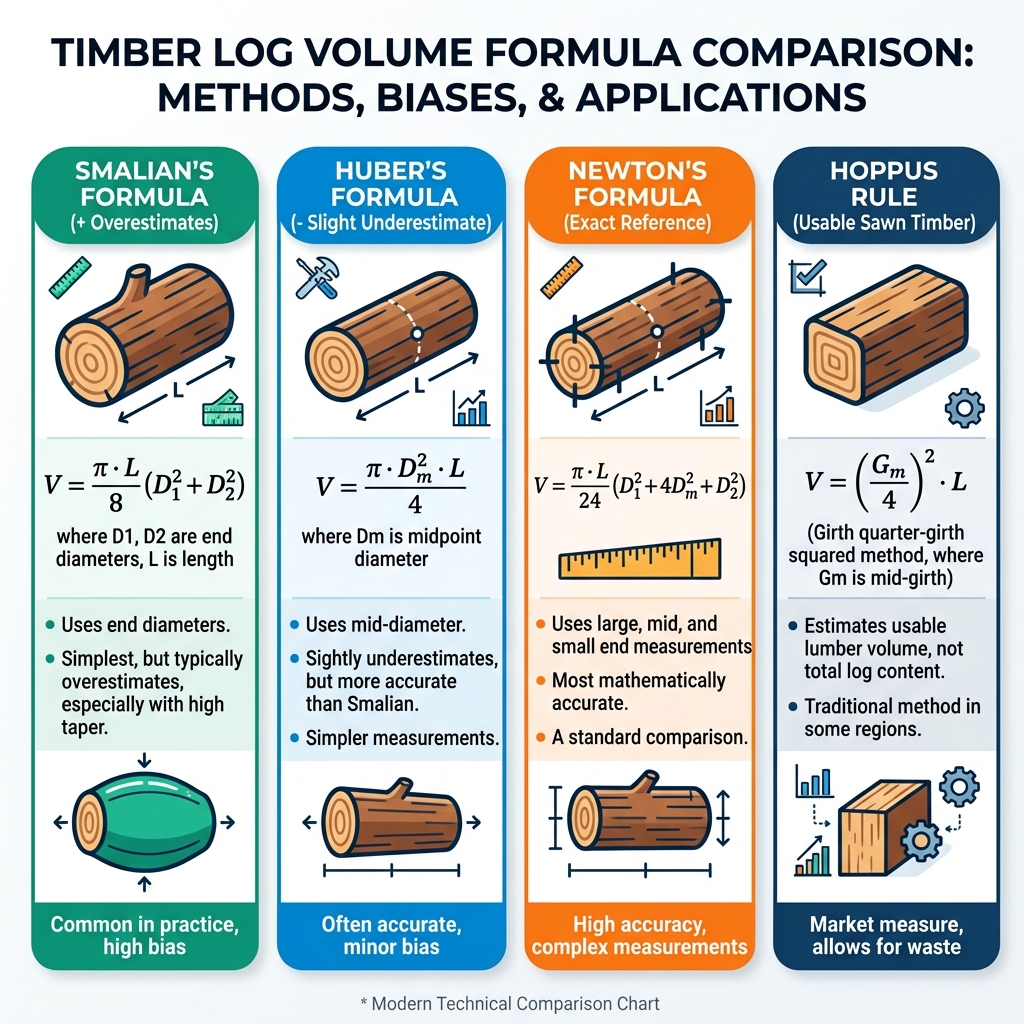
V = (A_butt + A_top) ÷ 2 × LIt needs only two diameter measurements, one at each end, which makes it popular for stacked logs where you can only reach the ends. Its weakness is that it tends to overestimate the volume of a tapered log.
Huber’s formula
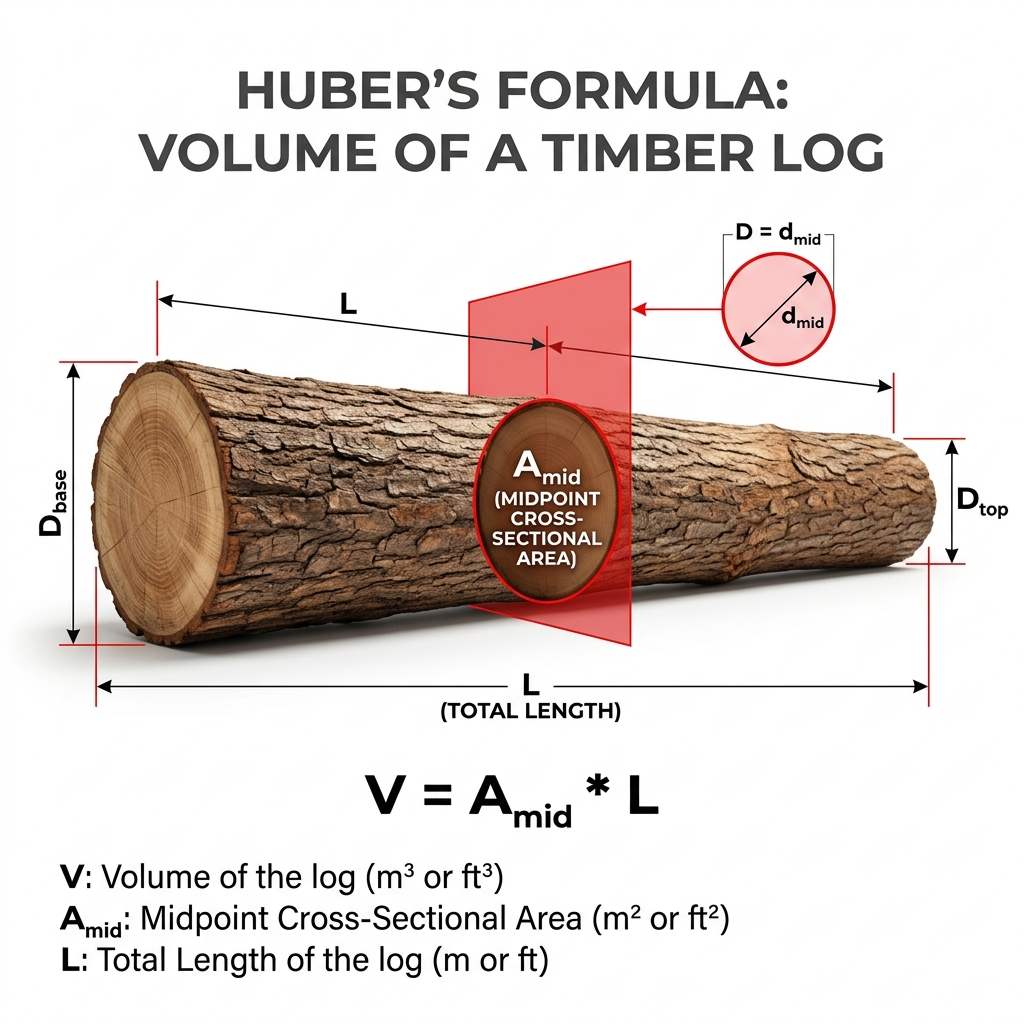
Huber uses the area at the midpoint of the log:
V = A_mid × LIt needs only one measurement, but that measurement has to be taken at the middle, which is not always easy in a stack. The FAO notes that Huber’s formula is the standard choice for individual log volume in many inventories (FAO, Volume tables and equations). Huber tends to underestimate slightly.
Newton’s formula
Newton uses all three points, both ends and the middle:
V = (A_butt + 4 × A_mid + A_top) ÷ 6 × LIt needs the most measurements but gives the most accurate result. It is the reference other formulas are judged against.
Worked example 3: the same tapered log, three ways
A log is 5 m long. Its butt diameter is 40 cm, its top diameter is 30 cm, and its middle diameter is 35 cm.
First, find the three areas:
A_butt = π × (0.20)² = 0.12566 m²
A_mid  = π × (0.175)² = 0.09621 m²
A_top  = π × (0.15)² = 0.07069 m²
Now apply each formula:
Smalian: V = (0.12566 + 0.07069) ÷ 2 × 5 = 0.491 m³
Huber:   V = 0.09621 × 5              = 0.481 m³
Newton:  V = (0.12566 + 4×0.09621 + 0.07069) ÷ 6 × 5 = 0.484 m³
Notice the pattern. Newton gives 0.484 m³. Smalian sits above it at 0.491, and Huber sits below it at 0.481. Here is the useful part that most guides skip: Huber’s error is exactly half of Smalian’s error, and it points the opposite way. Smalian is high by 0.007, Huber is low by 0.003. That two to one relationship holds for evenly tapered logs, and it is a quick way to sense-check your numbers. If Smalian and Huber disagree, the true value sits closer to Huber, about one third of the way from Huber toward Smalian.
| Formula | Measurements needed | Result | Tendency |
|---|---|---|---|
| Smalian | Both ends | 0.491 m³ | Overestimates |
| Huber | Midpoint only | 0.481 m³ | Slight underestimate |
| Newton | Both ends and middle | 0.484 m³ | Most accurate |
The Hoppus formula: how the timber trade measures logs
The Hoppus rule answers a different question. The cylinder, Smalian, Huber, and Newton formulas all estimate the true volume of wood in the round log. The Hoppus rule estimates how much usable squared timber you can saw out of it after waste. That is what a log buyer is really paying for.
The English surveyor Edward Hoppus published the rule in 1736, and it is still used in the hardwood trade in the UK, India, and several former Commonwealth countries, and for teak in Myanmar (Hoppus, reference overview).
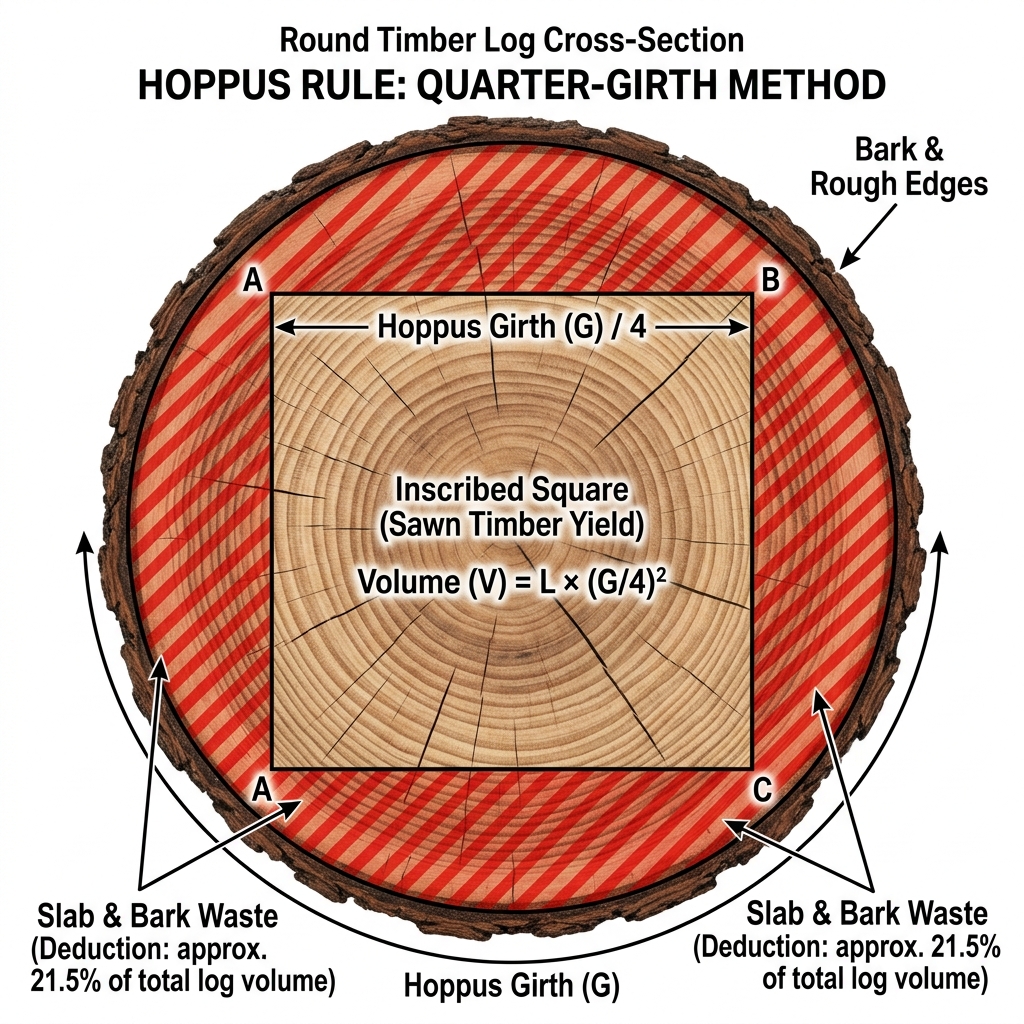
You measure the girth (the circumference) at the midpoint of the log in inches, and the length in feet:
Hoppus volume (h ft) = (girth in inches ÷ 4)² × length in feet ÷ 144The “girth divided by four” part squares off the round log in your head, and it quietly removes about 4 inches of girth as slab waste. The result comes out about 21.5% smaller than the true cylinder volume. That gap is the built-in allowance for the wood lost when a round log is cut into square planks.
Worked example 4: a hardwood log measured the Hoppus way
A teak log has a midpoint girth of 48 inches and a length of 10 feet.
Quarter girth = 48 ÷ 4 = 12 inches
Hoppus volume = (12)² × 10 ÷ 144
Hoppus volume = 144 × 10 ÷ 144
Hoppus volume = 10 hoppus feet
Convert that to the units your invoice or your cylinder wood m3 calculator expects:
10 hoppus feet × 1.273 = 12.73 true cubic feet
10 hoppus feet × 0.036 = 0.36 m³
10 hoppus feet ≈ 100 board feet (rough trade rule)
Sanity check against the true cylinder: a 48 inch girth means a diameter of 48 ÷ π = 15.28 inches, so the radius is 0.6366 ft. The true volume is π × 0.6366² × 10 = 12.73 ft³. The Hoppus figure of 10 hoppus feet is the saleable timber inside that 12.73 cubic feet of round wood. The two numbers agree, which is exactly what you want to see.
Which method should you use?
Pick the method that matches your goal and how many measurements you can take.
- A rough estimate of a straight log: the cylinder formula. Fast and good enough for firewood or a single fence post.
- You can only reach the log ends (a stack): Smalian’s formula. Accept a small overestimate.
- You can measure the middle and want good accuracy: Huber’s formula. The forestry default.
- You need the most accurate figure and can take three measurements: Newton’s formula.
- You are buying or selling sawlogs or hardwood in the trade: the Hoppus rule, because it estimates usable timber, not raw round volume. This is the lumber log volume scale that mills and merchants still quote in many regions.
Unit conversions for log volume
Log volume gets quoted in several units, so keep this table handy. Values use π = 3.14159 and are rounded for everyday use.
| From | To | Multiply by |
|---|---|---|
| 1 hoppus foot | cubic feet (true) | 1.273 |
| 1 hoppus foot | cubic metres | 0.036 |
| 1 hoppus foot | board feet (approx) | 10 |
| 1 cubic metre | hoppus feet | 27.7 |
| 1 cubic foot | cubic metres | 0.0283 |
| 1 cubic metre | cubic feet | 35.315 |
| 1 inch | centimetres | 2.54 |
If your measurements are in feet and you want the answer in metric, a volume in cubic feet reference makes the swap quick.
Common mistakes when measuring log volume
A few errors show up again and again:
- Using diameter instead of radius. The formula squares the radius, so putting the diameter in gives four times the correct answer. Halve the diameter first.
- Mixing units. Diameter in inches and length in feet will not divide cleanly. Convert everything to one system before you multiply.
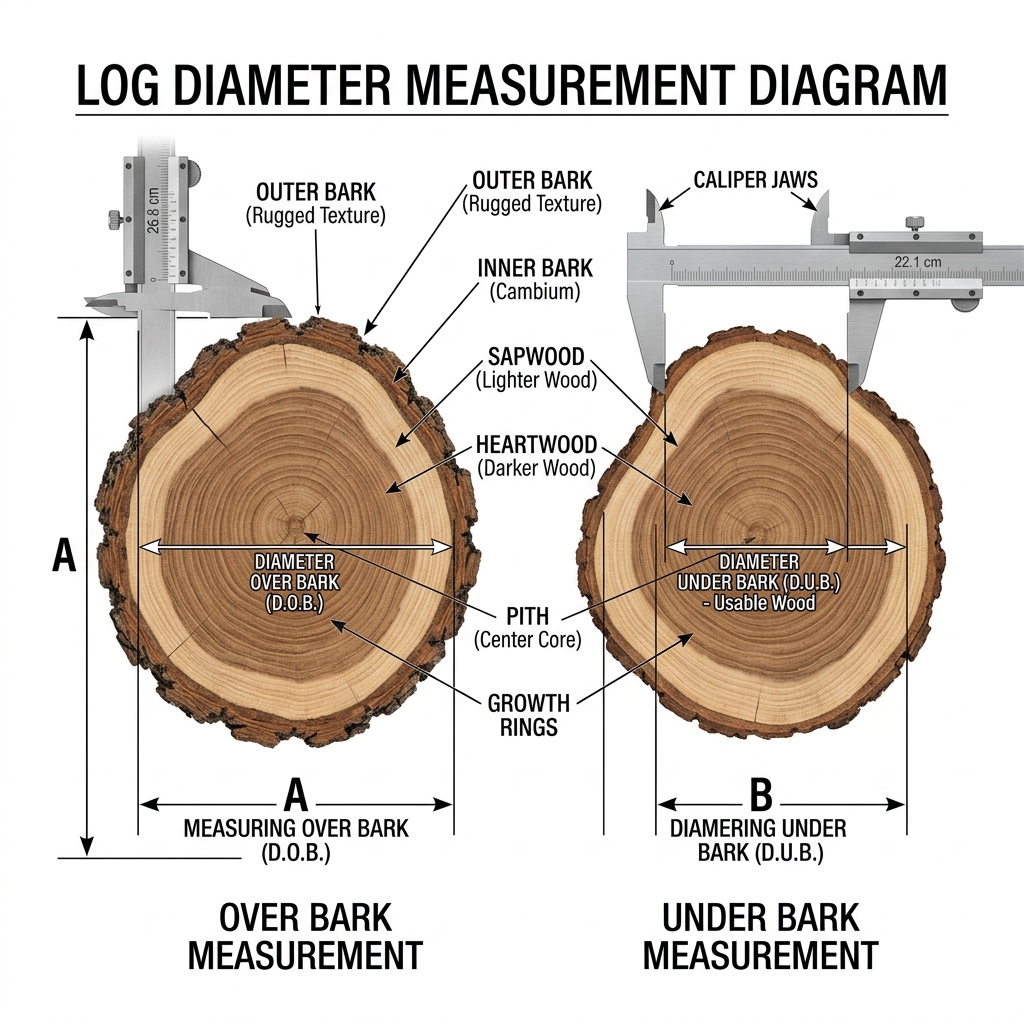
- Measuring over the bark. Bark is not usable timber. For sawlog volume, measure the diameter under the bark or subtract a bark allowance.
- Ignoring taper on long logs. A single cylinder figure can be well off for a long, tapered stem. Use Huber or Newton instead.
- Confusing true volume with Hoppus volume. They answer different questions. Do not compare a cubic metre reading to a hoppus foot reading without converting first.
Frequently Asked Questions
What is the formula for the volume of a round log?
The basic formula treats the log as a cylinder: V = π × r² × h, where r is the radius and h is the length.
How do I find the radius if I only measured the diameter?
Divide the diameter by two. A 30 cm diameter log has a 15 cm radius.
Which log volume formula is the most accurate?
Newton’s formula is the most accurate because it uses the diameter at both ends and at the middle. It needs three measurements, so people often use Huber’s formula, which uses only the midpoint and is close.
What is the difference between Smalian and Huber?
Smalian averages the two end areas, so it needs both ends but tends to overestimate. Huber uses the midpoint area only, and tends to underestimate by about half as much. For an evenly tapered log, Huber is usually the better single-measurement choice.
How do I convert hoppus feet to cubic metres?
Multiply hoppus feet by 0.036. So 10 hoppus feet is about 0.36 m³. To go from cubic metres to hoppus feet, multiply by about 27.7.
Why is the Hoppus volume smaller than the true volume?
The Hoppus rule estimates the usable timber left after a round log is sawn into square pieces. It builds in a waste allowance, so it comes out about 21.5% below the true round volume. In practice, one hoppus foot is roughly 10 board feet of sawn wood, though the real yield varies with the log.
Can I use a cylinder calculator for firewood?
Yes. For firewood you usually want a rough figure, so the cylinder method is fine. Measure the diameter and length, halve the diameter, and apply V = π × r² × h. A free cylinder volume calculator will do the arithmetic for you.
Do I measure the log with or without bark?
For a rough total volume, measuring over the bark is acceptable. For the volume of usable timber, measure under the bark or subtract a bark thickness allowance, because bark is not sawn into lumber.
Sources and verification note
The cylinder volume formula follows the standard geometric definition (Wolfram MathWorld, Cylinder). The Smalian, Huber, and Newton formulas and Huber’s use as the forestry default are documented by the FAO (Volume tables and equations). The Hoppus rule, its 1736 origin, and its conversion factors (1 hoppus foot = 1.273 cubic feet = 0.036 m³) are drawn from published references on the unit (Hoppus overview). All calculations in this article were worked step by step and independently checked. This article was drafted with AI assistance and reviewed for accuracy by the CylinderVolume-Calculator.com editorial team.