Formulas & Calculations · August 7, 2026
Volume of a Cylinder Using Diameter: V = pi d2 h over 4
Master cylinder diameter calculations and avoid the five most common mathematical and physical measuring mistakes on pipes, tanks, and columns.
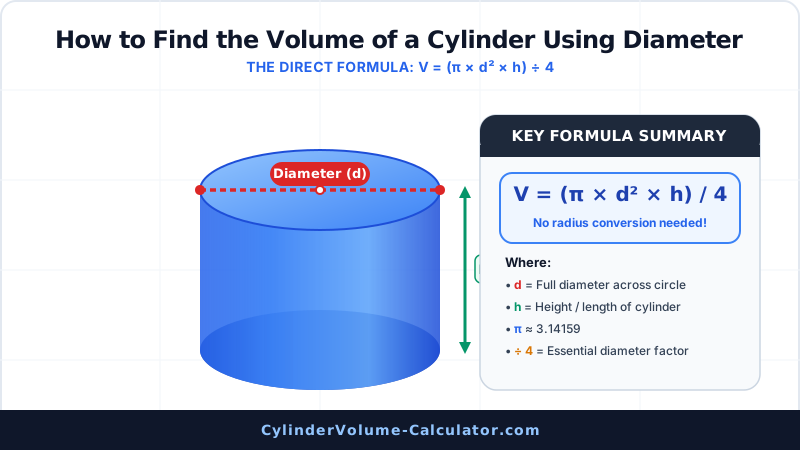

- The five biggest diameter calculation traps
- Trap 1: The halving error and 4x volume magnification
- Trap 2: Squaring before vs after halving
- Trap 3: Confusing circumference with diameter
- Trap 4: Measuring outer diameter instead of inner diameter
- Trap 5: Mixing units across diameter and height
- Five-point verification checklist before ordering materials
- Frequently Asked Questions
- What is the most common diameter calculation mistake?
- Why does squaring diameter without dividing by 4 quadruple the result?
- How do pipe wall thicknesses affect diameter volume calculations?
- Why is squaring before halving mathematically incorrect?
- How do I avoid unit mixing errors with diameter?
- Where can I calculate cylinder volume with diameter automatically?
Calculating the volume of a cylinder using its diameter is standard practice on job sites, in fabrication shops, and in engineering offices. Measuring straight across a circle is simpler than locating an invisible center point to measure radius.
However, calculating from diameter introduces subtle mathematical and physical traps. A minor arithmetic slip or a misaligned measuring tape gets squared in the equation, compounding errors by fourfold.
This guide breaks down the five most frequent diameter calculation mistakes, explains why they happen, and provides a clear checklist to ensure your numbers are accurate.
For direct calculations without manual arithmetic, use our interactive Cylinder Volume Calculator with Diameter.
The five biggest diameter calculation traps
The table below summarizes the five most frequent errors encountered when calculating cylinder capacity from diameter:
| Mistake Type | Common Cause | Numerical Impact | How to Prevent It |
|---|---|---|---|
| The Halving Error | Forgetting that diameter is twice radius | Answer is 400% of true volume (4× too high) | Use V = (π / 4) × d² × h or divide d by 2 before squaring |
| Squaring Order Error | Squaring diameter and dividing by 2 instead of 4 | Answer is 200% of true volume (2× too high) | Remember (d / 2)² = d² / 4 |
| Circumference Confusion | Plugging tape wrap reading directly into formula | Answer is roughly 10× too high (π² factor) | Divide tape reading by π (3.14159) to find diameter |
| OD vs ID Mix-Up | Measuring outer pipe wall instead of fluid cavity | 15% to 40% volume overestimation | Subtract 2× wall thickness: ID = OD - 2t |
| Unit Mixing | Entering diameter in inches and height in feet | Inconsistent, wildly incorrect units | Convert all inputs to one common unit first |
Trap 1: The halving error and 4x volume magnification
The most frequent calculation mistake occurs when a builder or student measures a cylinder diameter of 10 inches and plugs 10 directly into the radius slot of the standard formula:
Incorrect: V = π × (10)² × 20 = 3.14159 × 100 × 20 = 6,283.19 cubic inches
Correct:   V = π × (5)² × 20  = 3.14159 × 25 × 20  = 1,570.80 cubic inches
Because diameter is double the radius (d = 2r), squaring the diameter squares that factor of two: (2r)² = 4r². If you forget to divide by 2 or forget to divide by 4 in the direct formula, your final volume will be exactly four t× too large.
If you are ordering ready-mix concrete for cylindrical sonotubes, this mistake means ordering four t× more concrete than the job requires.
Trap 2: Squaring before vs after halving
A related algebra error happens when people attempt to create a shortcut formula. They know diameter must be halved, but they apply the division after squaring:
Incorrect Shortcut: V = π × (d² / 2) × h
Correct Equation:   V = π × (d / 2)² × h = π × (d² / 4) × h
Here is the mathematical proof of why the divisor must be 4:
When you divide diameter by 2 and square the entire fraction, both the numerator and the denominator are squared:
(d / 2)² = (d × d) / (2 × 2) = d² / 4Dividing by 2 after squaring gives d² / 2, which is double the correct base area. Always divide by 4 when squaring the raw diameter.
Trap 3: Confusing circumference with diameter
When measuring large cylindrical tanks, culverts, or silos, measuring across the center can be physically impossible with a rigid ruler. People frequently take a flexible measuring tape and wrap it around the outside perimeter of the cylinder.
That perimeter reading is the circumference (C), not the diameter (d).
If a culvert has a circumference of 31.42 inches, its diameter is:
Diameter = Circumference ÷ π = 31.42 ÷ 3.14159 = 10.0 inchesPlugging 31.42 directly into a diameter formula treats the cylinder as if it were over 31 inches wide. This inflates the calculated volume by a factor of π² (nearly ten t× the actual volume).
If you measured with a wrap-around tape, use our dedicated Cylinder Circumference Calculator to compute volume directly.
Trap 4: Measuring outer diameter instead of inner diameter
When working with pipes, metal drums, concrete manholes, and storage tanks, the physical wall has thickness.
The outer diameter (OD) measures the total envelope of the cylinder in space. The inner diameter (ID) measures the internal cavity where fluid, grain, or gas is stored.
Consider a 4-inch Schedule 40 PVC pipe:
- Nominal Size: 4 inches
- Actual Outer Diameter (OD): 4.500 inches
- Wall Thickness (t): 0.237 inches
- Actual Inner Diameter (ID): 4.500 - (2 × 0.237) = 4.026 inches
If you calculate holding capacity using the outer diameter (4.500 in) instead of inner diameter (4.026 in) on a 100-foot run:
- Capacity using OD: 82.6 US gallons
- True Capacity using ID: 66.1 US gallons
Using the outer diameter overestimates liquid capacity by 25 percent. On structural hollow tubes, visit our Hollow Cylinder Calculator to separate wall material volume from internal cavity volume.
Trap 5: Mixing units across diameter and height
Because diameter is often measured in small increments (inches or centimeters) while length or height is measured in large increments (feet or meters), unit mixing is widespread.
For example, calculating a concrete pillar with a 12-inch diameter and a 10-foot height:
Incorrect (mixed units): V = (π / 4) × (12)² × 10 = 0.7854 × 144 × 10 = 1,131The resulting number 1,131 is neither cubic inches nor cubic feet. It is a meaningless hybrid unit (square inches t× feet).
To calculate correctly, convert all inputs to the same unit before multiplying:
Option A (all in feet):   Diameter = 1.0 ft, Height = 10.0 ft
Volume = (π / 4) × 1.0² × 10.0 = 7.854 cubic feet

Option B (all in inches): Diameter = 12 in, Height = 120 in
Volume = (π / 4) × 144 × 120 = 13,571.7 cubic inches
Convert to cubic feet: 13,571.7 ÷ 1,728 = 7.854 cubic feet
Five-point verification checklist before ordering materials
Before submitting purchase orders for liquid tanks, ready-mix concrete, or piping systems, verify your numbers against this checklist:
- Verify Diameter vs Radius: Did you divide by 4 if using diameter squared, or divide diameter by 2 before squaring?
- Verify Circumference Conversion: If you used a flexible tape, did you divide the reading by 3.14159?
- Verify Internal Cavity: Did you subtract double the wall thickness on thick-walled pipes and tanks?
- Verify Unit Consistency: Are diameter and height expressed in identical units (both inches, both feet, or both cm)?
- Double Check with an Online Tool: Run your dimensions through the Cylinder Volume Calculator with Diameter to confirm decimal accuracy.
Frequently Asked Questions
What is the most common diameter calculation mistake?
The halving error: entering diameter directly into V = π r² h without dividing by 2 first, which makes the calculated volume four t× too large.
Why does squaring diameter without dividing by 4 quadruple the result?
Because (2r)² = 4r². Squaring diameter doubles the radius error into a factor of four.
How do pipe wall thicknesses affect diameter volume calculations?
Measuring outer diameter instead of inner diameter overestimates internal capacity by 15% to 40% depending on pipe schedule and wall gauge.
Why is squaring before halving mathematically incorrect?
Squaring diameter first and then dividing by 2 produces d² / 2, which is twice as large as the true (d / 2)² = d² / 4.
How do I avoid unit mixing errors with diameter?
Convert diameter and height to identical units (such as both in inches, both in feet, or both in centimeters) before multiplying.
Where can I calculate cylinder volume with diameter automatically?
Use our dedicated online Cylinder Volume Calculator with Diameter for automated, error-free calculations.