Geometry & Basics · August 7, 2026
How Many Faces Does a Cylinder Have? Faces, Edges, Vertices
A standard cylinder has 3 faces (2 circular bases plus 1 curved surface), 2 circular edges and 0 vertices. Full 3D geometric breakdown with diagrams.

- The short answer
- Why the answer changes: what counts as a “face”?
- The everyday and school definition (3 faces)
- The strict definition where a face must be flat (2 faces)
- The formal geometry definition (0 faces)
- The 2 flat faces (the bases)
- The 1 curved face (the lateral surface)
- Edges, vertices, and corners
- Why a cylinder has 2 edges
- Why a cylinder has 0 vertices
- Count them yourself with real objects
- Is a cylinder a prism?
- Cylinder vs other solids: a quick comparison
- Common mistakes to avoid
- Frequently Asked Questions
- How many faces does a cylinder have?
- How many edges does a cylinder have?
- How many vertices or corners does a cylinder have?
- Does a cylinder have 2 or 3 faces?
- How many flat surfaces does a cylinder have?
- How many faces, edges, and vertices does a cylinder have?
- Can a cylinder be classified as a prism?
- What is the difference between a face and a surface?
- Why do some people say a cylinder has 0 faces?
- Sources and verification note
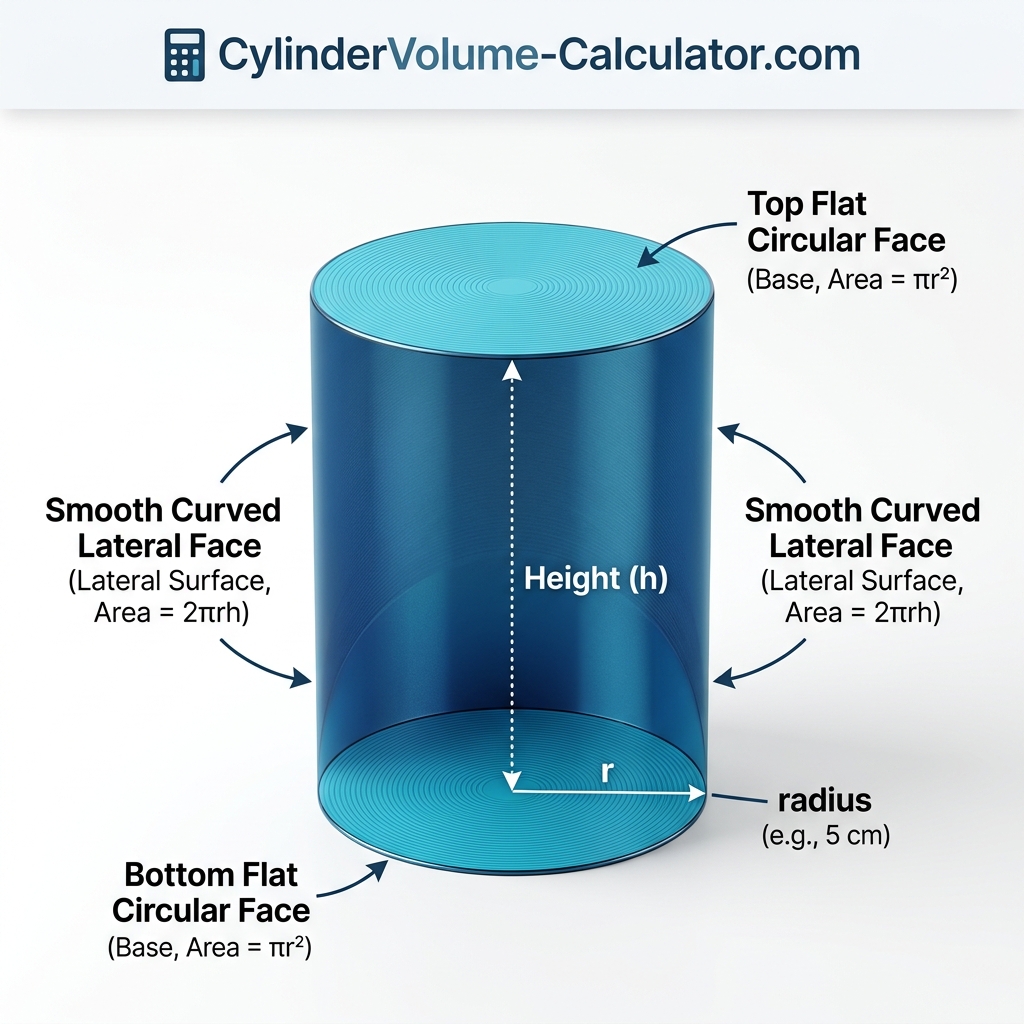
A cylinder has 3 faces: 2 flat circular faces (the top and bottom, called bases) and 1 curved face (the side that wraps around). It also has 2 edges and 0 vertices. That is the answer most schools teach. But you will also see the answer given as 2, or even 0, and both of those are correct too. The number you get depends entirely on how you define the word “face.” This guide sorts out every version so you know which one to use.
The short answer
| Feature | Count | What it is |
|---|---|---|
| Faces | 3 | 2 flat circles + 1 curved surface |
| Flat faces | 2 | The top and bottom bases |
| Curved faces | 1 | The side wrapped around |
| Edges | 2 | The two circles where flat meets curved |
| Vertices (corners) | 0 | A cylinder has no pointed corners |
If you only need the classroom answer, that table has it. To calculate surface area or internal capacity across these geometric faces, use our cylinder geometry calculator or standard cylinder volume calculator using radius. If you want to understand why some sources disagree, keep reading.
Why the answer changes: what counts as a “face”?
The confusion around this question is real. There is even a well-known Reddit poll asking people to guess without searching, and the votes split badly. The reason is simple. Different levels of math define “face” differently.
The everyday and school definition (3 faces)
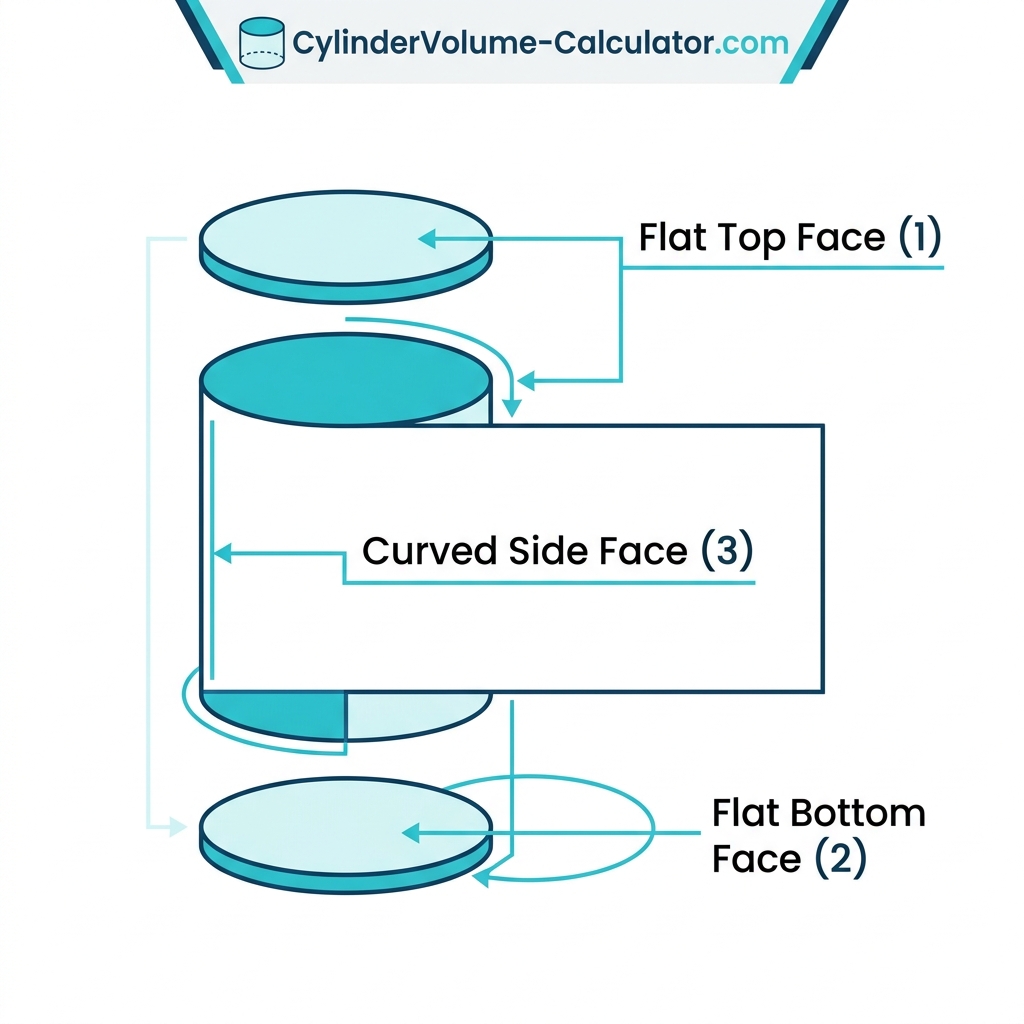
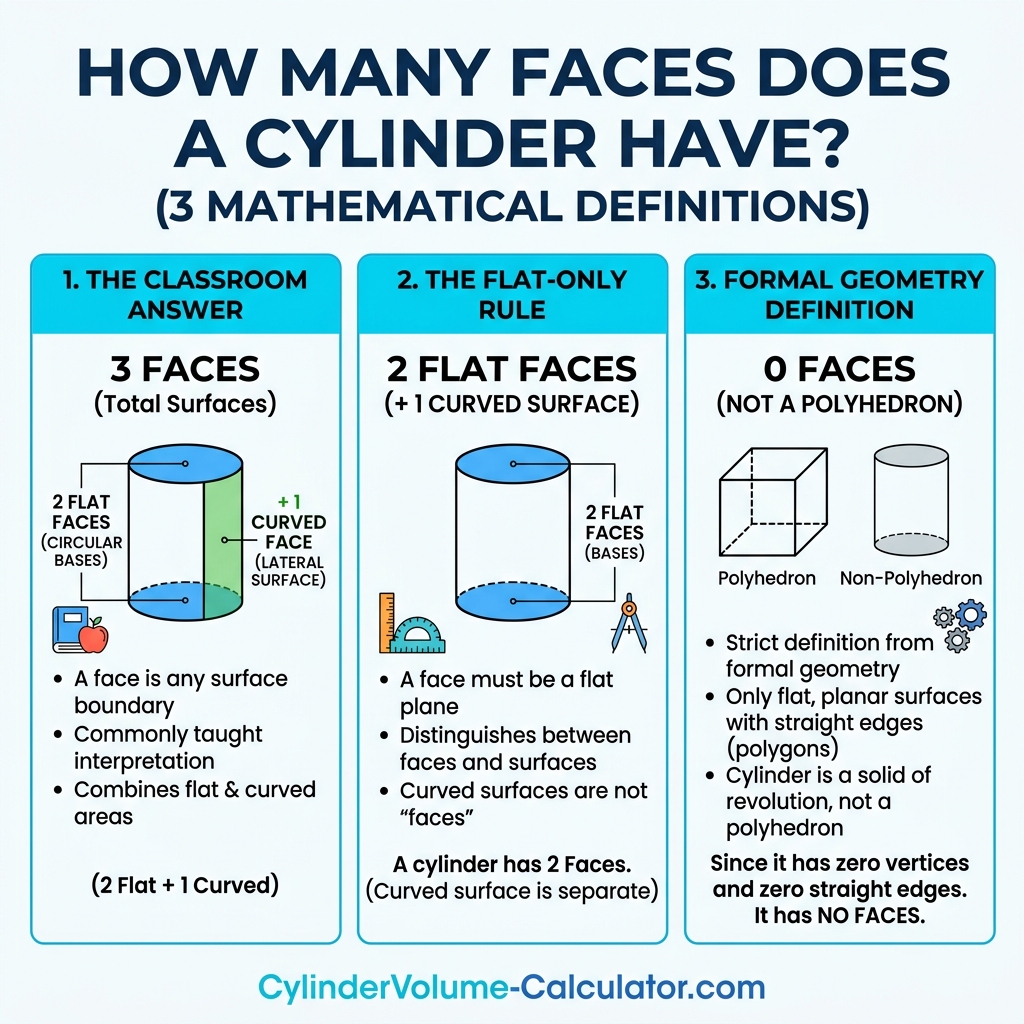
In most primary and secondary classrooms, a face is any single surface of a solid, whether it is flat or curved. Under this rule, a cylinder has three surfaces you can touch:
- The flat circle on top
- The flat circle on the bottom
- The curved surface that connects them
Three surfaces, so three faces. This is the answer expected on most homework and tests. If a teacher asks “how many faces does a cylinder have,” they almost always want 3.
The strict definition where a face must be flat (2 faces)
Some curricula, especially in early primary years, define a face as a flat surface only. Under that rule, the curved side is not a face. It is called a “curved surface” instead. So the count becomes 2 flat faces plus 1 curved surface. If your worksheet lists “faces” and “curved surfaces” in separate columns, this is the definition it uses.
The formal geometry definition (0 faces)
In higher math, the words face, edge, and vertex belong to polyhedra. A polyhedron is a solid whose surfaces are all flat polygons, like a cube or a pyramid. A cylinder is not a polyhedron, because two of its surfaces are round and one is curved. By this strict definition, a cylinder has no polygonal faces at all, so the technical answer is 0.
So all three answers are “right.” The trick is matching the answer to the question:
- School quiz? Say 3.
- Worksheet that separates flat faces from curved surfaces? Say 2 flat faces.
- Formal geometry or a “gotcha” debate? Explain that a cylinder is not a polyhedron, so strictly 0.
Learn more about the shape itself on our what is a cylinder guide.
The 2 flat faces (the bases)
The two flat faces of a cylinder are identical circles. They sit parallel to each other, one on top and one on the bottom. In geometry these are called the bases. They are the same size and the same shape, which is what makes a cylinder a cylinder rather than a cone.
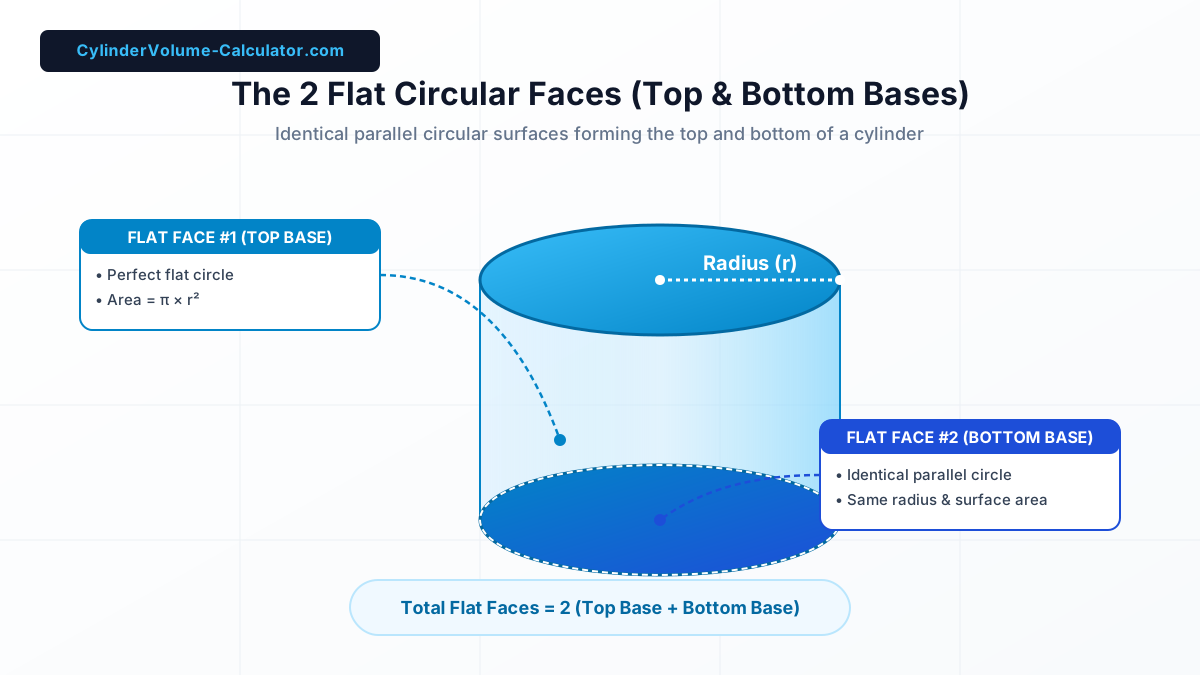
You can measure a base with a ruler. Its radius and height are also the two numbers you need to find volume, which you can work out fast with our free cylinder volume calculator. If you measured directly across the circular face, see our guide on how to find the volume of a cylinder using diameter.
The 1 curved face (the lateral surface)
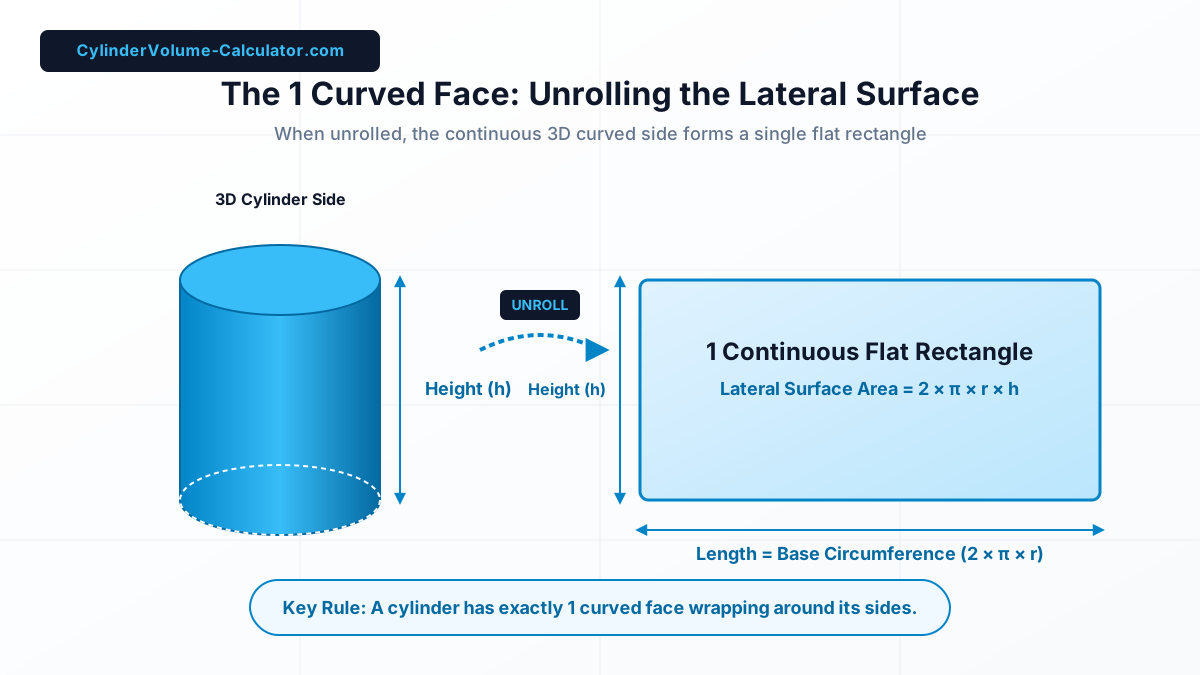
The single curved face is the side of the cylinder. Its proper name is the lateral surface. Picture peeling the label off a soup can in one piece. That label, laid flat, is a rectangle. Its length equals the distance around the base (the circumference) and its width equals the height of the cylinder. This is exactly one continuous surface, so it counts as one face, not many.
For a full breakdown of every part, see our parts of a cylinder guide.
Edges, vertices, and corners
Why a cylinder has 2 edges
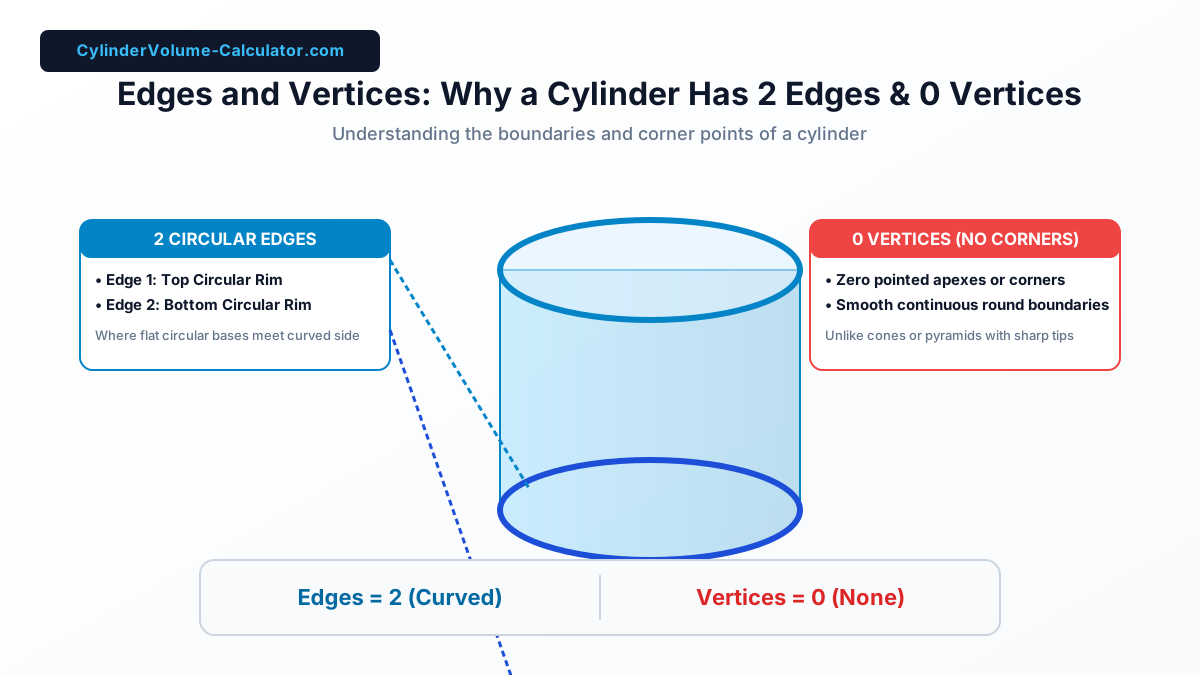
An edge is the line where two surfaces meet. On a cylinder, the flat top meets the curved side along a circle. The flat bottom meets the curved side along another circle. That gives 2 edges, and both of them are curved circles rather than straight lines.
This is another spot where strict math differs. In polyhedra, edges are straight. Because a cylinder’s edges are round, formal geometry again says a cylinder has 0 edges. School math counts the two circles, so it says 2.
Why a cylinder has 0 vertices
A vertex is a corner point where edges meet. Think of the sharp tip of a cone or the corner of a box. A cylinder has no such point anywhere. Its surfaces flow into smooth circles, never into a spike. So a cylinder has 0 vertices and 0 corners. “Vertices” and “corners” mean the same thing here.
Count them yourself with real objects
You do not need to trust the number. Pick up something cylindrical and check.
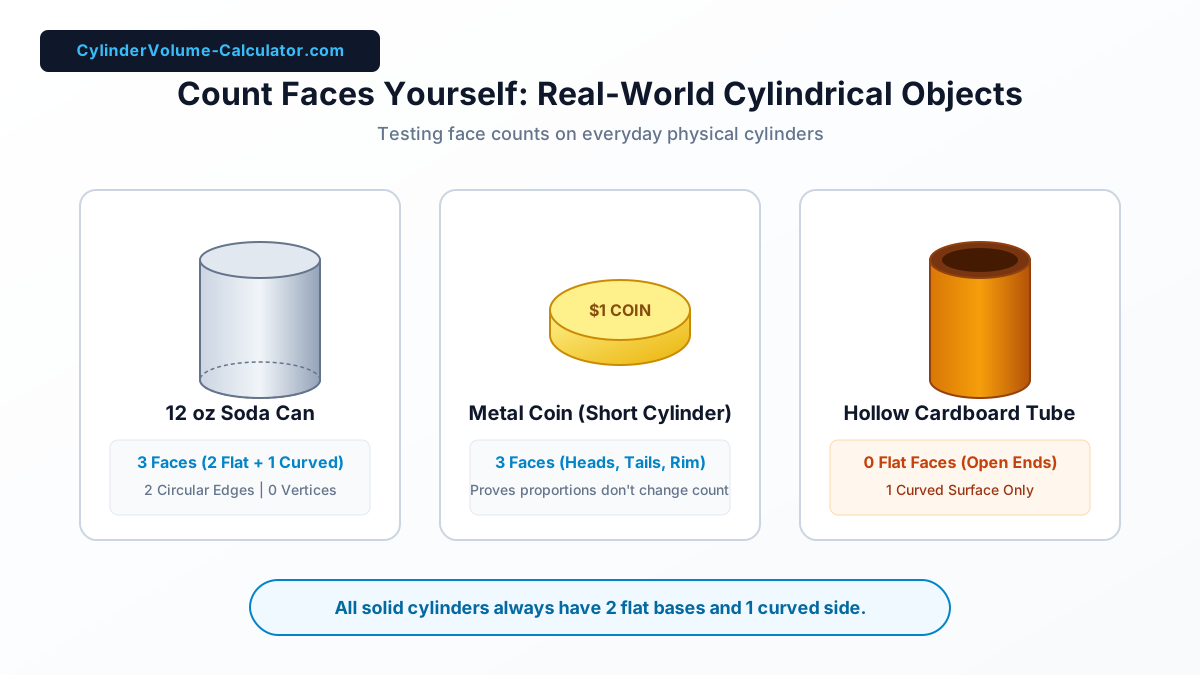
A 12 oz soda can. A standard US can is about 66 mm across and 122 mm tall. Look at it. The lid is one flat face. The base is a second flat face. The printed side is one curved face. That is 3 faces. Run a finger around the top rim and the bottom rim: those are your 2 edges. Look for a sharp corner. There is none, so 0 vertices.
A coin. A coin is just a very short, wide cylinder. Heads is one flat face. Tails is the second flat face. The thin rim around the outside is the curved face. Again, 3 faces and 2 edges, with no corners. This shows the count does not depend on whether a cylinder is tall or squat.
A cardboard tube or a length of pipe. Here is a useful edge case. A kitchen roll tube, or a Schedule 40 PVC pipe cut open at both ends, has no flat top or bottom. It is open at each end. So it has only its curved surface, and no flat faces at all. This is a hollow cylinder (an open tube), which is why builders and engineers treat it as its own case. If you cap both ends, the flat faces come back and you are at 3 again.
Is a cylinder a prism?
No, a cylinder is not a prism. A prism has two flat polygon bases joined by flat rectangular sides. A triangular prism, for example, has flat triangle bases and flat rectangular sides. A cylinder has round bases and one curved side, so it fails the “flat polygon” test.
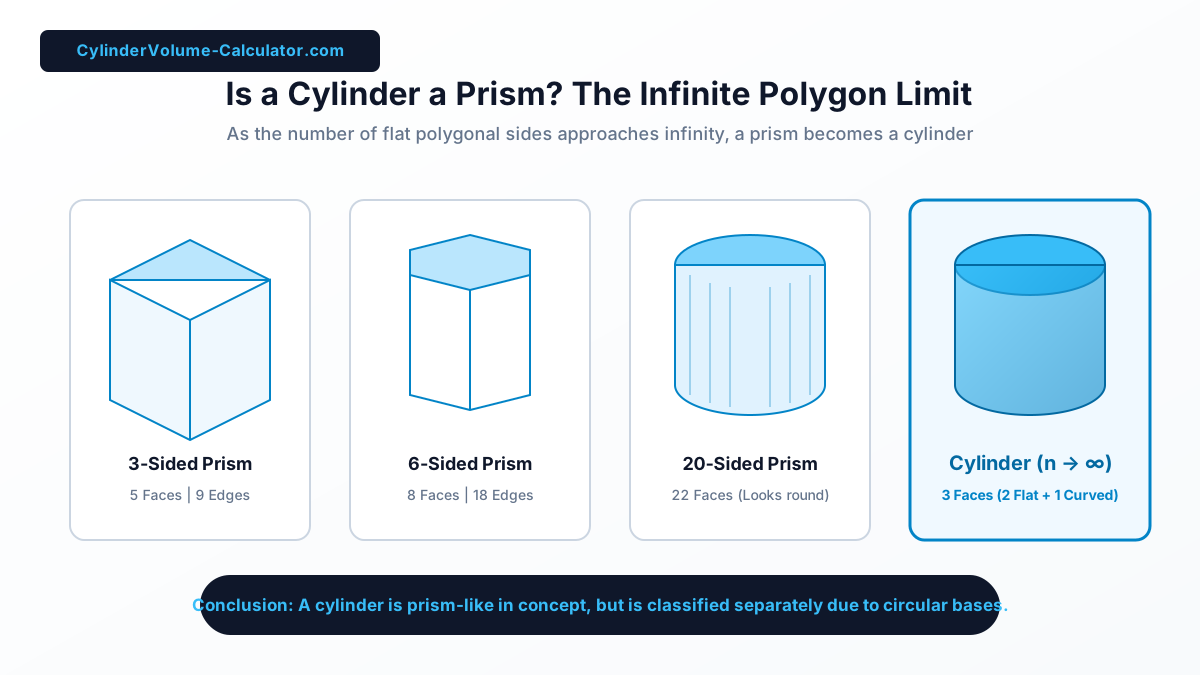
There is a nice way to see the link, though. Imagine a prism with a base that has more and more sides: a hexagon, then a decagon, then a hundred sides. As the number of sides climbs, the prism looks rounder and rounder. A cylinder is what you approach in the limit, when the base has “infinitely many” tiny sides. So a cylinder is prism-like in spirit, but it is not a true prism.
Cylinder vs other solids: a quick comparison
This table uses the common school convention, where curved surfaces count as faces. It is the fastest way to see how a cylinder compares.
| Solid | Faces | Edges | Vertices |
|---|---|---|---|
| Cylinder | 3 | 2 | 0 |
| Cone | 2 | 1 | 1 |
| Sphere | 1 | 0 | 0 |
| Cube | 6 | 12 | 8 |
| Triangular prism | 5 | 9 | 6 |
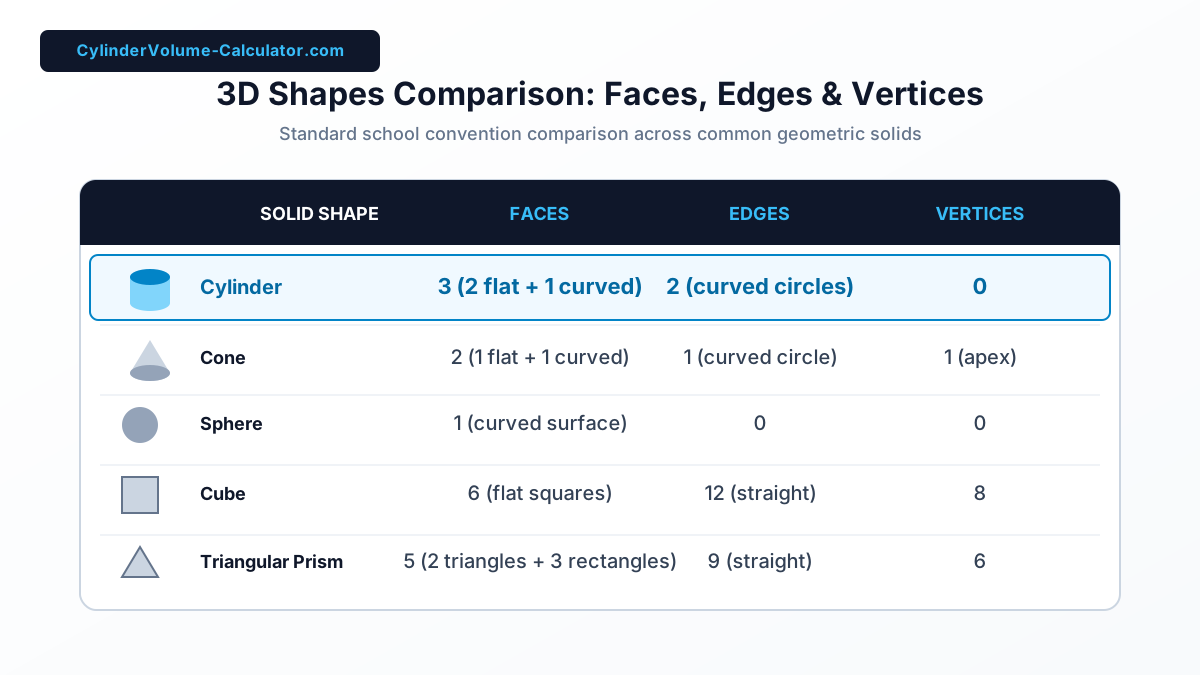
Notice the cone. It has one flat base and one curved face, one circular edge, and a single vertex at its tip. The cylinder is close to the cone but has an extra flat face and no vertex. If you want the volume difference between the two, see cylinder vs cone volume.
Common mistakes to avoid
- Counting the curved side as many faces. It is one continuous surface, so it is one face, not several.
- Calling the round edges “sides.” The word “sides” is loose. Most teachers use it to mean faces, which gives 3. Be ready to clarify what the question means.
- Saying a cylinder has 1 or 2 vertices. It has none. Confusing the edge circles with vertices is the most common slip.
- Giving one number without context. If the marks depend on it, state the definition you are using. “3 faces (2 flat, 1 curved)” leaves no room for doubt.
Frequently Asked Questions
How many faces does a cylinder have?
Three. Two flat circular faces and one curved face.
How many edges does a cylinder have?
Two. They are the circles where the curved side meets the top and bottom.
How many vertices or corners does a cylinder have?
Zero. A cylinder has no pointed corners of any kind.
Does a cylinder have 2 or 3 faces?
Both answers appear in textbooks. You get 3 when you count the curved side as a face, which is the usual school rule. You get 2 when “face” is defined as a flat surface only, and the curved side is listed separately as a curved surface. Check which wording your worksheet uses.
How many flat surfaces does a cylinder have?
Two. The top base and the bottom base are both flat circles.
How many faces, edges, and vertices does a cylinder have?
Using the standard school definition, a cylinder has 3 faces, 2 edges, and 0 vertices. That single line covers most homework questions.
Can a cylinder be classified as a prism?
No. A prism needs flat polygon bases and flat sides. A cylinder has round bases and a curved side. It behaves like a prism with endlessly many sides, but it is not classed as one.
What is the difference between a face and a surface?
In casual and school use they mean the same thing, so a cylinder has 3 of each. In strict geometry, “face” is reserved for the flat polygon surfaces of a polyhedron. Since a cylinder is not a polyhedron, formal math says it has surfaces but no true faces.
Why do some people say a cylinder has 0 faces?
Because in formal solid geometry, faces are flat polygons, edges are straight lines, and vertices are corner points. Those terms describe polyhedra like cubes and pyramids. A cylinder is not a polyhedron, so by that strict standard it has 0 faces, 0 edges, and 0 vertices. This is the answer behind most “trick question” debates online.
Sources and verification note
Definitions of face, edge, and vertex, and the classification of a cylinder as a non-polyhedron, follow standard geometry references including Wolfram MathWorld and Math is Fun. For a broader review of solid shapes and their properties, see Khan Academy Geometry. Standard 12 oz can dimensions (66 mm diameter, 122 mm height) are industry standard for the US format. All counts in the comparison table use the common school convention, stated in the table caption.
For the calculations that use these same parts, try our free cylinder volume calculator or read the cylinder volume formula explainer.