Geometry & Formulas · August 7, 2026
Area of a Circle Calculator: A = pi r squared with Steps
The circular base area step inside every cylinder volume calculation. How to find circular cross-section area from radius, diameter, and circumference.
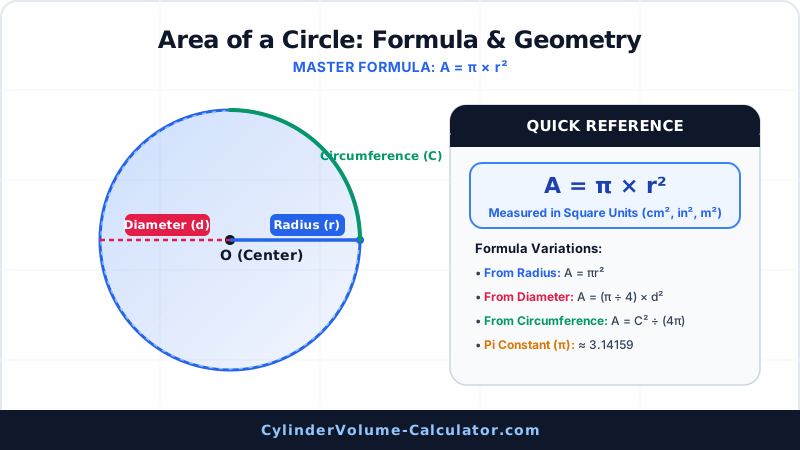

- The three ways to calculate circular base area
- Method 1: Calculating base area from radius (A = π r²)
- Step by step radius calculation
- Method 2: Calculating base area from diameter (A = (π / 4) d²)
- Step by step diameter calculation
- Method 3: Calculating base area from circumference (A = C² / 4π)
- Step by step circumference calculation
- Circular base area and volume multiplier reference table
- How base area measurement errors propagate into 3D volume
- Frequently Asked Questions
- How does the area of a circle relate to cylinder volume?
- What is the formula for the area of a circular base?
- How do I calculate circular base area from diameter directly?
- How do I find circular base area from circumference?
- Why do base area errors cause large cylinder volume errors?
- Which cylinder calculator should I use once I have the base area?
Every cylinder volume calculation begins with a single fundamental geometric step: finding the two-dimensional area of the circular base.
A cylinder is a uniform solid formed by taking a flat circle and extending it vertically through space by a distance equal to height (h). Because the cross-section remains constant from bottom to top, the three-dimensional capacity is simply the base area (A) multiplied by the height (h):
Cylinder Volume (V) = Base Area (A) × Height (h) = π × r² × hIf your base area calculation is incorrect, your entire volume, fluid capacity, and weight estimates will fail. This comprehensive guide explains how to calculate circular base area from three different starting measurements: radius, diameter, and circumference.
To calculate full three-dimensional cylinder volume directly, explore our specialized tools:
- Measuring from center to edge: Cylinder Volume Calculator Using Radius
- Measuring straight across: Cylinder Volume Calculator with Diameter
- Measuring with a wrap-around tape: Cylinder Circumference Calculator
The three ways to calculate circular base area
Depending on what physical tools you have on a job site, you can determine base area from three different starting dimensions:
| Starting Dimension Available | Primary Base Area Formula | Decimal Shortcut Form | Ideal Practical Scenario |
|---|---|---|---|
| Radius (r) | A = π × r² | A ≈ 3.14159 × r² | Compass drawings, textbook geometry, CAD models |
| Diameter (d) | A = (π / 4) × d² | A ≈ 0.785398 × d² | Steel rulers, calipers, factory pipe specifications |
| Circumference (C) | A = C² / (4 π) | A ≈ C² / 12.5664 | Flexible tape measures wrapped around closed tanks or trees |
Method 1: Calculating base area from radius (A = π r²)
The classic mathematical formula uses the radius (r), which is the distance from the exact center point to any point on the circular rim:
Base Area (A) = π × r²Step by step radius calculation
- Measure the radius in centimeters, inches, or feet.
- Multiply the radius by itself to obtain the squared radius (r²).
- Multiply by pi (3.14159265).
- Label the result in square units (such as cm², in², or ft²).
Example: Sizing a circular base with radius r = 6.0 cm:
- r² = 6.0 × 6.0 = 36.0 cm²
- A = 3.14159 × 36.0 = 113.10 cm²
- If this cylinder has a height of 15.0 cm, its volume is V = 113.10 × 15.0 = 1,696.5 cm³ (1.70 liters).
Method 2: Calculating base area from diameter (A = (π / 4) d²)
In construction, metal fabrication, and pipe fitting, measuring diameter (d) is far easier than finding the invisible center point of a solid circle.
Because radius is half of diameter (r = d / 2), substituting (d / 2) into pi r² produces the direct diameter formula:
Base Area (A) = π × (d / 2)² = (π / 4) × d² ≈ 0.785398 × d²Step by step diameter calculation
- Measure the full width across the widest point of the circle.
- Square the diameter (d × d).
- Multiply by 0.785398 (or multiply by pi and divide by 4).
Example: Sizing a 10-inch diameter structural sonotube base:
- d² = 10 × 10 = 100 in²
- A = 0.785398 × 100 = 78.54 square inches
- If poured to a height of 48 inches (4 feet), the concrete volume is V = 78.54 × 48 = 3,769.9 in³ (2.18 ft³).
Method 3: Calculating base area from circumference (A = C² / 4π)
When measuring standing storage tanks, utility poles, or installed round ductwork where the circular end is inaccessible, wrap a flexible tape around the outside to read the circumference (C).
Because circumference equals pi × d, solving for radius gives r = C / (2pi). Squaring this and multiplying by pi yields:
Base Area (A) = C² / (4 × π) ≈ C² / 12.56637Step by step circumference calculation
- Wrap a flexible tape measure snugly around the perimeter to record circumference C.
- Square the circumference value (C × C).
- Divide the result by 12.56637.
Example: An installed water storage tank has an outer circumference of 94.25 inches:
- C² = 94.25 × 94.25 = 8,883.06 in²
- A = 8,883.06 div 12.56637 = 706.88 square inches
- At a tank height of 60 inches, the holding capacity is V = 706.88 × 60 = 42,412.8 in³ (183.6 US gallons).
Circular base area and volume multiplier reference table
The reference matrix below displays circular base dimensions across standard metric and imperial sizes, showing the resulting base area and the volume produced for each unit of cylinder height:
| Nominal Diameter | Radius | Circumference | Base Area | Volume per Unit Height |
|---|---|---|---|---|
| 5.0 cm | 2.5 cm | 15.71 cm | 19.63 cm² | 19.63 cm³ per cm height |
| 10.0 cm | 5.0 cm | 31.42 cm | 78.54 cm² | 78.54 cm³ per cm height (0.079 L) |
| 20.0 cm | 10.0 cm | 62.83 cm | 314.16 cm² | 314.16 cm³ per cm height (0.314 L) |
| 30.0 cm | 15.0 cm | 94.25 cm | 706.86 cm² | 706.86 cm³ per cm height (0.707 L) |
| 50.0 cm | 25.0 cm | 157.08 cm | 1,963.50 cm² | 1,963.50 cm³ per cm height (1.964 L) |
| 4.0 inches | 2.0 in | 12.57 in | 12.57 in² | 12.57 in³ per in height (0.054 gal) |
| 6.0 inches | 3.0 in | 18.85 in | 28.27 in² | 28.27 in³ per in height (0.122 gal) |
| 8.0 inches | 4.0 in | 25.13 in | 50.27 in² | 50.27 in³ per in height (0.218 gal) |
| 12.0 inches | 6.0 in | 37.70 in | 113.10 in² | 113.10 in³ per in height (0.490 gal) |
| 24.0 inches | 12.0 in | 75.40 in | 452.39 in² | 452.39 in³ per in height (1.958 gal) |
How base area measurement errors propagate into 3D volume
Because circle area relies on squaring the radius or diameter, linear measuring errors grow exponentially.
If you measure the diameter of a 100 cm tank as 105 cm (a 5 percent measurement error):
- True Base Area (d = 100 cm): A = 7,853.98 cm²
- Measured Base Area (d = 105 cm): A = 8,659.01 cm² (a 10.25 percent error)
When this base area is multiplied by a height of 200 cm:
- True Cylinder Volume: 1,570.80 liters
- Calculated Cylinder Volume: 1,731.80 liters (overestimated by 161 liters!)
Always take multiple measurements across different angles of the circular face to confirm roundness before calculating base area and cylinder volume.
Frequently Asked Questions
How does the area of a circle relate to cylinder volume?
Every cylinder is a uniform three-dimensional prism whose volume equals the area of its circular base multiplied by its height (V = Base Area × Height = pi r² h).
What is the formula for the area of a circular base?
The standard formula is Area = pi r², where r is the radius and pi is approximately 3.14159.
How do I calculate circular base area from diameter directly?
Use Area = (pi / 4) × d² approx 0.785398 × d², where d is the diameter.
How do I find circular base area from circumference?
Use Area = C² / (4 pi) approx C² / 12.5664, where C is the outer circumference measured with a flexible tape.
Why do base area errors cause large cylinder volume errors?
Because volume equals base area multiplied by height, any percentage error in base area is transferred 1-to-1 across the entire height of the cylinder.
Which cylinder calculator should I use once I have the base area?
Use our Cylinder Volume Calculator Using Radius or Cylinder Volume Calculator with Diameter for direct 3D volume computations.