Math Foundations · May 14, 2026
Understanding Pi (π): The Hidden Constant Behind Every Cylinder
Learn why pi (π) appears in every cylinder volume formula. V = π � r² � h explained with real examples + free calculator.
- Understanding Pi (π): The Hidden Constant Behind Every Cylinder
- So What Actually Is Pi?
- Why Does Pi Show Up in Cylinder Volume?
- Let’s See Pi at Work — Real Examples
- Example 1: A Standard Soda Can (Metric)
- Example 2: A 5-Gallon Propane Tank (Imperial)
- Example 3: A Rooftop Water Storage Tank
- Bonus Example: Engine Displacement
- What Happens If You Change Pi?
- Pi Beyond Cylinders
- The Mistake I See Constantly
- Quick Reference: Pi in Common Formulas
- Frequently Asked Questions
- Why is pi used in the cylinder volume formula?
- Can I just use 3.14 for pi?
- What would happen if pi were a whole number?
- Is pi the same in every cylinder formula?
- Who discovered pi?
- How do I remember the cylinder volume formula?
- Does pi change if I use inches instead of centimeters?
- Why does a cone hold exactly 1/3 of a cylinder?
Understanding Pi (π): The Hidden Constant Behind Every Cylinder
Meta Title: Pi in Cylinder Volume — Why π Makes It All Work
Meta Description: Learn why pi (π) appears in every cylinder volume formula. V = π × r² × h explained with real examples + free calculator.
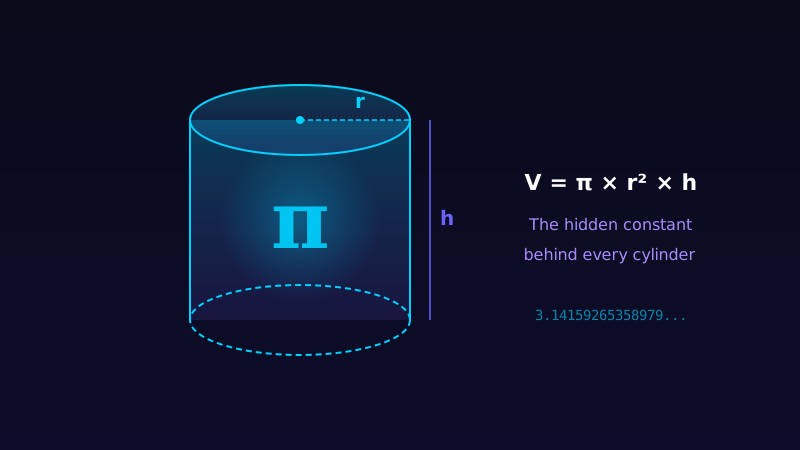
Every cylinder volume you’ll ever calculate comes down to one formula: V = π × r² × h. And that little π symbol? It’s doing more heavy lifting than most people realize. I first really got pi when I was trying to figure out how much water my rooftop tank could hold. I measured the diameter (120 cm), the height (150 cm), grabbed a calculator, and punched in π × 60² × 150. The answer — 1,696,460 cm³, or about 1,696 liters — was almost exactly what the manufacturer’s spec sheet said. That was the moment pi stopped being an abstract number and became a real tool.
If you want to skip the reading and just crunch numbers, our cylinder volume calculator handles everything instantly. For unit changes between cm^3, liters, and gallons, use the Volume Unit Conversion Guide or learn how to calculate cylinder capacity in gallons and cubic feet. But stick around — understanding why pi shows up in that formula will make you a sharper problem-solver.
So What Actually Is Pi?
Here’s how I explain it to anyone who asks: measure the distance around any circle (the circumference), then divide it by the distance across (the diameter). You’ll get approximately 3.14159. Every single time. Doesn’t matter if the circle is a manhole cover, a dinner plate, or the orbit of a planet. If you are calculating volume directly from width across, read our guide on how to find the volume of a cylinder using diameter.
That ratio — circumference ÷ diameter — is pi.
It’s irrational, meaning its decimal digits go on forever without repeating: 3.14159265358979… and on and on. For most real-world calculations, 3.14159 is more than enough precision. I’ve never been on a job site where anyone needed more than five decimal places.
The ancient Babylonians approximated it as 3.125 around 1900 BC. The Egyptians got close with 3.1605. Archimedes pinned it down between 3.1408 and 3.1429 using inscribed polygons — basically drawing 96-sided shapes inside and outside a circle and averaging the perimeters. That’s brilliantly clever when you think about it. No calculus, no computers, just geometry and patience.
Why Does Pi Show Up in Cylinder Volume?
This is the part most articles skip, and I think it’s the most important part.
A cylinder is basically a circle that’s been stretched upward. Picture stacking thousands of paper-thin circular discs on top of each other. Each disc has an area of a circle (A = π × r²). Stack them to a height of h, and you’ve filled a cylinder. So the total volume is just the area of one disc multiplied by how many discs you stacked:
V = π × r² × h
Pi is there because the base is a circle. That’s it. That’s the whole reason. Every shape with a circular cross-section — cylinders, cones, spheres — has pi baked into its volume formula. If the base were a square, you’d just use side × side × height, and pi wouldn’t appear at all.
I remember a student once asking me, “But where does pi come from in the formula?” And the simplest answer I could give was: pi is what connects a circle’s straight-line measurement (the radius) to its curved reality (the area). Without pi, you can’t translate between straight and curved. It’s the bridge.
Let’s See Pi at Work — Real Examples
Example 1: A Standard Soda Can (Metric)
I keep a Coca-Cola can on my desk for exactly this kind of thing. Here are the measurements I took:
- Diameter: ~6.6 cm → Radius: 3.3 cm
- Height: ~12.2 cm
V = π × 3.3² × 12.2
V = 3.14159 × 10.89 × 12.2
V = 3.14159 × 132.858
V = 417.4 cm³
The label says 355 ml (355 cm³). The difference — about 62 cm³ — is headspace and the tapered top. The math checks out, and pi made it possible. You can verify this yourself with our cylinder volume using radius tool.
Example 2: A 5-Gallon Propane Tank (Imperial)
Last winter I was trying to figure out the actual capacity of my small propane tank. I measured:
- Diameter: ~12 inches → Radius: 6 inches
- Height: ~18 inches
V = π × 6² × 18
V = 3.14159 × 36 × 18
V = 3.14159 × 648
V = 2,035.75 in³
Converting: 2,035.75 ÷ 231 = 8.81 US gallons of total internal volume.
But propane tanks are only filled to about 80% for safety. So usable capacity ≈ 7.05 gallons. That’s close to the “5-gallon” rating, which refers to gallons of propane by weight, not container volume. See the difference? The math reveals what the marketing label hides. Our volume in gallons calculator makes these conversions painless.
Example 3: A Rooftop Water Storage Tank
This is the one I mentioned at the top. My building’s cylindrical water tank:
- Diameter: 120 cm → Radius: 60 cm
- Height: 150 cm
V = π × 60² × 150
V = 3.14159 × 3,600 × 150
V = 3.14159 × 540,000
V = 1,696,460 cm³
Since 1,000 cm³ = 1 liter:
V = 1,696.46 liters — roughly 448 US gallons.
The manufacturer’s label said 1,700 liters. Close enough that I trust the math more than I trust the sticker. If you’re sizing a tank, our cylinder tank calculator was built for exactly this.
Bonus Example: Engine Displacement
Here’s one that surprises people. When a car engine is described as “2.0L” or “2000cc,” that’s cylinder volume — and pi is right there in the calculation.
A typical 2.0L four-cylinder engine might have:
- Bore (cylinder diameter): 86 mm → Radius: 43 mm = 4.3 cm
- Stroke (height): 86 mm = 8.6 cm
- Number of cylinders: 4
Single cylinder volume = π × 4.3² × 8.6
= 3.14159 × 18.49 × 8.6
= 499.56 cm³
Total displacement = 499.56 × 4 = 1,998.24 cm³ ≈ 2.0 liters
Pi literally determines your engine’s power class. Our engine cylinder volume calculator handles multi-cylinder setups automatically.
What Happens If You Change Pi?
This is a thought experiment I love. What if pi were exactly 3 instead of 3.14159?
Take that soda can again: V = 3 × 3.3² × 12.2 = 3 × 132.858 = 398.57 cm³.
That’s about 4.5% less than the real answer (417.4 cm³). Doesn’t sound like much, but scale it up. On a 10,000-liter industrial tank, using 3 instead of 3.14159 gives you an error of over 450 liters. That’s real money in chemical processing or water treatment.
The moral: pi’s precision matters more than you think once you leave textbook-sized objects.
Pi Beyond Cylinders
Once you see pi in the cylinder formula, you start noticing it everywhere:
- Circle area: A = π × r² (the foundation of cylinder volume)
- Sphere volume: V = (4/3) × π × r³
- Cone volume: V = (1/3) × π × r² × h — exactly one-third of a cylinder, which still blows my mind. Check our cylinder vs cone volume comparison to see this visually.
- Surface area of a cylinder: SA = 2πr² + 2πrh — pi again, twice
Pi is the universal connector between straight-line measurements and curved shapes. Every time you see a circle involved, pi is lurking. Khan Academy’s geometry section has great visual explanations if you want to go deeper.
The Mistake I See Constantly
People forget that the formula uses radius, not diameter. If your pipe is 10 cm across, the radius is 5 cm, not 10 cm. Plugging in diameter instead of radius quadruples your answer because you’re squaring it (10² = 100 vs. 5² = 25).
I personally think it’s easier to measure diameter — it’s what a tape measure gives you naturally — and then divide by two. If you’d rather skip that step, our cylinder volume using diameter calculator takes diameter directly.
Quick Reference: Pi in Common Formulas
| Shape | Volume Formula | Pi’s Role |
|---|---|---|
| Cylinder | π × r² × h | Converts r² to circular area |
| Cone | (1/3) × π × r² × h | Same, but one-third the fill |
| Sphere | (4/3) × π × r³ | Extends circular area into 3D |
| Hollow Cylinder | π × (R² − r²) × h | Difference of two circular areas |
For hollow cylinders — like pipes and tubes — check our hollow cylinder calculator.
Frequently Asked Questions
Why is pi used in the cylinder volume formula?
Because the base of a cylinder is a circle. Pi (π) is the ratio that connects a circle’s radius to its area (A = πr²). Multiply that circular area by height and you get volume. No circle, no pi.
Can I just use 3.14 for pi?
For rough estimates, sure. I use 3.14 for quick mental math all the time. But for anything involving money, materials, or engineering — use at least 3.14159, or better yet, let a free cylinder volume calculator handle it. The difference between 3.14 and 3.14159 is small on a coffee cup but real on a storage tank.
What would happen if pi were a whole number?
Every circle-based calculation would be slightly off. A pi of exactly 3 underestimates area by about 4.5%, and a pi of 4 overestimates it by about 27%. The universe didn’t pick pi — pi emerges from the geometry of flat space itself. It’s not a choice; it’s a consequence. Math is Fun has a nice interactive demo of this.
Is pi the same in every cylinder formula?
Yes. Pi is a universal constant — 3.14159265… — regardless of the cylinder’s size, the units you’re using, or whether it’s vertical, horizontal, or oblique. What changes is how you plug in the other measurements. Our oblique cylinder calculator handles tilted cylinders where height isn’t perpendicular.
Who discovered pi?
Nobody “discovered” it in the lightbulb-moment sense. The Babylonians and Egyptians approximated it thousands of years ago. Archimedes formalized the first rigorous bounds around 250 BC. The symbol “π” was popularized by Welsh mathematician William Jones in 1706 and adopted by Euler. It’s been refined ever since — we now know trillions of digits, though you’ll never need more than about 15 for any engineering purpose.
How do I remember the cylinder volume formula?
I get asked this a lot. Think of it as: area of the bottom × how tall it is. The bottom is a circle (π × r²), and the height just stretches that circle upward. Area × height. That mental model works for any prism, not just cylinders.
Does pi change if I use inches instead of centimeters?
Not at all. Pi is dimensionless — it’s a pure ratio. Your answer will be in different units (cubic inches vs. cubic centimeters), but pi itself is always 3.14159… regardless of measurement system. Use our volume in cubic inches or volume in liters calculators to convert between systems.
Why does a cone hold exactly 1/3 of a cylinder?
This is one of those facts that feels wrong until you test it. Fill a cone with water and pour it into a cylinder with the same radius and height — it takes exactly 3 cones to fill the cylinder. The proof involves calculus (integrating circular cross-sections that shrink linearly), but the result is beautifully clean: V_cone = (1/3) × π × r² × h. Pi is present in both formulas; the only difference is that factor of 1/3.
All calculations in this article use π = 3.14159 and are verified against manufacturer specifications where available. For instant results with any measurements, try our online cylinder volume calculator.