Math Education · May 18, 2026
Teach Cylinder Volume to Kids: 5 Hands-On Experiments
Simple ways to explain cylinder volume to kids using rice, water and playdough. Demonstrates V = base area times height with engaging 3D activities.

- Why Kids Struggle With Cylinder Volume (And It’s Not the Math)
- Activity 1: The Rice-Filling Experiment
- What You Need
- Here’s What You Do
- Worked Example: Toilet Paper Roll
- Worked Example: Pringles Can
- Activity 2: Build Your Own Cylinders From Paper
- Let Me Prove It
- Tall Cylinder (Rolled Along the 11-Inch Side)
- Short, Wide Cylinder (Rolled Along the 8.5-Inch Side)
- Activity 3: Kitchen Math - Measuring Real Containers
- Worked Example: Campbell’s Soup Can (Imperial)
- Making pi Less Scary
- A Quick Note on Age-Appropriate Expectations
- Ages 6-8
- Ages 9-11
- Ages 12+
- The Cone Comparison Trick
- Common Mistakes to Watch For
- Confusing Radius and Diameter
- Forgetting to Square the Radius
- Mixing Units
- Putting It All Together
- Frequently Asked Questions
- What age should kids learn cylinder volume?
- How do you explain pi to a child?
- Why does the formula use r^2 and not just r?
- What’s a good hands-on activity for cylinder volume?
- Can kids use a calculator for cylinder volume?
- How is cylinder volume different from surface area?
- Why does a cone hold exactly 1/3 of a cylinder?
- My kid keeps confusing radius and diameter. Any tips?
- What household objects can we use to practice?
- Does this formula work for all cylinders?
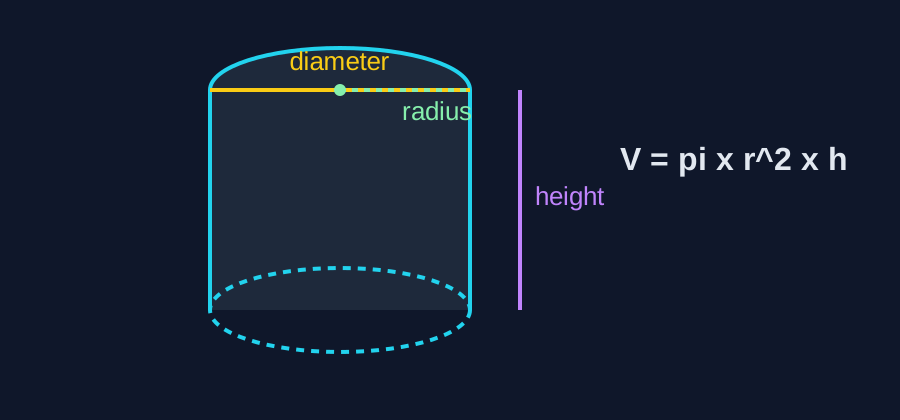
Here’s the formula your kid needs: V = pi x r^2 x h. That’s it. But if you just write it on a whiteboard and move on, it’s gone from their brain by lunchtime. I know because I’ve tutored enough 10- and 12-year-olds to see the exact moment their eyes glaze over. What does work? Handing them a toilet paper roll and a cup of rice. Seriously.
I’ve spent way too many weekends testing kitchen-counter math experiments with my own kids and with students I’ve helped over the years. The ones that stick are always the ones where they get to measure something real, predict an answer, and then check it. That little dopamine hit when the math matches the rice level in the measuring cup? That’s when geometry clicks.
Let me walk you through the activities that actually work - not the Pinterest-pretty stuff that looks great in photos but teaches nothing.
Why Kids Struggle With Cylinder Volume (And It’s Not the Math)
Most kids can multiply. They can even handle squaring a number once you show them. The problem isn’t pi x r^2 x h - it’s that they have no idea what they’re calculating.
I see this constantly. A student can plug numbers into the formula and get the right answer on a worksheet, but if I hold up a mug and ask “how much water fits in here?” they freeze. There’s a disconnect between the formula and the physical world.
That’s why every activity below starts with a real object, not a textbook problem.
Activity 1: The Rice-Filling Experiment
This is my go-to. It’s messy, it’s fun, and it drives the concept home like nothing else.
What You Need
- Two or three cylinders of different sizes (a toilet paper roll with one end taped shut, a Pringles can, a tall drinking glass)
- Uncooked rice (or dry lentils - anything pourable)
- A measuring cup marked in milliliters
- A ruler
- A calculator (or use our free cylinder volume calculator)
Here’s What You Do
First, have your kid measure each cylinder - the diameter across the top (then divide by 2 for the radius) and the height. I personally think measuring diameter is easier for kids than radius, because you just lay the ruler across the opening. Use our cylinder volume using diameter tool if you want to skip the division step.
Now, before they fill anything, have them calculate the volume with the formula.
Worked Example: Toilet Paper Roll
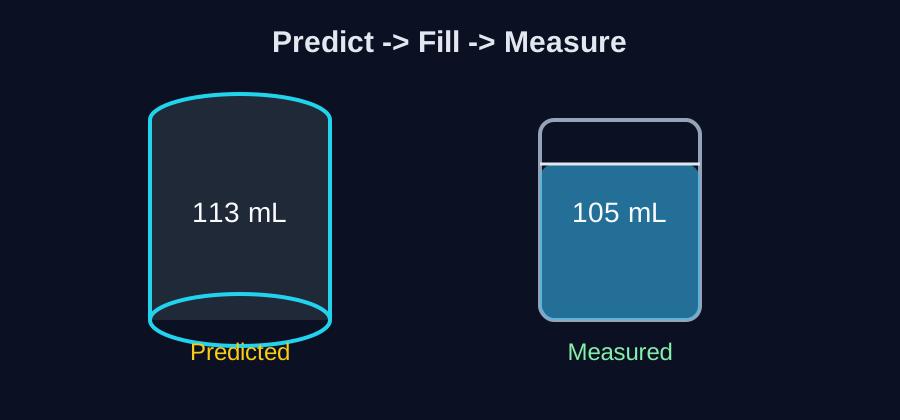
I measured a standard roll from my bathroom. Inner diameter: about 3.8 cm, so radius = 1.9 cm. Height: 10 cm.
V = pi x 1.9^2 x 10
V = 3.14159 x 3.61 x 10
V = 113.4 cm^3
Since 1 cm^3 = 1 mL, that’s roughly 113 mL.
Then they fill the roll with rice, pour it into the measuring cup, and check. My daughter got about 105 mL when she tried this - the difference is because rice grains don’t pack perfectly (there’s air between them). That led to a great conversation about why real-world measurements don’t always match the math exactly. Which is a lesson some adults still need, honestly.
Worked Example: Pringles Can
I had one in the pantry, so we measured it. Diameter: about 7.5 cm (radius = 3.75 cm). Height: 23 cm.
V = pi x 3.75^2 x 23
V = 3.14159 x 14.0625 x 23
V = 1,015.7 cm^3
That’s just over 1 liter. And when we filled it with water to check? Right around 1,010 mL. Close enough that my kid actually said “whoa.” Mission accomplished.
If you want to convert that to other units, our volume in liters calculator handles it instantly.
Activity 2: Build Your Own Cylinders From Paper
This one is brilliant for younger kids - maybe ages 7 to 10 - because it answers a question they don’t even know they have: does a tall, skinny cylinder hold more or less than a short, wide one?
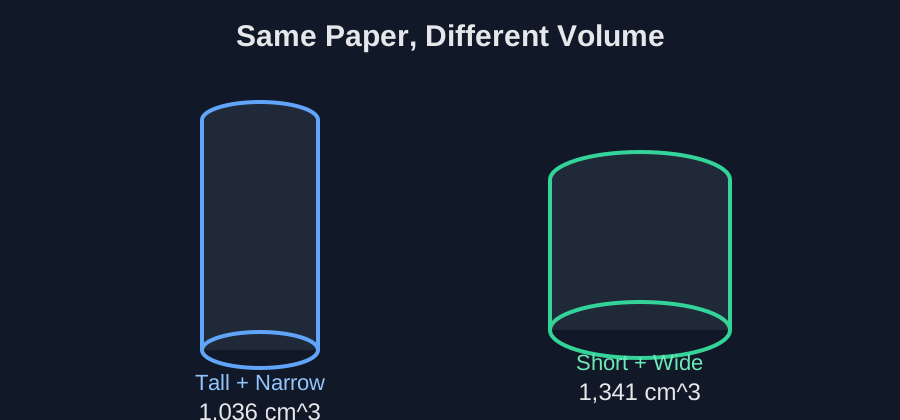
Take two identical sheets of paper (standard A4 or letter size). Roll one the tall way and tape it into a cylinder. Roll the other the wide way. Stand both on a flat surface and ask your kid: which one holds more rice?
Almost every kid guesses the taller one. They’re almost always wrong.
Let Me Prove It
A US letter sheet is 11 x 8.5 inches (27.94 x 21.59 cm).
Tall Cylinder (Rolled Along the 11-Inch Side)
- Height = 11 in = 27.94 cm
- Circumference = 8.5 in = 21.59 cm
- Radius = Circumference / (2pi) = 21.59 / 6.2832 = 3.437 cm
- V = pi x 3.437^2 x 27.94 = pi x 11.81 x 27.94 = 1,036 cm^3
You can double-check this with our calculate from circumference tool.
Short, Wide Cylinder (Rolled Along the 8.5-Inch Side)
- Height = 8.5 in = 21.59 cm
- Circumference = 11 in = 27.94 cm
- Radius = 27.94 / 6.2832 = 4.448 cm
- V = pi x 4.448^2 x 21.59 = pi x 19.78 x 21.59 = 1,341 cm^3
The shorter cylinder holds about 29% more. That blows kids’ minds. And it teaches a deeper lesson: because the radius gets squared in the formula, making a cylinder wider has a bigger impact than making it taller. That’s a concept most adults don’t intuitively grasp either.
Activity 3: Kitchen Math - Measuring Real Containers
This is less of a structured activity and more of a habit. Whenever you’re in the kitchen with your kid, grab a cylindrical container and ask: “How much do you think this holds?”
We did this with a standard soup can. Here’s how it went.
Worked Example: Campbell’s Soup Can (Imperial)
I measured ours: diameter about 2.625 inches (radius = 1.3125 in), height about 4 inches.
V = pi x 1.3125^2 x 4
V = 3.14159 x 1.7227 x 4
V = 21.64 in^3
To convert: 21.64 in^3 x 16.387 cm^3/in^3 = 354.7 cm^3 = 354.7 mL.
The label says 305 mL of condensed soup - but the can’s total internal volume is closer to our calculation. The headspace at the top accounts for the difference. I love this example because it shows kids that the math works, and the real world just adds wrinkles.
For more imperial conversions, the volume in cubic inches page is handy.
Making pi Less Scary
Here’s the thing - a lot of kids hit a wall at pi. They’ve been told it’s 3.14, but they don’t really know why it shows up or what it means.
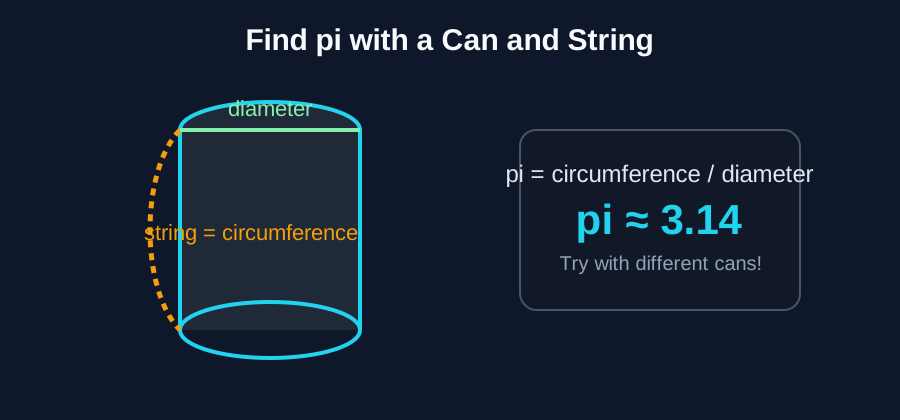
My favorite trick: grab a can, wrap a string around it, then stretch the string along a ruler. That’s the circumference. Now measure the diameter. Divide circumference by diameter. They’ll get something close to 3.14.
Do it with three different cans. They’ll get roughly 3.14 every time. That’s the moment pi goes from being a random number to something real. I’ve seen kids genuinely light up during this. It’s one of those rare moments where abstract math becomes tangible.
Khan Academy’s geometry section has some excellent interactive tools for reinforcing this, if your kid wants to go deeper.
A Quick Note on Age-Appropriate Expectations
Not every kid needs to do full calculations. Here’s roughly how I break it down:
Ages 6-8
Focus on the concept. “Volume means how much fits inside.” Do the rice experiment. Let them fill and pour. Skip the formula.
Ages 9-11
Introduce the formula with diameter (easier to measure). Let them use a calculator for the multiplication. Focus on the process: measure, calculate, predict, check.
Ages 12+
Full formula, unit conversions, multi-step problems. This is where you introduce concepts like hollow cylinders (a pipe vs. a solid rod) or comparing cylinder vs. cone volume.
The Cone Comparison Trick
If you really want to cement cylinder volume, do this: buy a cylinder and a cone with the same radius and height. (Math supply stores sell these, or you can 3D print them.) Fill the cone with rice, pour it into the cylinder. Repeat.
It takes exactly three cone-fills to fill the cylinder.
That’s because a cone’s volume is 1/3 x pi x r^2 x h - exactly one-third of a cylinder. When a kid sees this physically happen, they never forget it. I’ve tested this with probably two dozen students, and it lands every single time.
Common Mistakes to Watch For
I’ve seen these so many times:
Confusing Radius and Diameter
This is the #1 error. If your kid measures 10 cm across the top of a can and plugs in 10 as the radius, the answer will be 4x too large. Always ask: “Did you measure across the whole circle, or from the center to the edge?”
Forgetting to Square the Radius
They’ll compute pi x r x h instead of pi x r^2 x h. The result looks plausible enough that they don’t catch it. I always tell kids: “The formula has a little 2 on the r. Don’t skip it - it’s doing a lot of work.”
Mixing Units
Radius in centimeters and height in inches? You’ll get nonsense. Everything has to be in the same unit before you multiply. Our online cylinder volume calculator handles unit conversions automatically, which is useful for checking work.
Putting It All Together
The best way to teach cylinder volume to kids isn’t a single activity - it’s layering several. Start with rice and real objects. Build paper cylinders and compare them. Measure things in the kitchen. Let the formula emerge from the experience, not the other way around.
I’ll be honest - I used to teach formula-first. Write it on the board, do three examples, assign homework. It wasn’t until I started handing kids actual objects that I saw real understanding happen. The formula is just a shortcut for something they can see and touch.
And if at any point they (or you) want to check the math, the cylinder volume calculator is always there. No judgment. I use it myself.
For the underlying math concepts, Math is Fun’s cylinder page and Wolfram MathWorld are both solid references if your kid wants to explore further.
Frequently Asked Questions
What age should kids learn cylinder volume?
Most kids are ready for the concept (filling and comparing) around age 6-7. The actual formula with pi usually clicks around age 10-11, which lines up with when most schools introduce it.
How do you explain pi to a child?
I get this question all the time. Forget decimals at first. Just wrap a string around a round object, measure it, then measure the diameter. Divide. They’ll discover pi themselves. It’s the number you always get when you divide “around” by “across.”
Why does the formula use r^2 and not just r?
Because you’re calculating the area of the circular base first (pi x r^2), then stretching it upward by the height. Think of it like stacking hundreds of thin circular coins on top of each other. Each coin’s area is pi x r^2, and the stack is h coins tall.
What’s a good hands-on activity for cylinder volume?
The rice-filling experiment. Hands down. Tape the bottom of a toilet paper roll, have your kid calculate the volume, then fill it with rice and pour into a measuring cup. When the prediction matches the measurement, they get it. I’ve done this dozens of times and it never fails to click.
Can kids use a calculator for cylinder volume?
Absolutely. The point is understanding what they’re calculating, not mental arithmetic. Let them use a cylinder volume using radius calculator to check their work - it actually builds confidence.
How is cylinder volume different from surface area?
Volume is how much fits inside - think water, rice, air. Surface area is how much material covers the outside - think wrapping paper or paint. A tall, skinny can and a short, wide can might have similar volumes but very different surface areas.
Why does a cone hold exactly 1/3 of a cylinder?
This is one of those things that’s surprisingly hard to prove without calculus, but easy to demonstrate. Fill a cone three times and pour each into a cylinder of the same dimensions. Three cone-fills = one full cylinder. The mathematical proof involves integration, but the physical demonstration is all kids need.
My kid keeps confusing radius and diameter. Any tips?
Tell them: “Diameter is the whole line across the circle. Radius is half.” Then always have them measure diameter first (it’s easier - just lay the ruler across the top) and divide by 2. After about five measurements, it becomes automatic.
What household objects can we use to practice?
Soup cans, drinking glasses, toilet paper rolls, Pringles cans, water bottles, candles, PVC pipe sections, coffee mugs, food storage containers. Basically anything round and open-ended or with a flat bottom. I keep a small collection of random cylinders in my teaching bag - people think it’s weird, but it works.
Does this formula work for all cylinders?
It works for right circular cylinders - the straight, upright kind. If the cylinder is tilted (oblique), the formula still works as long as h is the perpendicular height, not the slant. For weirdly shaped cylinders, try our oblique cylinder calculator.